Blood flow restriction (BFR) training is often promoted as a way to make low-load exercise more effective. By applying specialized cuffs around the upper arms or thighs, the method partially restricts blood flow during exercise, allowing muscles to experience a demanding training stimulus without necessarily using heavy weights.
That raises a question for people exercising at home: if ordinary bodyweight movements already provide enough resistance to improve strength, does adding BFR equipment produce better results?
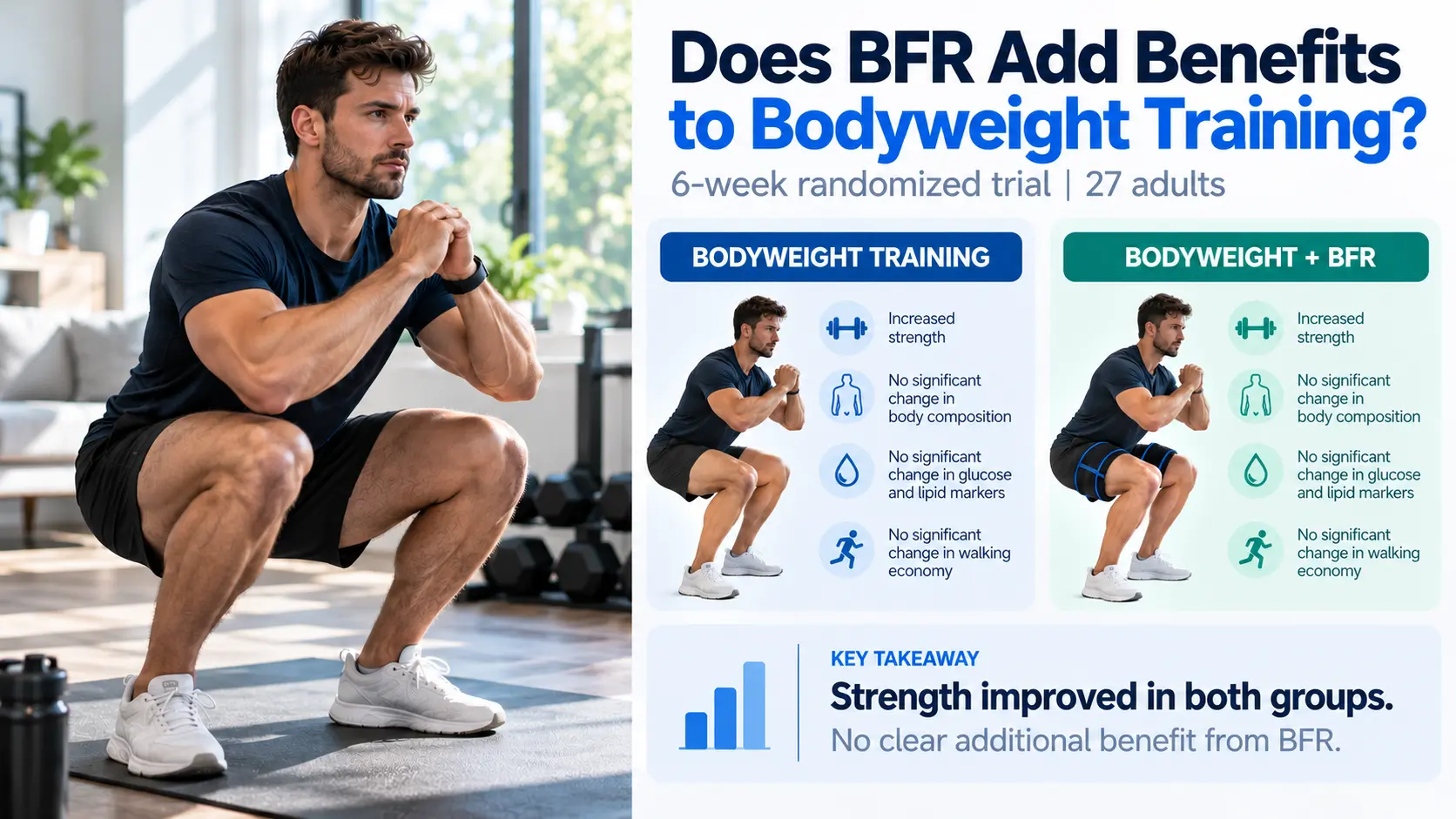
A randomized controlled trial published in the European Journal of Applied Physiology on September 8, 2026, investigated this question in previously sedentary adults with overweight or obesity. After six weeks of remotely supervised training, both groups improved lower-body strength. The researchers found no statistically significant additional benefit from BFR for strength, body composition, metabolic markers or walking performance.
The findings offer a useful perspective on what beginners may need from a resistance training program and where specialized methods might have a place.
What Is Blood Flow Restriction Training?
Blood flow restriction training involves placing cuffs around the proximal portion of the arms or legs while performing exercise. The cuffs are intended to restrict venous return while allowing some arterial blood flow, altering the conditions under which the muscles work.
BFR is commonly combined with relatively light resistance. This makes it of interest in situations where heavy loading is difficult or undesirable, including certain rehabilitation settings.
The amount of restriction depends on several factors, including cuff design, limb circumference, blood pressure and the pressure applied. Two people using the same absolute cuff pressure may therefore experience different levels of restriction.
BFR should not be confused with simply wearing tight bands during exercise. Appropriate equipment, pressure selection and screening matter, particularly for people with cardiovascular or vascular concerns.
How the 2026 Study Was Conducted
Researchers led by Tom Citherlet recruited sedentary adults between 30 and 60 years old with a body mass index between 25 and 35 kg/m².
Thirty participants initially entered the study, and 27 completed it. The participants were allocated to two groups:
- BFR group: 13 participants performing bodyweight training with pneumatic restriction cuffs.
- Non-BFR group: 14 participants performing the same bodyweight exercises without cuffs.
Both groups completed an identical six-week training program under live supervision through video conferencing.
Training took place three times per week, for a total of 18 sessions. Each session lasted approximately 30–35 minutes.
The program included standing arm curls, calf raises, push-ups, hip raises, air squats, box steps and front lunges. Participants performed three sets of 10–30 repetitions per exercise at a controlled tempo. Rest intervals were gradually reduced from 60 to 30 seconds.
This is an important feature of the design. The researchers were comparing the additional effect of BFR while keeping the underlying exercise program similar.
The BFR group used a specific elastic pneumatic cuff system. After lower introductory pressures, the prescribed absolute pressures were 250 mmHg for the arms and 400 mmHg for the legs. Individual arterial occlusion pressure was not measured, which limits how directly this protocol can be compared with other BFR methods.
Both Groups Improved Lower-Body Strength
The clearest training adaptation was an improvement in knee extensor and flexor strength.
Researchers assessed strength using isometric and isokinetic dynamometry, including several testing velocities.
Across the six-week intervention, measured strength outcomes improved in both groups. Depending on the test, increases ranged from approximately 8% to 33% in the BFR group and 6% to 14% in the non-BFR group.
Those ranges might initially suggest an advantage for BFR. However, the statistical analysis found no significant group-by-time interaction for any strength outcome.
In other words, the study did not establish that the participants using BFR improved more than those performing conventional bodyweight training.
The early strength gains may have involved neural adaptations, such as improved motor-unit recruitment and coordination. The researchers did not directly measure these mechanisms, so this remains an interpretation rather than a demonstrated physiological explanation.
The result is particularly relevant to people who have not trained regularly. Exercises such as bodyweight squats, lunges and push-ups can provide a meaningful starting stimulus without specialized equipment.
Did BFR Improve Muscle Mass or Fat Loss?
The researchers used dual-energy X-ray absorptiometry (DEXA) to assess body composition.
Total body mass, fat mass and total lean mass did not change significantly over the intervention.
Trunk lean mass increased modestly across both groups. The reported average changes were approximately 2.8% in the BFR group and 1.6% in the non-BFR group. There was no significant interaction demonstrating a greater training effect from BFR.
These measurements should not be interpreted as proof that BFR caused greater muscle hypertrophy. DEXA-derived lean mass is not a direct measurement of individual muscle-fiber growth, and the study did not find significant increases in total or leg lean mass.
Six weeks is also a relatively short period for evaluating body composition changes. The intervention did not include a structured dietary program, making it difficult to expect substantial changes in fat mass from resistance training alone.
For readers interested in developing a basic exercise routine, a beginner bodyweight workout provides examples of movements that can be performed with little or no equipment. Such routines should be adjusted to individual fitness levels rather than copied as the exact protocol used in this study.
What Happened to Blood Sugar and Cholesterol?
The researchers also measured fasting blood glucose, glycated hemoglobin (HbA1c), cholesterol and triglycerides.
BFR did not produce a significant advantage in any of these metabolic outcomes.
Two small changes occurred across the study population: HDL cholesterol decreased and HbA1c increased. Both changes were statistically significant but considered clinically negligible by the researchers. Their direction was unfavorable rather than beneficial.
This distinction matters because an improvement in muscular strength does not guarantee an immediate improvement in every marker of metabolic health.
The study lasted only six weeks, and HbA1c reflects average blood glucose over a much longer period. The absence of dietary control and the relatively small sample further limit conclusions about metabolic effects.
It would be inaccurate to use these findings to claim that bodyweight training worsens metabolic health. The trial was not designed to establish that conclusion, and the observed changes cannot be confidently attributed to a specific training component.
Did Blood Flow Restriction Improve Walking Economy?
The researchers examined whether the intervention affected walking performance, including preferred walking speed, biomechanical characteristics and the energy cost of treadmill walking.
Neither group demonstrated significant improvements in the measured walking outcomes.
Adding BFR also failed to produce a measurable advantage.
Strengthening the knee extensors and flexors does not necessarily change walking mechanics in a short intervention, particularly when the participants do not have a diagnosed walking impairment.
The training sessions primarily involved resistance exercises rather than a dedicated walking or aerobic conditioning program. The results therefore should not be interpreted as evidence that exercise cannot improve walking economy in this population.
Why Might BFR Have Provided No Additional Benefit?
Several explanations are possible, although the study cannot establish which one was responsible.
The Participants Were Previously Sedentary
Individuals with limited resistance training experience can respond to a relatively modest training stimulus.
For these participants, the bodyweight exercises themselves may have provided enough challenge to produce early strength improvements. An additional BFR stimulus might have had less opportunity to create a detectable difference.
That does not mean trained athletes would respond in the same way.
The Intervention Was Short
Six weeks allowed the researchers to examine early strength adaptations, but longer interventions may be necessary to identify differences in muscle size or other outcomes.
The study cannot determine whether the groups would have responded differently after three or six months.
Cuff Pressure Was Not Individually Calibrated
The researchers used fixed absolute pressures rather than determining each participant’s arterial occlusion pressure.
Because limb size and vascular characteristics vary, the physiological restriction may have differed substantially between participants.
This limits the conclusions that can be drawn about BFR protocols using individually calibrated pressures.
The Study Was Relatively Small
Only 27 participants completed the trial.
Although the researchers conducted a sample-size calculation for their primary outcomes, the study had limited ability to detect smaller differences, particularly across secondary measurements.
A nonsignificant difference is therefore evidence that superiority was not demonstrated under these conditions. It is not proof that BFR and non-BFR training are identical.
Can Remote Home Workouts Build Strength?
The study provides encouraging evidence for remotely supervised resistance training.
All 27 participants who completed the trial attended the prescribed 18 sessions. The program used familiar bodyweight movements, required relatively little space and lasted approximately half an hour per session.
The participants improved lower-limb strength without needing a conventional gym environment.
For beginners, the important programming decisions may involve choosing manageable exercises, learning proper technique and progressing the training demand over time.
A starting routine might use squats, supported lunges, push-up variations and hip bridges. Fitnessprogramer’s bodyweight exercise collection offers examples of these movements, while its exercise library can help readers identify alternatives suited to their equipment and ability.
The study does not establish that any unsupervised home workout will produce the same results. Live coaching, attendance monitoring and exercise instruction were part of the intervention.
Who Might Still Benefit From BFR Training?
These findings should not be generalized to every population or training objective.
BFR may still be relevant when conventional heavy resistance training is difficult to perform, especially in selected rehabilitation or low-load training settings. Whether it is appropriate depends on the individual’s medical history, training capacity and the intended outcome.
The 2026 trial did not study postoperative rehabilitation, competitive athletes or long-term hypertrophy-focused programs.
For sedentary adults with overweight or obesity who can already perform conventional bodyweight exercises, the results provide no clear reason to add BFR cuffs solely to obtain greater short-term strength gains.
People considering BFR should seek appropriate professional guidance, particularly if they have cardiovascular disease, vascular disorders, a history of blood clots or other medical risk factors. The high absolute pressures used with the study’s specific cuff system should not be copied with ordinary elastic bands or different devices.
What Coaches Can Take From the Findings
A beginner’s resistance training program does not necessarily need sophisticated equipment to be productive.
In this trial, the conventional bodyweight group improved strength with three supervised sessions per week. Adding BFR increased the equipment and monitoring requirements without producing a statistically detectable advantage in the measured outcomes.
For coaches working with previously inactive adults, establishing a repeatable training schedule and selecting exercises that participants can perform consistently may be a more sensible starting point than introducing restriction cuffs.
The next step should depend on progress. As bodyweight exercises become easier, the program can be adjusted through exercise selection, repetitions, movement difficulty or added resistance.
BFR remains a specialized option with potential uses beyond the conditions tested here. This study gives coaches a reason to evaluate whether it adds something necessary for a particular client rather than assuming that an advanced training method will automatically produce better results.
Research Source
Citherlet T, Christe S, Cattin A, Mota GR, Millet GP. (2026). Remote coaching with blood flow restriction training: impact on strength, body composition, metabolism, and walking energetics in overweight adults. European Journal of Applied Physiology. PubMed: https://pubmed.ncbi.nlm.nih.gov/42709150/ Study registration: NCT05371119.