
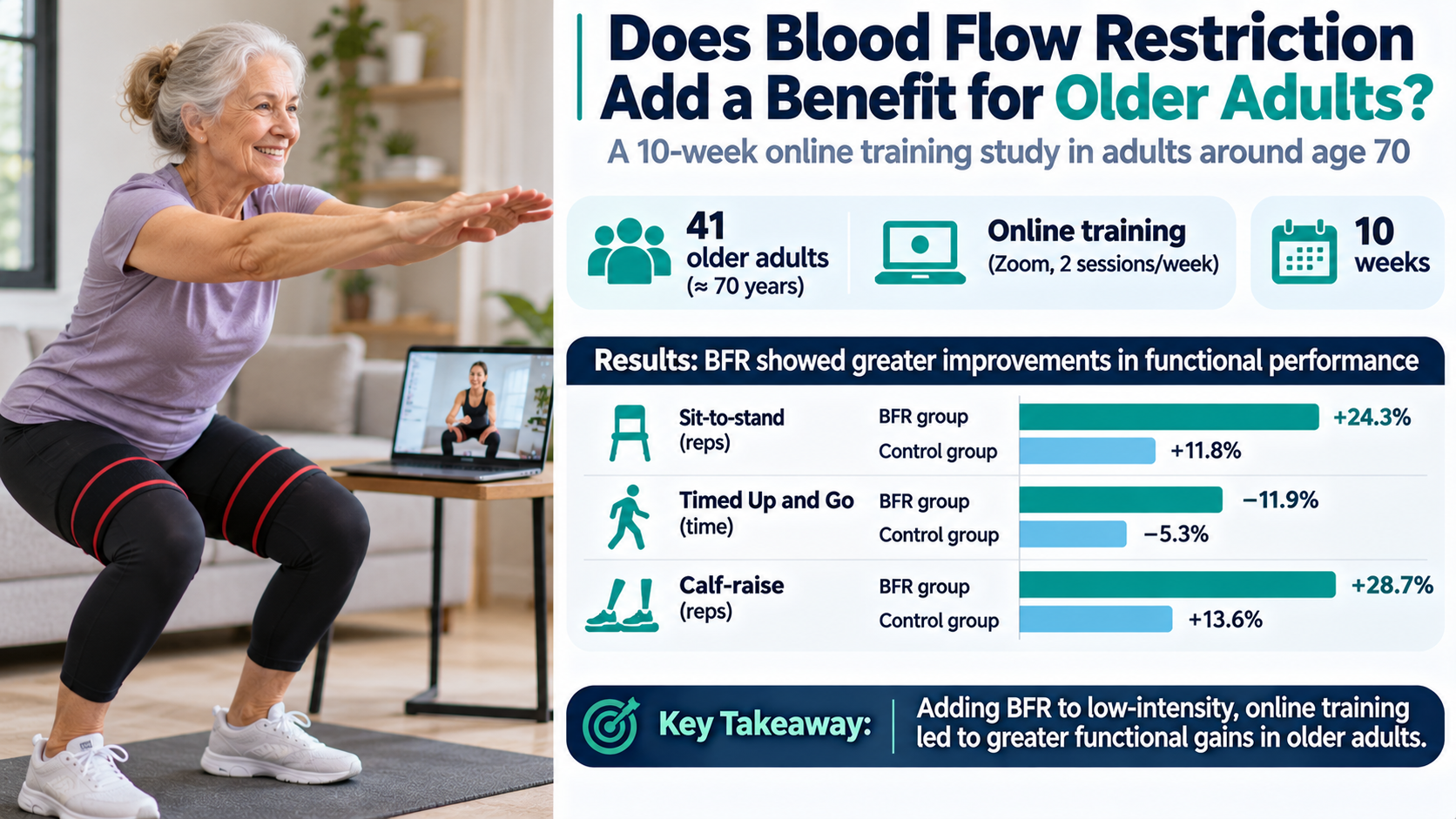
Standing up from a chair, walking across a room and rising onto your toes may not sound like demanding exercise. Yet these movements can become increasingly difficult with age, particularly when leg strength and physical confidence begin to decline.
Resistance training can help preserve those abilities. The difficulty is finding a program that people can perform regularly, especially when traveling to a gym or lifting heavy weights isn’t practical.
Online exercise classes offer one possible solution. But could adding blood flow restriction (BFR) make a relatively gentle home workout more effective?
A randomized trial published in Physical Activity and Nutrition on September 30, 2026, investigated that question in older adults. Participants followed ten weeks of low-intensity resistance training through Zoom. One group used blood flow restriction straps around the thighs; the other performed the same exercises without restriction [1].
Both groups improved aspects of lower-body strength and function. The BFR group achieved greater gains in two functional tests: repeated sit-to-stands and calf raises.
The findings are promising, although they don’t establish that BFR is necessary for effective home exercise—or that older adults should experiment with restriction straps without professional supervision.
Why Blood Flow Restriction Is Being Studied in Older Adults
Conventional resistance training becomes more demanding as the load increases. That can be useful for building strength, but heavier weights aren’t always appropriate or comfortable for every older adult.
Joint discomfort, limited mobility, recovery from illness and unfamiliarity with exercise equipment can all make traditional strength programs harder to manage.
Blood flow restriction offers a different approach.
Specialized cuffs or straps are placed around the upper portion of a limb during exercise. They restrict venous return while allowing some arterial blood flow, changing the physiological environment in which the working muscles contract.
This can increase the metabolic demands of relatively light exercise.
Researchers have investigated whether those conditions can help stimulate muscular adaptations without requiring the same external loads used in conventional resistance training.
The appeal is understandable. A person who struggles with heavy resistance might still be able to perform bodyweight squats, calf raises or other manageable movements.
But the pressure applied, the equipment used and the individual’s vascular health all influence the safety and effectiveness of BFR.
It is not simply a matter of tightening a strap until an exercise feels harder.
How the Ten-Week Online Study Worked
Daniela Presta and colleagues recruited older adults from community and fitness centers in Montreal.
Forty-seven people entered the study, and 41 completed the intervention. Their average age was approximately 70 years, with 30 women and 11 men in the final sample.
Participants were randomly allocated to two groups:
- BFR training: 22 participants performing low-intensity resistance exercises with thigh restriction straps.
- Conventional training: 19 participants completing the same exercise program without BFR.
Both groups attended two online sessions per week for ten weeks.
Classes were delivered through Zoom, and recordings were available when participants could not attend live. Attendance was monitored, and an additional staff member was present online to assist if an emergency occurred.
The exercise program included squats combined with overhead presses, deadlift movements combined with biceps curls, lunges, glute bridges, lateral raises, dead bugs and calf raises.
The program progressed during its second five-week period through changes in repetitions and exercise difficulty.
The exercises used body weight rather than heavy external resistance.
Participants attended in-person assessments before, during and after the intervention. Researchers measured knee flexor and extensor strength using dynamometers and evaluated functional performance through three practical tests.
These included the 30-second sit-to-stand, the eight-foot Timed Up and Go and the 30-second calf-raise test.
The study was registered as NCT06724393.
Where BFR Made a Difference
The strongest evidence for an additional BFR benefit appeared in two functional assessments.
| Test | Comparison between groups | Interpretation |
|---|---|---|
| 30-second sit-to-stand | p = 0.004 | Significant BFR advantage |
| 30-second calf raise | p = 0.049 | Significant BFR advantage |
| Eight-foot Timed Up and Go | p = 0.380 | No significant difference |
| Knee extension strength | p = 0.898 | No significant difference |
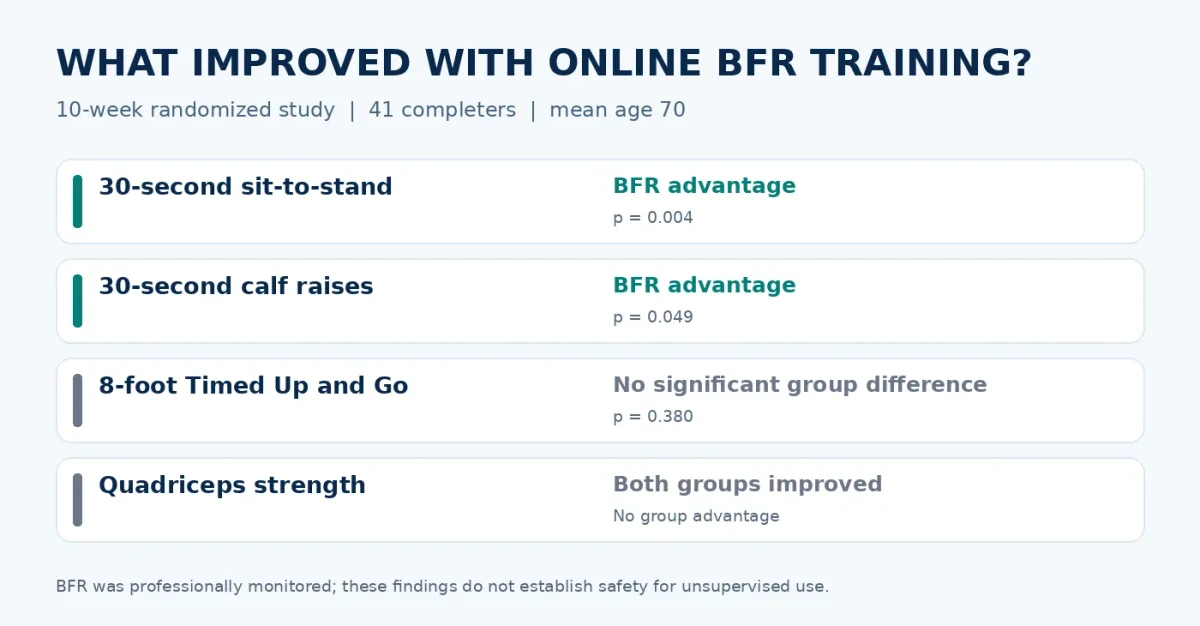
These results are important because they separate improvements within a group from evidence that one program outperformed another.
A participant can improve considerably during a training program without that improvement being significantly greater than the progress made by a comparison group.
In this trial, BFR provided additional benefits for some functional tasks, but not for every outcome measured.
The Sit-to-Stand Test
The 30-second sit-to-stand test counts how many times someone can rise from a chair and sit back down within half a minute.
The test reflects lower-body muscular endurance and the ability to perform a movement used repeatedly in daily life.
The BFR group improved significantly from baseline to the midpoint and again between the midpoint and final assessment.
The conventional training group also improved by the end of the intervention, although its earlier progress was less apparent.
The between-group comparison favored BFR, with p = 0.004.
For an older adult, repeated sit-to-stand performance has obvious practical relevance. Getting out of a chair without assistance is part of maintaining independence.
Still, the trial did not establish whether the observed changes reduced falls, prevented disability or improved long-term independence.
Those outcomes require different measurements and longer follow-up.
The Calf-Raise Test
Participants also performed as many controlled calf raises as possible in 30 seconds.
Both groups improved, but the BFR group showed a statistically greater benefit (p = 0.049).
The calf muscles contribute to ankle movement during walking and other weight-bearing activities. Improving the ability to perform repeated heel raises may reflect better local muscular endurance or functional capacity.
The result was close to the conventional statistical significance threshold.
It is therefore reasonable to describe it as a favorable finding, while avoiding claims that BFR produces a large or reliably superior calf-training effect in all older adults.
The study’s relatively small sample makes replication especially valuable.
Why the Timed Up and Go Result Was Different
The Timed Up and Go test requires a participant to rise from a chair, walk a short distance, turn, return and sit down.
It combines several abilities: leg strength, walking speed, balance, turning and coordination.
The BFR group reduced its completion time by approximately 5.8% from baseline to the final assessment.
However, the within-group change was not statistically significant (p = 0.102), and the comparison between BFR and conventional training was also non-significant (p = 0.380).
The result should not be described as proof that BFR improved mobility more than ordinary low-intensity training.
A numerical improvement is not necessarily a statistically reliable training effect.
Timed Up and Go also measures more than muscular endurance. A program that improves repeated squatting or calf raises may not produce the same magnitude of change in turning, walking coordination or balance.
That may help explain why the outcomes differed, although the researchers did not directly establish the underlying mechanism.
Did BFR Increase Leg Strength More?
Both groups demonstrated improvements in quadriceps strength over the intervention.
The BFR group improved significantly by the midpoint and maintained a significant baseline-to-final improvement. The conventional training group also improved significantly by the final assessment.
But the difference between groups was not significant.
At the slower knee-extension testing velocity, the between-group p-value was 0.898.
Knee-flexion strength likewise showed no significant between-group difference.
This is an important qualification to the study’s overall positive conclusion.
BFR did not clearly outperform conventional training for the measured dynamometer strength outcomes.
Its additional benefits were more evident in certain functional tests involving repeated movements.
Those findings should not be translated into a claim that BFR builds more muscle, either. The study did not directly measure muscle hypertrophy.
Why Functional Performance and Maximum Strength Can Respond Differently
A person can become better at repeating a movement without showing an equally large increase in a separate strength test.
Consider the difference between performing calf raises for 30 seconds and producing maximum knee-extension torque on a dynamometer.
The first requires repeated muscular effort, movement control and tolerance of accumulating fatigue.
The second measures force production under controlled testing conditions.
Although both involve the lower body, they do not assess identical abilities.
Blood flow restriction may alter the physiological demands of repeated low-load contractions, potentially influencing fatigue resistance or local muscular endurance.
That is a plausible explanation for why some functional tests improved more in the BFR group.
It remains an interpretation, not a mechanism directly demonstrated by the trial.
The study did not measure the complete chain of physiological changes needed to establish why one test responded differently from another.
A Previous BFR Study Found No Additional Benefit
The findings become more interesting when compared with another remote-training trial published earlier in 2026.
That study investigated BFR during six weeks of remotely supervised bodyweight training in previously sedentary adults with overweight or obesity [2].
Both groups improved lower-body strength, but adding BFR did not produce a statistically significant advantage in strength, body composition, metabolic measurements or walking outcomes.
FitnessProgramer covered those findings in Does Blood Flow Restriction Add Benefits to Bodyweight Training?.
At first glance, the two studies may seem contradictory.
One reports additional functional benefits; the other does not.
But the populations, training durations, cuff systems, restriction procedures and outcome measurements differed.
The newer study involved older adults averaging 70 years of age and lasted ten weeks. The earlier investigation involved sedentary adults aged 30–60 with overweight or obesity and lasted six weeks.
The newer trial also found advantages in specific repeated-movement tests rather than across all strength measures.
These differences offer possible explanations for the results, but neither study was designed to compare the two protocols directly.
The evidence does not justify claiming that BFR always works better in older adults. Nor does the earlier negative trial establish that BFR is ineffective.
Both studies suggest that the added value of BFR may depend on the population, protocol and outcome being measured.
What Makes Remote BFR Training Different?
Most discussions of blood flow restriction focus on exercise intensity, cuff pressure or muscle adaptation.
The online setting adds another concern: supervision.
During in-person training, a qualified professional can inspect cuff placement, observe the participant’s response and intervene immediately if problems arise.
Video coaching limits some of those opportunities.
In the Montreal trial, participants received in-person instruction and assessments, including guidance on their assigned restriction tightness.
The researchers used an individualized perceived-pressure approach rather than a directly measured arterial occlusion pressure for every participant.
That approach may have made the intervention easier to implement outside a laboratory, but it also introduced uncertainty about the actual degree of blood-flow restriction.
A perceived tightness score cannot guarantee the same vascular response across individuals.
The trial reported no emergency incidents during its online sessions. That is reassuring within the observed study, but a sample of 41 completers is too small to establish the safety of remote BFR training broadly.
In particular, the findings should not be interpreted as permission to use improvised bands or copy a perceived-pressure target without clinical assessment.
Who Was Excluded From the Study?
The researchers did not enroll every older adult who expressed interest.
Exclusion criteria included varicose veins, certain chronic diseases and a stroke within the preceding six months.
Participants also needed to be able to attend in-person testing and use Zoom.
Those criteria are important when interpreting the results.
An older adult with significant vascular disease, a history of thrombosis, uncontrolled cardiovascular problems or other medical concerns may have a different risk profile from the participants studied.
BFR can produce acute cardiovascular responses that warrant caution. A separate 2026 systematic review and meta-analysis reported that low-load BFR resistance exercise could increase certain blood-pressure measures during exercise compared with relevant controls, even though longer-term resting cardiovascular outcomes were generally unchanged [3].
For that reason, suitability should be determined through professional screening and individualized supervision, not through a generic online exercise tutorial.
What About Ordinary Home Exercise Without BFR?
One of the most useful findings is easy to overlook: the conventional training group improved too.
Participants completed a structured program using familiar bodyweight movements, with progression over ten weeks and regular instructor contact.
Those features are valuable independently of blood flow restriction.
For older adults who are not ready for heavy resistance training, exercises such as supported squats, glute bridges and calf raises may provide an accessible starting point when selected appropriately.
FitnessProgramer’s bodyweight exercise guide provides examples of movements that can be adapted to different abilities.
Another related article, Are Slower Reps Better for Older Adults?, examined a different ten-week bodyweight training study involving people averaging approximately 77 years of age.
In that investigation, extending the lowering phase from three to five seconds did not produce a significant advantage in strength or functional outcomes.
The studies investigated different interventions, so their results cannot be combined into one optimal home-training prescription.
They do, however, highlight the importance of choosing an approach that people can perform consistently.
For many beginners, learning a manageable movement and repeating it regularly may be more useful than immediately introducing advanced training methods.
What the Study Cannot Establish
The trial was randomized, but outcome assessors were not blinded to group allocation.
That creates a potential source of measurement or assessment bias, particularly for performance tests involving instruction and repetition counting.
The final sample was also small, with 22 participants in the BFR group and 19 in the conventional group.
Six participants did not complete the intervention. The analysis was therefore based on completers rather than a full intention-to-treat population.
The program lasted ten weeks, providing no evidence about whether the additional benefits would persist over six months or longer.
The study did not directly measure changes in muscle thickness, muscle cross-sectional area or whole-body lean mass.
Its results therefore cannot establish a hypertrophy advantage.
The researchers also examined multiple outcomes, which makes careful interpretation of individual statistically significant results important.
Finally, the findings apply to a selected group of older adults who could participate in the online program and attend testing sessions. They should not be generalized automatically to frail older adults or people with significant medical conditions.
Is BFR Worth Adding to Online Exercise?
For some older adults, professionally supervised blood flow restriction may offer additional benefits during low-intensity resistance training.
In this trial, the clearest advantages appeared in repeated sit-to-stand and calf-raise performance.
The results were less convincing for Timed Up and Go and measured knee strength, where no significant between-group advantage was established.
That pattern makes the study useful without making it definitive.
BFR may have a place when heavier resistance is unsuitable and a qualified professional determines that the individual can use the method safely.
It should not be presented as a necessary part of home exercise, a substitute for progressive training or an intervention that has been proven safe for unsupervised use.
The more immediate message for many older adults is encouraging: a structured, remotely delivered low-intensity exercise program can improve aspects of physical function even without specialized restriction equipment.
Whether adding BFR is worth the additional complexity depends on the person, the intended outcome and the quality of supervision.
References
[1] Presta D, Chen EH, Kraemer K, Bergdahl A. (2026). The effects of blood flow restriction training during low intensity online resistance training with older adults. Physical Activity and Nutrition, 30(3), 1–9. https://doi.org/10.20463/pan.2026.0033
Full text: https://pmc.ncbi.nlm.nih.gov/articles/PMC13655434/
[2] Citherlet T, et al. (2026). Remote coaching with blood flow restriction training: impact on strength, body composition, metabolism, and walking energetics in overweight adults. European Journal of Applied Physiology. https://pubmed.ncbi.nlm.nih.gov/42709150/
[3] Norouzi K, et al. (2026). Acute and Chronic Cardiovascular and Neuromuscular Effects of Blood Flow Restriction Resistance Training in Older Adults: A Systematic Review and Meta-Analysis. Biological Research for Nursing. https://pubmed.ncbi.nlm.nih.gov/42950254/