A woman adds 10 kilograms to her bench press. A man adds 15 kilograms. Who made better progress?
Most people would give the man the edge. He lifted an additional five kilograms, after all. But suppose the woman started at 30 kilograms and the man started at 80. Her improvement would be 33%, compared with less than 19% for him.
Neither calculation is wrong. They answer different questions.
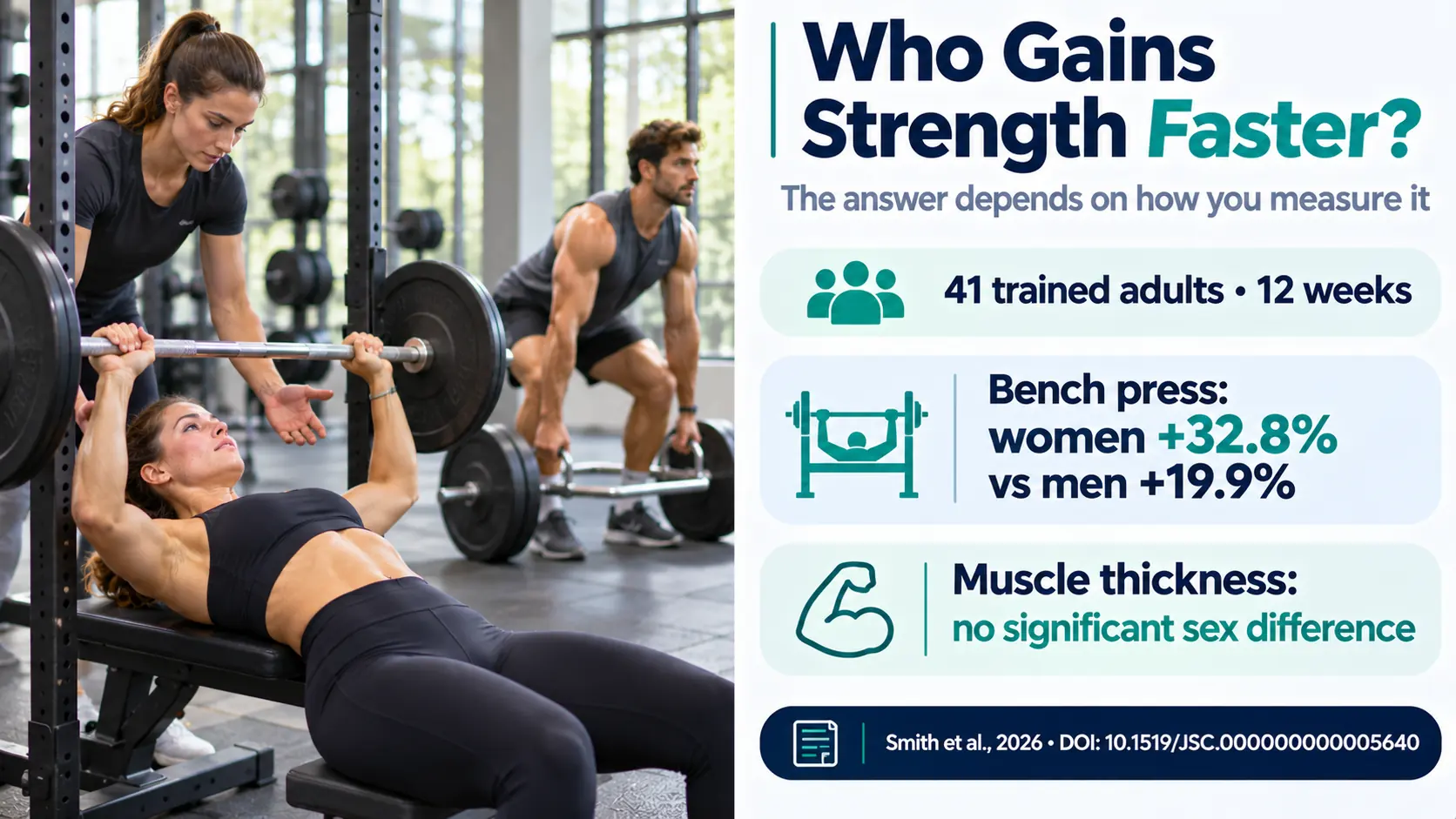
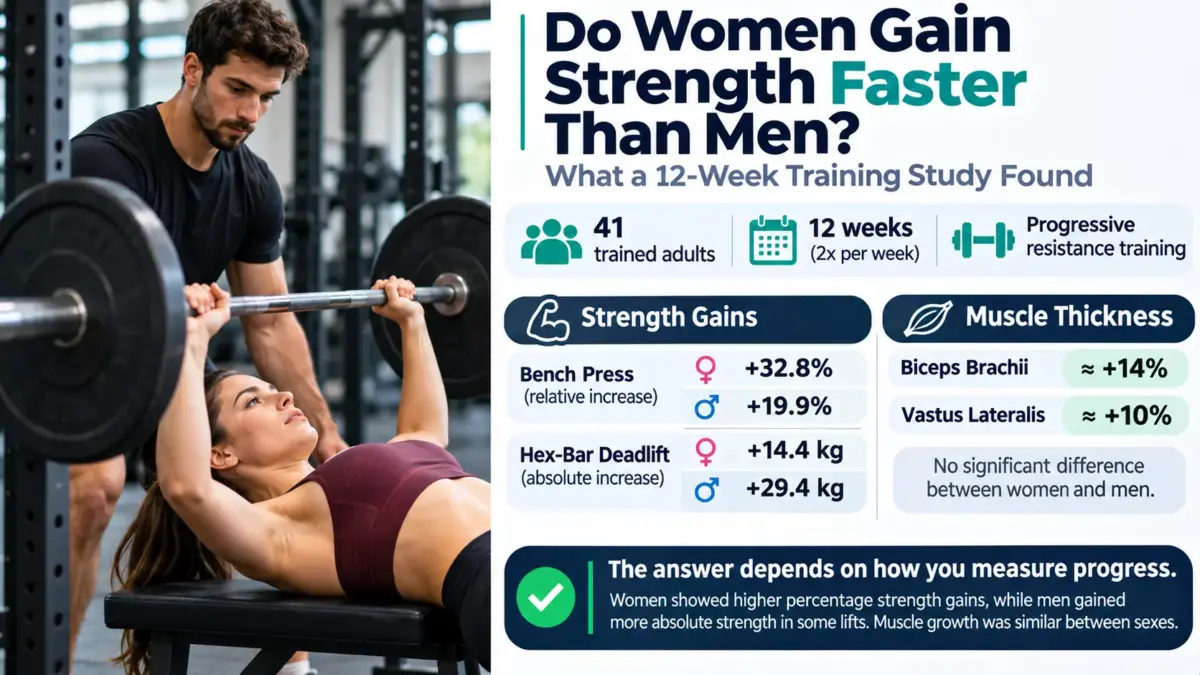
This problem sits at the center of a study published in the Journal of Strength and Conditioning Research on September 30, 2026. Researchers followed 41 physically active men and women through 12 weeks of supervised resistance training, measuring changes in strength and muscle thickness [1].
The results were not as simple as one sex responding better to training. Women recorded larger percentage improvements in bench press strength, while men gained more kilograms on the hex-bar deadlift. Those differences disappeared when the outcomes were evaluated using the alternative calculation.
Meanwhile, muscle thickness increased substantially in both groups, without a statistically significant difference between women and men.
The study raises a question that extends beyond sex comparisons: when we describe someone as making faster progress in the gym, what exactly are we measuring?
The Problem With Comparing Strength Gains
Strength can be expressed in several ways, and each has a purpose.
Absolute strength describes how much weight someone can lift. If a person’s bench press increases from 60 to 75 kilograms, the absolute gain is 15 kilograms.
Relative change describes that improvement in relation to the starting value. In this example, the increase is 25%.
Neither approach is inherently superior.
Absolute gains can be especially relevant when the goal is to lift a particular weight. A powerlifter attempting a competition total needs to know the kilograms added to the bar.
Percentage gains are useful for understanding improvement relative to someone’s previous ability. They can also help compare people who began training at very different strength levels.
But percentages are sensitive to the denominator.
Someone starting from a low baseline can achieve a large percentage increase with a relatively modest change in kilograms. A stronger lifter may add more weight yet record a smaller percentage improvement.
This becomes particularly relevant when comparing groups that differ in average starting strength.
Men generally have higher absolute strength in many upper-body exercises, although there is substantial variation between individuals. A comparison based only on percentages may therefore produce a different impression from one based on kilograms.
The researchers wanted to see how much those analytical choices affected conclusions about training adaptations.
Inside the 12-Week Training Study
Steven Smith and colleagues recruited 22 men and 19 women who had more than one year of resistance-training experience.
The men were approximately 29 years old on average, while the women averaged about 31.
All participants completed a supervised, progressive resistance-training program twice per week for 12 weeks. The program was periodized, meaning the training was organized to adjust demands over time rather than remaining unchanged throughout.
Strength was assessed through one-repetition maximum testing, including the bench press and hex-bar deadlift.
The researchers also used two-dimensional ultrasound to measure muscle thickness in two locations: the biceps brachii in the upper arm and the vastus lateralis in the thigh.
These measurements allowed them to examine two different adaptations.
One was the ability to lift more weight. The other was a change in muscle size at specific anatomical sites.
The team analyzed progress in three ways: absolute change, percentage change and change adjusted for baseline differences using analysis of covariance (ANCOVA).
That third approach is important. Instead of comparing gains without accounting for where participants started, baseline-adjusted analysis attempts to account statistically for differences in initial performance.
The study was a parallel-group pre-post investigation, not an experiment that randomly assigned participants to be male or female. It can identify patterns in these groups, but it cannot isolate biological sex from every other characteristic that may influence training responses.
Women Improved Their Bench Press More—In Percentage Terms
After 12 weeks, both groups increased bench press strength.
When the researchers expressed those gains as percentages, the women showed a significantly larger improvement.
| Group | Average relative bench press gain |
|---|---|
| Women | +32.8% |
| Men | +19.9% |
The difference was statistically significant (p = 0.002), with an effect size of d = 1.07.
Taken alone, those numbers could support a striking headline: women gain upper-body strength faster than men.
But the researchers also compared the changes in absolute kilograms.
Under that analysis, the difference between groups was no longer statistically significant.
The same training results had not changed. Only the way they were expressed had changed.
A plausible contributor is the difference in starting strength. If one group begins with a lower bench press, a given increase in kilograms represents a larger proportion of its baseline.
That does not make the percentage improvement meaningless. It may reflect substantial progress relative to the participant’s previous capacity.
What it does mean is that the percentage alone cannot establish that one group experienced a greater underlying physiological adaptation.
The Hex-Bar Deadlift Reversed the Story
The deadlift findings provided an almost mirror-image example.
Men gained considerably more absolute weight on the hex-bar deadlift.
| Group | Average absolute hex-bar deadlift gain |
|---|---|
| Men | +29.4 kg |
| Women | +14.4 kg |
The absolute difference was statistically significant (p < 0.001), with an effect size of d = 1.15.
Looking only at kilograms, the men appeared to have responded much more strongly.
But when the researchers compared percentage changes, that between-group difference was no longer statistically significant.
The result is not evidence that the strength improvements were identical. Rather, it shows that the statistical evidence for a sex difference depended on the scale used to describe progress.
A 29-kilogram increase may be an impressive achievement for a stronger lifter. A 14-kilogram increase may be similarly substantial relative to another person’s starting capacity.
Neither number tells the entire story without the baseline.
The bench press and deadlift results also caution against treating strength as a single, uniform characteristic. Upper- and lower-body exercises can differ in initial performance, technical demands and the adaptations they reveal.
A conclusion based on one lift may not hold for another.
What Absolute and Relative Gains Actually Tell Us
Consider two hypothetical lifters:
| Starting bench press | Final bench press | Absolute gain | Relative gain | |
|---|---|---|---|---|
| Lifter A | 40 kg | 52 kg | +12 kg | +30% |
| Lifter B | 100 kg | 120 kg | +20 kg | +20% |
Lifter B added more kilograms. Lifter A improved by a larger percentage.
These are illustrative numbers, not individual participant data from the study.
The example shows why a coach might want both measures in a training report.
Absolute change answers, “How much more can this person lift?”
Relative change answers, “How large was the improvement compared with where this person started?”
Baseline-adjusted comparisons address a related but different statistical problem: whether the apparent group difference remains after accounting for initial values.
That approach is not automatically perfect. Its usefulness depends on the study design and whether the assumptions of the statistical model are reasonable.
Still, presenting several measures makes it harder for one favorable number to dominate the interpretation.
A training app that reports only percentage gains may exaggerate how differently two lifters progressed. An app that reports only kilograms may overlook the scale of improvement relative to starting strength.
Both pieces of information belong in a useful progress report.
Did Men Build More Muscle Than Women?
The muscle-thickness results were notably less divided.
Across the training period, biceps brachii thickness increased by approximately 14%, while vastus lateralis thickness increased by around 10%.
The researchers did not detect statistically significant differences between women and men in those muscle-thickness changes.
That result challenges the assumption that men necessarily experience faster proportional muscle growth during a comparable resistance-training program.
It does not mean men and women have identical muscle mass, hormonal profiles or absolute muscle-growth potential.
Nor does it prove that their responses would remain identical across every training program and stage of life.
The study measured two muscles over 12 weeks in physically active adults. It did not assess every major muscle group or track long-term changes over several years.
Ultrasound muscle thickness is also a local measurement. It provides useful information about changes at a measured site, but it is not the same as measuring total-body muscle mass.
Nevertheless, the findings are relevant to how training advice is presented.
Women do not need to be treated as physiologically incapable of substantial hypertrophy, and men should not assume that their sex guarantees a superior percentage response.
The training stimulus, prior experience, recovery and individual characteristics remain central considerations.
Why Starting Strength Can Distort Comparisons
A person who has trained for several years may already be closer to the level of strength they can achieve under their current circumstances.
Another person with the same number of years in the gym may have trained inconsistently, used different exercises or followed a less progressive program.
Both may technically meet a study’s minimum training-experience requirement while starting from very different performance levels.
That makes baseline strength important.
It also explains why comparing percentages across groups can be misleading when their starting values differ substantially.
A larger percentage improvement is not necessarily evidence of a greater biological capacity to adapt. Sometimes it reflects the mathematical relationship between the amount gained and the amount already possessed.
At the same time, baseline differences do not explain everything. Sex-related physiological characteristics, training history and individual responsiveness may all contribute to outcomes.
The Smith study did not conclude that statistical methods account for every observed difference. Its central observation was that the analytical method materially changed which differences appeared statistically significant.
How This Connects to Other Resistance-Training Research
Earlier research published in 2026 examined whether starting strength influenced responses to velocity-loss-based resistance training [2].
That meta-regression did not identify baseline strength as a statistically significant moderator of strength and power adaptations.
At first, that might appear to conflict with the present study’s emphasis on baseline values.
It doesn’t.
The velocity-loss investigation asked whether starting strength predicted the magnitude of training adaptations across studies using particular velocity-loss thresholds.
Smith and colleagues asked whether the statistical presentation of strength changes altered comparisons between men and women.
Those are different questions.
Baseline strength can affect how a percentage is calculated even when it does not reliably predict who will respond better to a particular training method.
Another recent study comparing velocity-based and percentage-based bench press programming found similar improvements in pectoralis major size and maximum strength between the two approaches [3].
That study also reinforces the value of separating the outcome from the method used to evaluate it. A program may look more sophisticated without demonstrating a greater adaptation.
FitnessProgramer’s previously published article on cluster sets versus traditional sets offers a related example. Cluster sets ranked favorably for maintaining repetition velocity, but the evidence did not establish that their acute speed advantage would necessarily produce greater long-term hypertrophy.
The common lesson is methodological rather than promotional: an impressive number is only useful when we understand what it measures.
How Coaches Should Track Progress
For someone following a progressive resistance-training program, the practical solution is relatively simple.
Record the weight lifted, the repetitions completed and the conditions under which performance was tested.
If a one-repetition maximum is assessed, use a consistent testing procedure whenever possible. Changes in technique, range of motion or testing conditions can make progress appear larger or smaller than it really is.
When comparing athletes, report both absolute and percentage changes.
A coach reviewing a bench press increase from 40 to 50 kilograms should recognize both the 10-kilogram improvement and the 25% gain.
Neither measure needs to replace the other.
The same principle applies to training programs. FitnessProgramer’s strength and muscle-building workout program for women provides an example of a structured resistance-training plan, while the site’s workout plan library includes programs for different training goals.
These resources can help readers organize exercise selection, but the study does not establish that men and women should use entirely different progression systems.
Progression should be based on performance, exercise technique, recovery and the individual’s goals.
What the Study Cannot Settle
Forty-one participants is a relatively small sample for drawing broad conclusions about sex differences in training adaptation.
The study included adults with at least one year of resistance-training experience, so its results may not apply to complete beginners, elite strength athletes or older populations.
The intervention lasted 12 weeks and involved twice-weekly supervised training. Different training frequencies, volumes or longer interventions might produce different patterns.
Only biceps brachii and vastus lateralis thickness were measured. The absence of a significant difference in those muscles cannot establish identical hypertrophy throughout the entire body.
The investigators also did not experimentally control every biological and behavioral factor that could influence sex-related differences. Menstrual-cycle phase, hormonal status, nutrition and previous training exposure may be relevant, but their independent contributions cannot be established from the reported findings.
There is another statistical caution: a non-significant between-group difference is not proof of equivalence.
The study did not demonstrate that every woman and man responds identically. It showed that some apparent differences depend on whether gains are expressed as percentages, kilograms or baseline-adjusted changes.
That is a narrower conclusion, and a more useful one.
So, Who Really Gains Strength Faster?
The answer depends on the exercise, the starting point and what “faster” is supposed to mean.
In this 12-week study, women achieved greater percentage gains in bench press strength, while men achieved larger absolute gains in hex-bar deadlift strength.
Neither difference remained statistically significant when the alternative change-score method was used.
Muscle thickness increased in both groups without a detected sex difference.
For coaches, the implication is not to ignore sex-related physiology. It is to avoid treating one calculation as a complete description of training adaptation.
For lifters, the study offers a more useful way to judge progress. A smaller increase in kilograms can represent substantial improvement, and a larger percentage does not automatically mean someone has developed more strength in absolute terms.
The most informative training record shows where a person started, where they finished and how the change was calculated.
Without that context, even accurate numbers can tell a misleading story.
References
[1] Smith S, Behan FP, Nolan D, Egan B. (2026). Changes in Strength and Muscle Thickness in Physically Active Males and Females in Response to Resistance Exercise Training: Comparison of Absolute and Relative Change Scores. Journal of Strength and Conditioning Research. Published online September 30, 2026. https://doi.org/10.1519/JSC.0000000000005640
[2] Tao J, et al. (2026). Does baseline strength influence adaptations to velocity loss threshold-based resistance training? BMC Sports Science, Medicine and Rehabilitation. https://doi.org/10.1186/s13102-026-02067-z
[3] Fitas A, et al. (2026). Effects of velocity-based hypertrophy training on pectoralis major morphology, neuromuscular activation and bench press maximal strength. European Journal of Applied Physiology. https://doi.org/10.1007/s00421-026-06428-x
[4] Nagatani T, et al. (2026). The Effectiveness of Cluster vs. Rest-Redistribution Set Configurations to Maintain Movement Velocity During Resistance Training: A Systematic Review and Bayesian Network Meta-analysis. Sports Medicine – Open. https://doi.org/10.1186/s40798-026-01106-w