The first few repetitions of a heavy squat often feel crisp. The bar moves quickly, the movement feels controlled, and every rep looks much like the one before it. By the end of a demanding set, that can change. The bar slows, the effort rises, and maintaining the same movement speed becomes increasingly difficult.
Coaches have several ways to manage that slowdown. One is to break a long set into smaller groups of repetitions, allowing brief pauses before continuing. Another is to move some of the rest normally taken between sets into the sets themselves.
These approaches are usually called cluster sets and rest redistribution. Both have been studied for their ability to preserve lifting velocity, but deciding which one works best has been less straightforward.
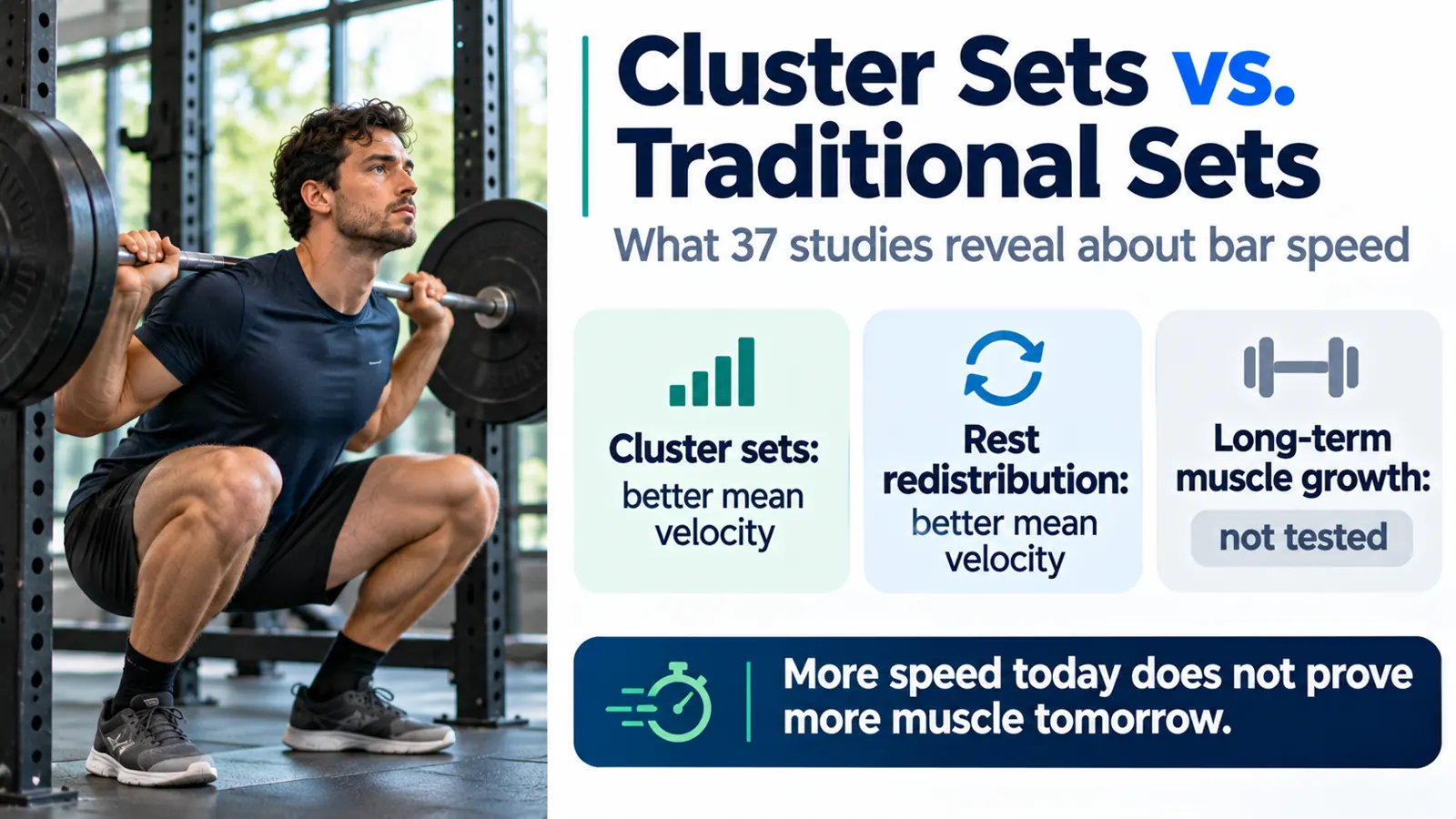
A systematic review and Bayesian network meta-analysis published in Sports Medicine – Open on September 22, 2026, examined 37 studies comparing these set structures [1]. The researchers found that alternative arrangements generally maintained movement velocity better than traditional sets.
Cluster sets ranked highest. Yet the evidence did not establish a meaningful advantage over the different rest-redistribution methods.
That leaves a more useful coaching question than which method wins a ranking: how should you organize rest when maintaining movement speed is the priority?
Why Repetition Speed Falls During a Set
Imagine performing six squats with a challenging weight. Even when you intend to lift every repetition as quickly as possible, the final two may move noticeably slower than the first two.
The decline can reflect accumulating fatigue and changes in the muscles’ ability to produce force rapidly. Movement technique, exercise selection and the relative load also affect the speed recorded.
Velocity-based training uses this information to monitor performance. A coach might track average concentric velocity, for example, to observe how movement speed changes across repetitions.
But there is a difference between measuring velocity and designing a workout to preserve it.
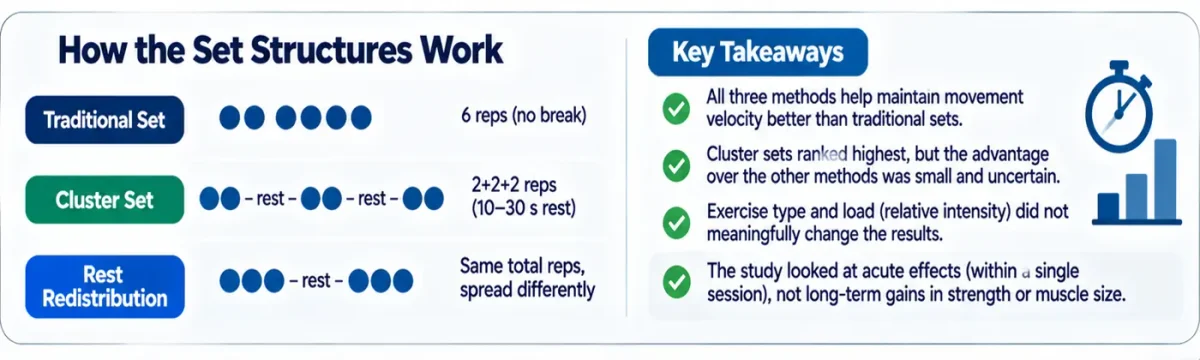
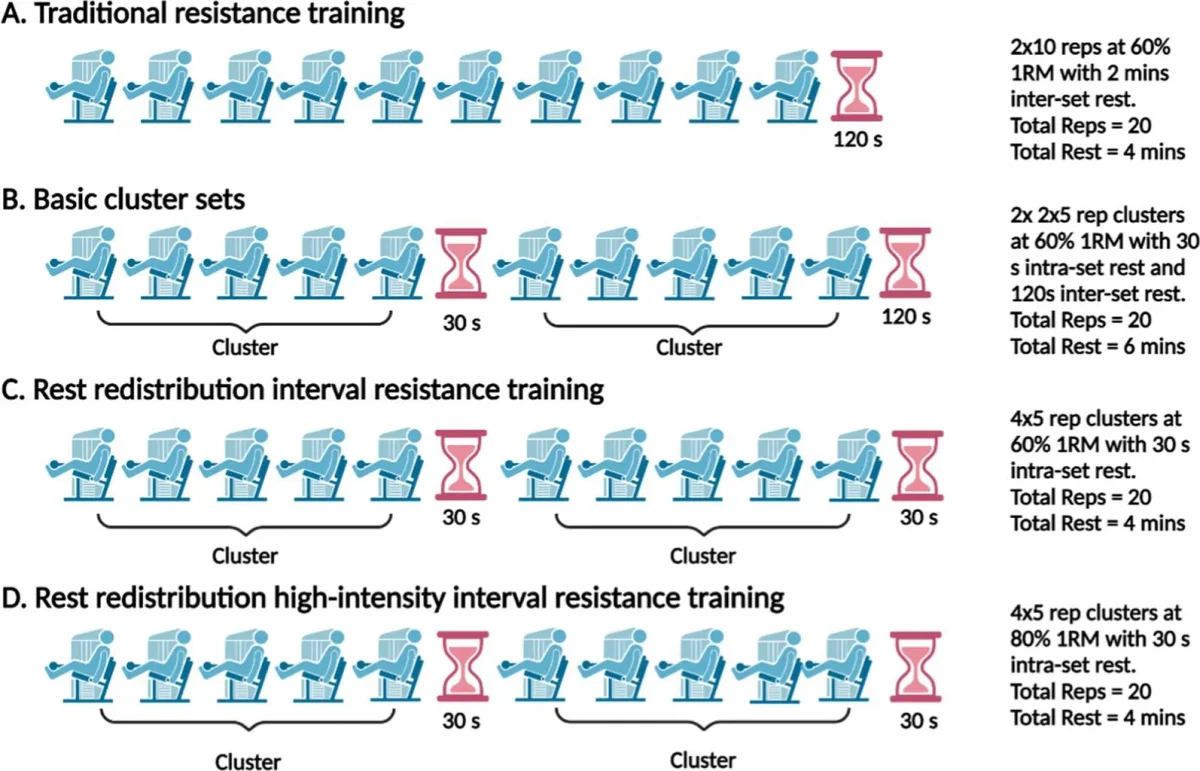
A traditional set groups repetitions together, followed by a longer rest period. Cluster sets interrupt that sequence with short breaks. Rest-redistribution approaches rearrange recovery periods without necessarily increasing the overall amount of rest.
The common idea is to give the athlete an opportunity to recover before speed declines too far.
Whether that produces better results depends on what is being measured.
Three Ways to Organize the Same Repetitions
The terminology can be confusing because different studies use slightly different protocols. Nagatani and colleagues separated the interventions into three alternative categories.
Cluster Sets
A cluster set divides a conventional set into smaller blocks, with brief recovery periods between them.
Instead of performing six consecutive repetitions, an athlete might perform two, rest briefly, complete another two, rest again and finish the final two.
The additional pauses can allow greater recovery between efforts.
In the studies included in the review, cluster-set protocols were distinguished from rest-redistribution approaches because they could increase total recovery time rather than merely move existing rest periods.
That distinction matters. If one workout contains more total rest than another, improved repetition speed may partly reflect the additional recovery opportunity.
Intra-Set Rest Redistribution
Intra-set rest redistribution moves part of the rest normally available between sets into the set itself.
Consider a program with several sets and a fixed overall rest allowance. Instead of using all recovery time between complete sets, some of it is inserted between smaller groups of repetitions.
The objective is to preserve performance without simply adding unlimited rest to the workout.
In practice, study protocols were not always perfectly matched for total recovery time. The review acknowledged cases where the intervention labeled rest redistribution actually provided slightly more rest than its traditional comparison.
Inter-Set Rest Redistribution
Inter-set rest redistribution divides the work into a larger number of smaller sets, with shorter breaks between them.
Rather than completing a few long sets, an athlete performs more short sets while keeping the intended total repetitions and rest time comparable.
This can be easier to organize than inserting pauses into the middle of a set, particularly when a coach is managing several athletes.
The three methods share a practical goal, but their rest arrangements are not identical.
What the 37 Studies Actually Measured
The review was prospectively registered on the Open Science Framework. Researchers searched PubMed and Web of Science for studies comparing traditional sets with cluster sets, rest redistribution or both.
Thirty-seven studies met the inclusion criteria.
Across the publications, there were 674 reported participant entries. Because some research groups used the same participants in multiple papers, the reviewers identified 611 unique individuals, including 557 men and 54 women.
Most studies examined lower-body exercises, including back squats, jump squats, leg presses and Olympic weightlifting derivatives. Bench press was the principal upper-body exercise investigated.
Thirty-five studies used within-participant comparisons, meaning individuals performed different set structures under separate conditions. Only two used between-participant designs.
The outcomes were acute measures of movement velocity. The researchers assessed mean velocity, mean propulsive velocity and peak velocity where available.
They did not pool months of muscle-growth measurements or long-term changes in one-repetition maximum strength.
This is the boundary of the evidence: the review can help answer which set structures preserve speed during a workout, not which program necessarily produces the most muscle or strength over a training cycle.
All Three Alternatives Preserved Mean Velocity Better
The researchers used a Bayesian network meta-analysis, allowing direct and indirect comparisons across the different set structures.
For mean movement velocity, every alternative method outperformed traditional sets.
| Set structure compared with traditional sets | Standardized mean difference | 95% credible interval |
|---|---|---|
| Cluster sets | 0.60 | 0.42 to 0.80 |
| Intra-set rest redistribution | 0.41 | 0.08 to 0.75 |
| Inter-set rest redistribution | 0.42 | 0.26 to 0.61 |
All three credible intervals were above zero, supporting a positive effect on mean velocity relative to traditional sets [1].
These values are standardized differences, not percentages. An effect of 0.60 does not mean the bar moved 60% faster.
The results indicate that changing the arrangement of work and recovery can help athletes maintain movement speed.
For a coach who wants repeated explosive efforts, that is a relevant outcome.
For someone whose primary objective is maximizing muscle size, it is only one piece of a much larger picture.
Cluster Sets Ranked First, but That Isn’t the Whole Result
Cluster sets received the highest ranking in the network analysis.
Their SUCRA scores were 99.7% for mean velocity and 95.6% for peak velocity. SUCRA is a statistical ranking measure that summarizes how favorably an intervention performs relative to alternatives in the network.
It is not a 99.7% probability that cluster sets will be the best choice for every athlete or exercise.
More importantly, the direct comparisons among cluster sets and the two rest-redistribution approaches did not show clear, meaningful differences.
The point estimates generally favored cluster sets, but the uncertainty around comparisons between alternative methods was sufficient to prevent a strong superiority claim.
One comparison between cluster sets and inter-set rest redistribution also showed local inconsistency in the network analysis.
That means the evidence supporting the exact ordering of those two approaches deserves caution.
A ranking can be useful for organizing results. It becomes misleading when presented as proof that the top-ranked method is substantially better than every other option.
Mean Velocity and Peak Velocity Tell Different Stories
The review examined both average and peak movement speed.
Mean velocity reflects movement across the concentric portion of a repetition. Peak velocity captures the highest speed reached during that movement.
They are related, but they are not interchangeable.
For peak velocity, cluster sets again showed a positive effect relative to traditional sets:
SMD = 0.48; 95% credible interval: 0.20 to 0.76.
Intra-set rest redistribution also performed better:
SMD = 0.39; 95% credible interval: 0.04 to 0.73.
The estimated effect for inter-set rest redistribution was less certain, with a credible interval ranging from −0.11 to 0.43.
Because that interval crossed zero, the analysis did not establish a clear peak-velocity advantage for inter-set rest redistribution.
That does not mean the method failed. Its mean-velocity results were favorable, and the available peak-velocity evidence was less precise.
A coach should therefore consider which velocity measure is relevant to the training objective rather than assuming all speed metrics respond identically.
Did Exercise Type or Training Load Change the Findings?
One reasonable suspicion is that cluster sets might work particularly well for heavy squats but offer less value during bench presses, or that the advantage might disappear at lighter loads.
The researchers investigated these possibilities using network meta-regression.
They compared upper- and lower-body exercise categories and examined moderate versus high relative training intensities.
Neither exercise type nor relative load significantly moderated the difference between traditional sets and the alternative structures.
The credible intervals around the moderator estimates included zero.
That result does not prove the methods work identically for every exercise or intensity. It means the available studies did not establish a reliable difference across the categories tested.
The evidence also contained far more lower-body than upper-body exercise investigations. Only a limited range of exercises was represented.
Applying the findings to every machine exercise, isolation movement or rehabilitation program would go beyond the review.
Does Maintaining Bar Speed Produce More Muscle Growth?
Not necessarily.
An athlete who pauses briefly between repetitions may complete the same workload at a higher average velocity. That can be useful when the session is intended to preserve rapid force production or technical quality.
Hypertrophy involves additional considerations, including mechanical tension, training volume, proximity to failure and the ability to progress over time.
A session that maintains velocity better is not automatically a superior muscle-building session.
The 2026 network meta-analysis examined immediate mechanical responses. It did not demonstrate that cluster sets produce more hypertrophy, larger one-repetition maximum improvements or better athletic performance after several months.
This distinction connects directly to two earlier resistance-training investigations.
A 2026 study comparing velocity-based loading with percentage-based bench press training found similar improvements in pectoralis major size and maximal strength across both groups [2].
Another meta-regression examined velocity-loss thresholds and reported that baseline strength did not significantly moderate strength and power adaptations [3].
Those studies address different questions and populations. They cannot be combined into a claim that velocity monitoring is unnecessary or that one set structure is universally superior.
Together, however, they show why an acute improvement in a training metric should not be mistaken for proof of a better long-term outcome.
When Cluster Sets Make Practical Sense
Consider a strength and conditioning session built around explosive squats, jumps or weightlifting derivatives.
The coach wants the athlete to produce rapid, technically consistent repetitions. As fatigue accumulates, slower movements may become less representative of the intended training quality.
Breaking repetitions into smaller clusters can help maintain speed.
A hypothetical example might involve six total repetitions arranged as three groups of two, with short pauses between groups.
That example illustrates the structure; it is not a protocol established as optimal by the meta-analysis.
The actual loading, recovery periods and number of repetitions should reflect the athlete’s ability, the exercise and the session objective.
For a power-focused workout, preserving movement quality may justify the extra pauses.
For a time-limited general fitness session, the additional complexity may not be worthwhile.
The Fitnessprogramer exercise library can help readers identify exercises such as squats and bench presses that commonly appear in resistance-training programs. The choice of set structure should still be based on the goal of the session rather than the exercise name alone.
Rest Redistribution May Be the More Convenient Option
Cluster sets can be effective, but they may require more total rest or more careful management of pauses.
That becomes a practical issue in busy gyms, group training sessions or workouts with strict time limits.
Rest redistribution offers another way to protect repetition speed. Instead of adding recovery time, the coach rearranges the rest already available.
For example, a session might use more short sets rather than fewer long ones, keeping total repetitions and planned recovery time similar.
The review suggests that these approaches can preserve mean velocity better than traditional sets.
It does not establish that every rest-redistribution arrangement is time-equivalent or that all protocols are equally convenient.
Equipment availability, coaching attention and the total duration of a workout can influence which structure is realistic.
The best theoretical ranking is not always the best practical choice.
Why the Evidence Still Has Limits
The review included 37 studies, but most participants were male. Women accounted for only 54 of the 611 unique individuals identified.
That imbalance limits confidence in applying the pooled results equally across sexes.
The included studies also used different exercises, relative loads, repetition schemes and rest arrangements. Some protocols classified as rest redistribution did not perfectly equalize total recovery time.
Only two databases were searched, leaving the possibility that relevant studies were missed.
Publication-bias analysis raised concerns for the mean-velocity network. Many studies also provided incomplete information about equipment reliability or outcome-assessment blinding.
The authors found relatively low statistical heterogeneity in their primary network models, but that does not eliminate concerns about protocol differences or study quality.
Finally, these were acute experiments. An athlete may lift faster during one session without necessarily accumulating better adaptations over weeks or months.
Longer training studies comparing matched programs would be needed to answer that question.
Which Set Structure Should You Choose?
If your priority is maintaining high movement speed across repetitions, the evidence favors moving away from uninterrupted traditional sets when appropriate.
Cluster sets have the strongest overall ranking, but the difference between them and rest-redistribution methods appears too uncertain to justify declaring one universally best.
For an athlete performing explosive lifts with sufficient time and supervision, cluster sets may be a sensible option.
For a coach working within a fixed session duration, redistributing existing rest can be an attractive alternative.
For someone training mainly for muscle growth, the review does not provide a reason to abandon traditional sets. Velocity preservation is not the same outcome as hypertrophy.
The most useful lesson from the research is that where rest occurs can change how quickly repetitions are performed. Whether that improvement deserves a place in your program depends on what you are trying to achieve.
References
[1] Nagatani T, Latella C, Yang J, Kendall KL, Vial S, Comfort P, Drinkwater EJ, Haff GG. (2026). The Effectiveness of Cluster vs. Rest-Redistribution Set Configurations to Maintain Movement Velocity During Resistance Training: A Systematic Review and Bayesian Network Meta-analysis. Sports Medicine – Open, 12, Article 141. https://doi.org/10.1186/s40798-026-01106-w
[2] Fitas A, et al. (2026). Effects of velocity-based hypertrophy training on pectoralis major morphology, neuromuscular activation and bench press maximal strength. European Journal of Applied Physiology. https://doi.org/10.1007/s00421-026-06428-x
[3] Tao J, et al. (2026). Does baseline strength influence adaptations to velocity loss threshold-based resistance training? BMC Sports Science, Medicine and Rehabilitation. https://doi.org/10.1186/s13102-026-02067-z