The fastest-looking exercise in a training program isn’t necessarily the one that makes someone run faster.
A squat jump is explosive by design. The athlete drops into a squat, rapidly extends the legs and leaves the ground. A heavy barbell squat looks almost like its opposite: the movement is slower, the resistance is considerably greater, and there is no takeoff.
If the objective is sprint acceleration, the jump might seem like the obvious choice.
Researchers in Norway recently put that assumption to the test. Rather than examining a single strength exercise, they compared three different resistance-training approaches alongside regular sprint practice.
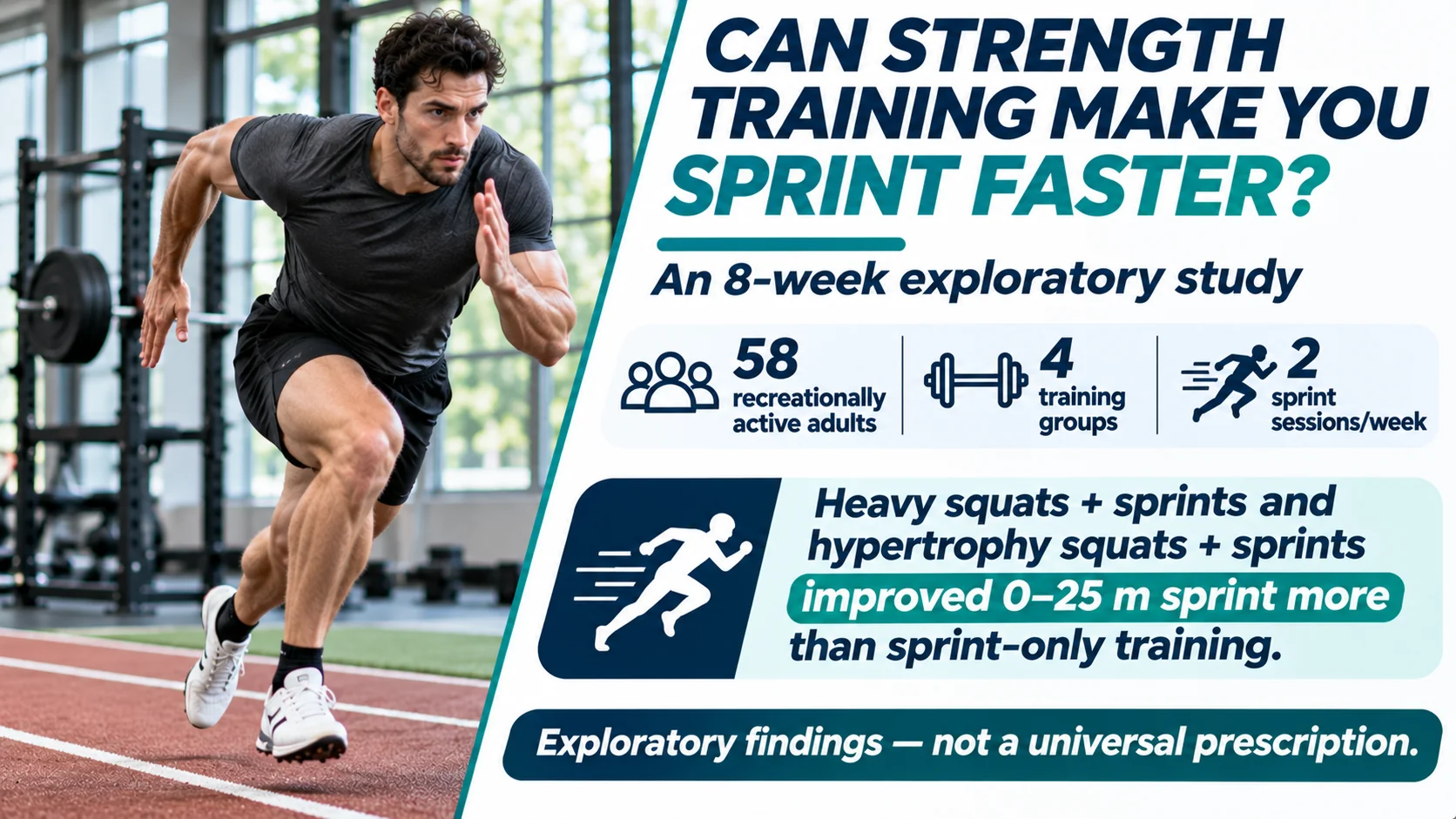
The eight-week study, published in the Journal of Strength and Conditioning Research on November 3, 2026, involved 58 recreationally active adults who did not have a background in structured strength training [1].
All participants practiced sprinting. Some also performed heavy squats, others used a moderate-load hypertrophy program, and a third group trained with explosive squat jumps.
The surprising result was that the maximal-strength and hypertrophy groups improved several performance measures more than the sprint-only group. Those advantages were not demonstrated in the explosive-training group.
The study offers a compelling reason to reconsider what contributes to early sprint development. It doesn’t establish that heavy lifting is always superior to explosive training, and the researchers were careful to describe their results as exploratory.
Why Sprinting Is More Than a Test of Explosiveness
Watch someone accelerate from a standing start. The first few steps involve substantial forward lean, powerful pushes against the ground and rapid coordination between the hips, knees and ankles.
Sprint acceleration depends on the ability to apply force effectively during very short ground-contact periods.
That creates two distinct demands.
The athlete must have enough force-producing capacity to generate a powerful push. They must also coordinate that force quickly and in the appropriate direction.
Maximal strength and explosive performance are related, but they are not the same quality.
Someone may possess substantial leg strength without being an accomplished sprinter. Equally, a technically efficient runner may accelerate well without producing exceptional numbers in a weight-room strength test.
This is why training for sprinting commonly combines running practice with exercises intended to develop the physical capacities that support it.
Heavy squats can increase maximal force-producing capacity. Jump squats challenge rapid force production. Moderate-load resistance training may develop strength and muscle through repeated demanding contractions.
Each method has a rationale.
What remains less clear is whether one produces a greater additional benefit when people are already practicing sprinting.
The Experiment: Everyone Sprinted, but Their Gym Work Differed
Glenn Trane and colleagues recruited 58 recreationally active men and women who were not regularly strength training.
Participants were randomly assigned to four groups and followed their programs for eight weeks.
Every group completed two sprint sessions per week. Each session consisted of six 25-metre sprints.
The difference was the additional resistance-training program.
| Group | Additional training | Weekly frequency |
|---|---|---|
| Maximal strength (MST) | 4 × 4 squats at ≥85% 1RM | 3 sessions |
| Hypertrophy (HT) | 3 × 8–12 squats at approximately 70–80% 1RM | 3 sessions |
| Explosive strength (EST) | 4 × 6–7 bodyweight squat jumps | 3 sessions |
| Control (CON) | No additional strength training | Sprint sessions only |
The comparison was particularly useful because the control group wasn’t inactive.
Everyone received sprint training, allowing the researchers to examine whether adding a particular form of strength training produced additional benefits.
The investigators assessed maximal force, dynamic rate of force development, sprint performance, running economy and power output during a 30-second Wingate cycling test.
These outcomes describe different physical abilities.
A heavy strength test measures something different from a short sprint. Cycling power also doesn’t reproduce the mechanics of running.
Examining several outcomes helps researchers see whether improvements in one capacity are accompanied by changes in another.
It also creates a statistical challenge: the more comparisons a study makes, the greater the possibility of finding apparently significant results by chance.
That issue becomes important when interpreting this particular experiment.
What Actually Improved After Eight Weeks?
The maximal-strength and hypertrophy groups produced several favorable results compared with sprint training alone.
The strongest reported differences involved leg force production, squat rate of force development, 0–25-metre sprint time and Wingate cycling performance.
| Outcome | Maximal-strength group | Hypertrophy group |
|---|---|---|
| Leg-press maximal isometric force | +14.5% | +10.6% |
| Squat dynamic rate of force development | +37.4% | +36.0% |
| 0–25 m sprint time | −0.11 seconds | −0.10 seconds |
| Wingate average power | +6.6% | +6.9% |
| Wingate peak power | +11.8% | +10.1% |
These figures describe the changes reported in the two training groups. They are not the numerical differences between those groups and the control condition.
The researchers found that maximal isometric leg-press force improved more with maximal-strength training than with explosive training or sprint training alone. Hypertrophy training also produced a larger improvement than sprint-only training.
The improvements in squat rate of force development were greater in both the maximal-strength and hypertrophy groups than in the sprint-only group.
Sprint time followed a similar pattern.
Compared with the control group, the maximal-strength group improved 0–25-metre sprint performance significantly more (p = 0.019). The hypertrophy group also showed a greater improvement (p = 0.042).
Those p-values were obtained using the study’s exploratory statistical approach, which requires caution.
The results don’t establish that every heavy-squat program will produce the same acceleration gains.
They show that, under these conditions, adding two different forms of loaded squatting was associated with better sprint improvement than sprint practice alone.
Why the Heavy-Squat Group Became Stronger
The maximal-strength group performed four sets of four repetitions using at least 85% of one-repetition maximum.
That is a demanding loading strategy, particularly for people who have not previously followed a structured strength program.
Training with heavy loads exposes the muscles and nervous system to substantial force requirements.
Over time, participants can become better at producing high forces through a combination of neuromuscular adaptation, technical learning and changes in muscle function.
The study found that maximal isometric leg-press force increased by 14.5% in the maximal-strength group.
For comparison, the explosive-strength group improved by 5.2%. The difference between these two groups was statistically significant (p = 0.004).
The maximal-strength group also improved significantly more than the sprint-only control group.
Those results support the idea that heavy resistance training was an effective way to develop maximal force capacity in these previously untrained participants.
But the study wasn’t designed to isolate exactly which adaptation caused the strength improvement.
Greater neural drive, better task familiarity and changes in muscle characteristics may all have contributed.
The authors did not establish that one physiological mechanism was solely responsible.
The Hypertrophy Group Wasn’t Simply Getting Bigger
The hypertrophy group trained with three sets of eight to twelve squats, using approximately 70–80% of one-repetition maximum.
This loading and repetition arrangement is commonly associated with muscle-building programs.
It would be easy to conclude that the group’s improved sprint performance resulted from growing larger leg muscles.
The available evidence doesn’t justify that explanation.
The experiment reported improvements in force production and performance, but the abstract does not establish that additional muscle growth directly caused the acceleration gains.
The group was named according to its training method, not because hypertrophy had been demonstrated as the mechanism behind every observed adaptation.
Moderate-load resistance training can also improve maximal strength, particularly in people without an established lifting background.
The hypertrophy group increased leg-press maximal isometric force by 10.6% and showed a 36.0% improvement in squat dynamic rate of force development.
Those are substantial changes in performance.
They suggest that the moderate-load program provided a meaningful strength stimulus alongside sprint practice.
This is also a reminder that training categories aren’t as physiologically separate as their labels sometimes imply.
A program described as hypertrophy training can increase strength. A maximal-strength program can stimulate muscle growth. Explosive exercises may also produce improvements outside the quality they’re primarily intended to develop.
The adaptations overlap.
Why Didn’t the Squat-Jump Group Show the Same Advantage?
This was the study’s most unexpected pattern.
The explosive-strength group performed bodyweight squat jumps, a movement requiring rapid extension of the hips, knees and ankles.
Yet the researchers did not establish the same additional performance benefits for this group relative to sprint training alone.
That result doesn’t demonstrate that squat jumps are ineffective.
The participants in every group were already completing two weekly sprint sessions. Those sessions provided repeated exposure to rapid, forceful lower-body movements.
It’s possible that the additional bodyweight jumps offered a smaller new stimulus than the loaded squat programs.
Another possibility is that the participants’ relatively limited strength-training background made improvements in maximal force particularly useful during the early stages of development.
These are interpretations, not mechanisms directly proven by the experiment.
The study also didn’t equalize every characteristic of the three resistance programs.
They used different loads, repetition ranges and movement patterns. The total mechanical work and training stimulus may therefore have differed.
Nor does a lack of significant superiority over the control group prove that the explosive program produced no adaptation.
It means an additional benefit wasn’t statistically demonstrated in the outcomes and comparisons examined.
An experienced sprinter with a strong force-production foundation might respond differently to an explosive program.
The study cannot answer that question.
The Sprint Result: Small Changes That Matter
A reduction of 0.11 seconds over 25 metres may sound modest outside competitive sport.
Over a short distance, however, fractions of a second can distinguish one level of performance from another.
The maximal-strength group recorded a 0.11-second reduction in 0–25-metre sprint time, while the hypertrophy group improved by 0.10 seconds.
Both changes were more favorable than those observed in the sprint-only comparison group.
But the experiment did not establish that maximal-strength training was superior to hypertrophy training for sprint improvement.
Their numerical changes were very similar, and the primary reported comparisons concerned their differences from the control condition.
It would therefore be misleading to rank the two approaches based on a hundredth of a second.
The more relevant observation is that both added resistance-training methods produced a favorable pattern in people without prior structured strength training.
For readers interested in sprint technique, acceleration and exercise selection, FitnessProgramer’s guide to improving sprint speed explains why sprint-specific running practice remains essential alongside gym training.
One point deserves emphasis: none of the groups replaced running with weightlifting.
Every participant practiced sprinting.
The experiment therefore supports investigating the value of added strength training, not substituting squats for sprint practice.
What the Wingate Cycling Test Adds
The researchers also examined performance during a 30-second Wingate cycling test.
This assessment requires participants to pedal intensely against resistance while the equipment records power output.
It provides information about short-duration anaerobic exercise performance, although cycling mechanics are different from sprint running.
Average Wingate power increased by 6.6% in the maximal-strength group and 6.9% in the hypertrophy group.
Both improvements were statistically greater than those in the explosive-strength and sprint-only groups.
Peak power showed increases of 11.8% and 10.1%, respectively, in the maximal-strength and hypertrophy groups. Both were greater than the sprint-only control group’s changes.
These findings suggest that the benefits were not confined to the squat or the running test.
The loaded-training groups also improved their capacity to produce power during a different high-intensity exercise task.
That is interesting evidence of performance transfer.
It should not be confused with proof that the participants would improve equally in cycling races, repeated sprint competitions or every other anaerobic activity.
The Wingate test was a controlled laboratory assessment. Sport performance involves additional technical and tactical demands.
A Possible Connection Between Maximal Strength and Sprint Improvement
The researchers reported an association between changes in maximal voluntary isometric force and changes in athletic performance.
Participants who made greater force-production gains also tended to show favorable changes in certain performance measures.
This led the authors to propose increased maximal strength as an important contributor to the observed improvements.
The explanation is plausible.
A stronger athlete may possess greater force-producing capacity to draw upon during sprint acceleration.
However, the study did not directly prove that maximal strength was the causal mechanism connecting squatting to faster running.
Two adaptations can develop together because they respond to a shared training stimulus or other factors.
A correlation between changes in strength and sprint performance cannot completely separate those explanations.
The association is useful for building a hypothesis. Confirming the mechanism would require additional experiments designed specifically to test it.
Running economy also changed
The maximal-strength group improved running economy by approximately 2.5% more than the control condition (p = 0.026).
Running economy concerns the energetic cost of maintaining a given running speed.
It is not the same outcome as maximum sprint velocity.
An improvement may indicate that a participant can perform a particular running task at a lower relative energy cost, depending on the measurement protocol.
Again, the finding was favorable to loaded strength training, but the short study and exploratory analysis limit how broadly it can be applied.
How This Compares With the Rugby Squat Study
An earlier 2026 trial examined loaded jump squats and traditional half squats in highly trained young rugby players [2].
The athletes improved their strength and jumping performance over six weeks, but their 30-metre sprint performance declined in both groups.
FitnessProgramer examined those findings in Jump Squat vs. Half Squat: Why Rugby Players Jumped Higher but Ran Slower.
At first glance, the rugby results might seem to contradict the new experiment.
One study found favorable sprint changes when resistance training was added. The other observed declining sprint performance despite improvements in gym-based strength and jumping.
The populations were very different.
The rugby players were highly trained and already involved in a demanding competitive schedule.
The participants in the Trane study were recreationally active but lacked structured strength-training experience.
The training methods also differed.
The rugby trial compared light-load ballistic and conventional squat approaches. The newer experiment included heavy squats, moderate-load squats and bodyweight squat jumps, with a sprint-only control group.
The context matters as much as the exercise label.
A beginner’s response to a new strength stimulus cannot be assumed to match the response of an experienced team-sport athlete managing substantial training and match demands.
Neither trial supports a universal claim that squat jumps are better or worse than heavy resistance training for sprint speed.
What This Means for Coaches Working With Beginners
The results suggest that developing maximal force capacity may be a productive part of early sprint preparation for people who have little resistance-training experience.
That doesn’t mean beginners should immediately reproduce four sets of four at 85% of their maximum squat.
The study protocol was supervised and applied in a controlled research setting.
Someone unfamiliar with squatting first needs to learn a stable movement pattern, develop suitable range of motion and become comfortable with gradually increasing resistance.
A moderate-load approach may be a practical starting point for many novice lifters.
Progression can then be adjusted according to technique, performance and recovery.
FitnessProgramer’s Power Training Guide discusses how strength and explosive training can serve different purposes within athletic preparation.
For sprint-focused training, the important question is how the gym program complements actual running practice.
If an athlete has a limited strength base, additional force-producing capacity may be useful.
If maximal strength is already well developed, movement speed, sprint mechanics or other qualities may deserve more attention.
The current experiment doesn’t establish how those priorities should change for advanced athletes.
It provides an early indication of what might work particularly well for a relatively inexperienced population.
The Statistical Caution Behind the Headlines
The authors explicitly described their investigation as exploratory.
That wording is important.
An exploratory study can identify promising relationships and differences, but it is not necessarily designed to provide definitive confirmation of every hypothesis tested.
This experiment assessed numerous outcomes across four groups.
The investigators used Fisher’s least significant difference post hoc tests for between-group comparisons.
That approach can increase the likelihood of false-positive findings when numerous comparisons are conducted without stronger control over the overall error rate.
Consequently, some statistically significant results may not be as robust as they would appear in isolation.
The authors themselves advised treating the findings as hypothesis-generating.
The study was also relatively small, involving 58 participants divided between four groups.
Small samples can produce imprecise estimates, particularly when individual responses vary substantially.
The intervention lasted eight weeks, so it provides no direct evidence about whether the pattern persists over six months or several years.
Participants had no structured strength-training background. Results from this population cannot be generalized automatically to competitive sprinters or highly trained team-sport athletes.
The training programs also differed in more than one characteristic, making it difficult to identify exactly which component produced a given adaptation.
These limitations don’t erase the results.
They determine how confidently we can apply them.
Where Sprint Training and Strength Training Meet
There is a temptation in athletic programming to treat every exercise as a direct rehearsal for the sport.
A jump looks explosive, so it must improve sprinting. A heavy squat moves slowly, so perhaps it has less relevance to fast running.
The new research shows why that reasoning can be incomplete.
In previously non-strength-trained adults, developing greater force-producing capacity through heavy or moderate-load squatting was accompanied by favorable improvements in sprint and anaerobic performance.
The additional bodyweight squat-jump program did not demonstrate the same advantages over sprint training alone.
But the study wasn’t large or definitive enough to establish one superior approach for every athlete.
A good training program may need both strength and explosive work, with the emphasis changing as the athlete develops.
The important part is to measure the outcome that matters.
If the goal is to run faster, test sprint performance under consistent conditions. If the goal is to improve maximal strength, measure force production. If the goal is to develop explosive power, choose tests relevant to that ability.
One impressive gym result shouldn’t be used as a substitute for all the others.
For now, the Norwegian experiment offers a useful working hypothesis: when people lack a strength foundation, adding loaded squats to sprint training may improve athletic performance more than sprint training alone.
It is a hypothesis that deserves a larger, confirmatory trial—not a reason to abandon explosive training or prescribe heavy squats indiscriminately.
References
[1] Trane G, Rodahl SE, Gomo OM, Mehus HA, Helgerud J, Unhjem RJ. (2026). Athletic Performance Adaptations: Just Training Sprints or Combining Sprints With Three Different Strength Training Methods? Journal of Strength and Conditioning Research. Published online November 3, 2026. https://doi.org/10.1519/JSC.0000000000005694
[2] Zabaloy S, et al. (2026). Effects of Ballistic and Traditional Half-Squat Training With Light Loads on Strength, Jump, and Sprint Performance in Young Rugby Players: A Randomized Controlled Trial. International Journal of Sports Physiology and Performance. https://doi.org/10.1123/ijspp.2026-0228