
The weight that nearly defeated you in your first week at the gym may feel surprisingly manageable a month later. You’re still doing three sets of ten. The exercise hasn’t changed, and neither has the number on the weight stack. Yet you’re finishing each set with more energy than before.
Is that a sign of progress, or is your workout becoming too easy to keep building muscle?
Progressive overload is one of the oldest principles in strength training. As the body adapts, the training stimulus needs to remain sufficiently challenging to encourage further adaptation. What isn’t always clear is how quickly that challenge needs to increase.
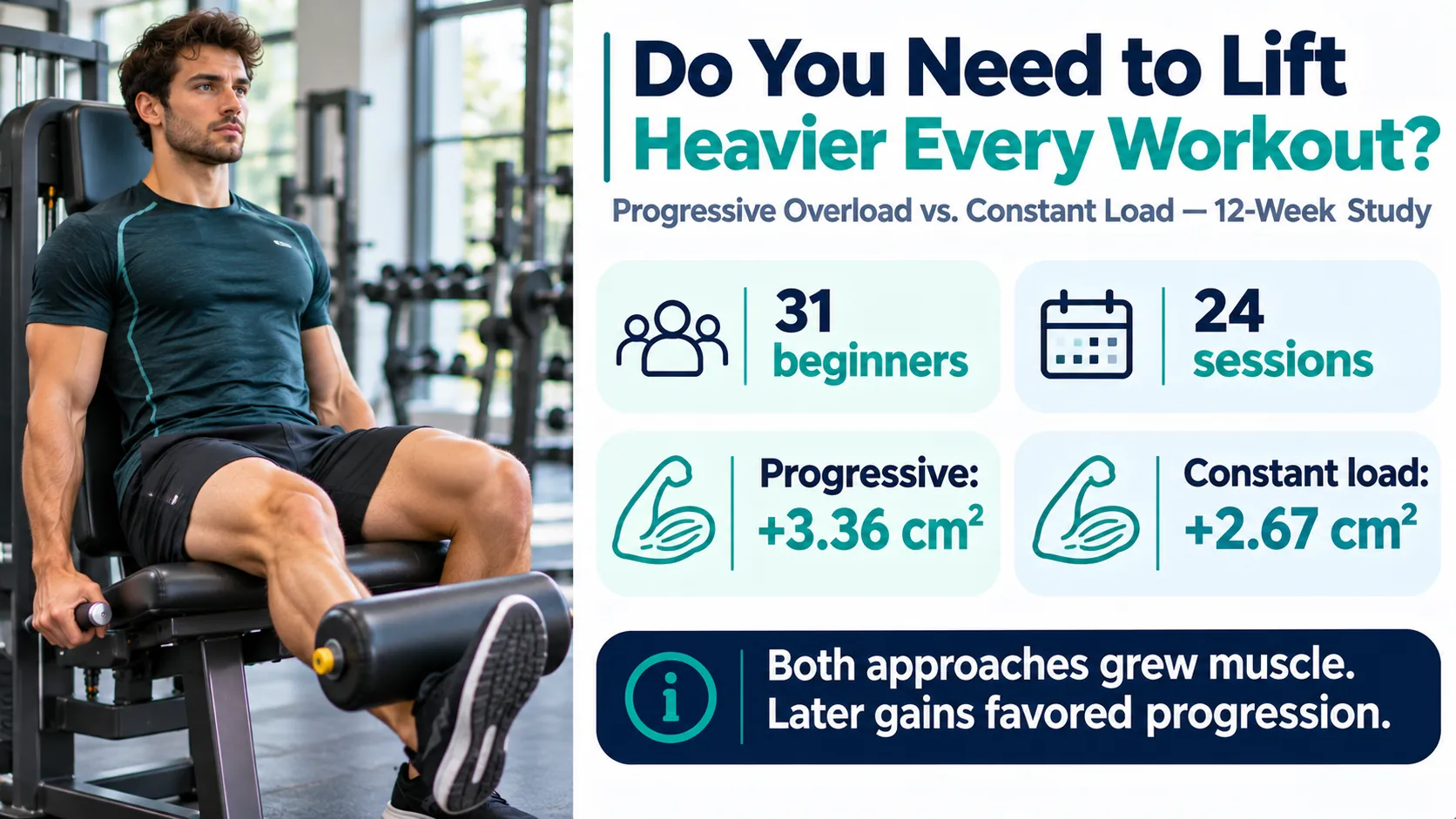
A study published in the International Journal of Sports Medicine on October 15, 2026, examined this question by following muscle growth throughout 12 weeks of resistance training—not simply measuring participants at the beginning and end [1].
The researchers asked 31 previously untrained adults to train one leg with progressively increasing resistance while the other leg continued using the same weight. Both legs grew. The more interesting difference appeared toward the end of the experiment, when the progressively loaded leg continued gaining muscle at a faster rate.
The findings offer a useful answer for beginners: you don’t need to add weight every time you train, but repeating an increasingly easy workout indefinitely may limit further progress.
A Training Experiment Where Each Person Was Their Own Control
Comparing two exercise programs is difficult when the people following them have different genetics, diets, sleeping habits or training histories.
The researchers, led by Otávio Ferrari, used an approach that reduced some of those differences.
Each of the 31 participants trained both legs, but the legs were assigned to different training conditions.
One leg followed a progressive loading protocol, referred to as PROG. The training weight was adjusted over time.
The other leg followed a nonprogressive protocol, N-PROG. Its training weight remained constant throughout the intervention.
Both legs performed unilateral knee extensions for three sets of 10–12 repetitions, twice weekly for 12 weeks.
The exercise was deliberately simple. A leg-extension machine isolates knee extension more than a complex movement such as a squat, making it easier to control the training protocol and measure changes in a specific thigh muscle.
Because the two legs belonged to the same participant, many individual characteristics were shared between conditions.
This is a strength of the design, although it doesn’t eliminate every potential influence. Adaptations in one limb may affect the other through neural or systemic mechanisms.
The researchers were interested in the development of muscle size over time, not merely which leg was bigger after 12 weeks.
Why Measuring Muscle Growth Every Three Weeks Changed the Story
Most people judge a training program by comparing their starting point with their final result.
That approach can miss what happened between those measurements.
Imagine two lifters who finish a program with similar gains. One may have improved steadily throughout. The other might have grown quickly at first and then made little additional progress.
Their final measurements could look similar despite very different training responses.
Ferrari and colleagues assessed muscle cross-sectional area before training and after sessions 6, 12, 18 and 24.
Since participants trained twice weekly, measurements were taken at approximately three-week intervals.
The researchers used ultrasound to assess the cross-sectional area of the vastus lateralis, a muscle on the outer portion of the thigh.
Cross-sectional area describes the size of a muscle in a measured anatomical plane. It is a more specific indicator of local muscle hypertrophy than body weight or thigh circumference.
The repeated measurements allowed the investigators to examine when the training protocols began producing different growth patterns.
This was the experiment’s most useful feature.
Both Training Programs Built Muscle
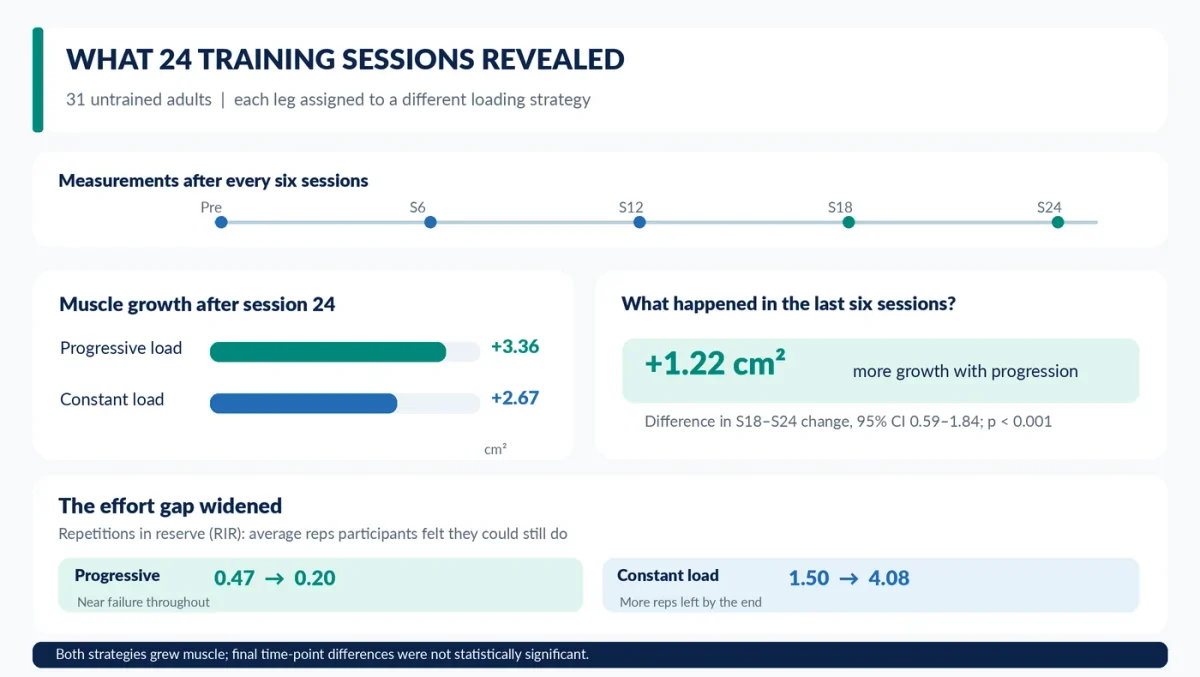
After 24 training sessions, both legs had increased in muscle cross-sectional area.
| Training condition | Mean increase in muscle cross-sectional area |
|---|---|
| Progressive loading | +3.36 cm² |
| Constant loading | +2.67 cm² |
The values represent average changes from baseline, not percentage increases.
The progressive condition showed a numerically larger overall gain. However, the researchers did not detect statistically significant differences between protocols at the individual measurement time points.
That distinction prevents us from simply declaring the progressive program the clear winner at week 12.
The overall analysis did reveal a significant interaction between training protocol and time (p = 0.002). In other words, muscle growth followed different patterns across the intervention.
More specifically, the difference in muscle growth between sessions 18 and 24 favored progressive loading.
During that final six-session period, the progressive condition gained an average of 1.22 cm² more muscle cross-sectional area than the constant-load condition.
The 95% confidence interval ranged from 0.59 to 1.84 cm², and the difference was statistically significant (p < 0.001).
That is the crucial finding.
Both approaches worked initially, but the growth response was more favorable to progressive loading during the final three weeks.
Why the Same Weight Gradually Became Easier
A fixed training weight doesn’t necessarily provide a fixed training stimulus.
Suppose someone starts leg extensions with a weight that allows twelve repetitions and almost nothing more.
After several weeks, that person might be capable of completing sixteen repetitions with the same resistance.
If the program still asks for twelve, the set now finishes several repetitions farther from muscular failure.
The weight hasn’t changed, but its difficulty relative to the person’s current ability has.
The researchers tracked this using repetitions in reserve, or RIR.
RIR estimates how many additional repetitions a person could complete before reaching muscular failure.
A set ending at 1 RIR means the athlete believes approximately one more repetition was possible. A set ending at 4 RIR leaves substantially more unused repetition capacity.
The contrast between training conditions became increasingly apparent.
| Training condition | Session 1 RIR | Session 24 RIR |
|---|---|---|
| Progressive loading | 0.47 | 0.20 |
| Constant loading | 1.50 | 4.08 |
The progressive leg remained close to muscular failure throughout the intervention.
The constant-load leg, meanwhile, finished the program with considerably more repetitions left in reserve.
That makes the results easier to understand.
The progressive protocol continued to provide a demanding workout. The fixed-load protocol became less challenging as participants adapted.
However, this also creates an important limitation: the study cannot establish whether heavier resistance itself was the decisive factor, because relative effort changed alongside the load.
The Study Didn’t Isolate Weight Progression From Training Effort
It’s tempting to look at the results and conclude that adding kilograms directly caused the additional late-stage muscle growth.
The evidence isn’t quite that specific.
The progressive condition differed from the constant-load condition in several ways.
Participants lifted progressively heavier weights, accumulated a greater overall volume load and reported higher perceived exertion.
Volume load describes the amount of resistance work performed, commonly calculated from sets, repetitions and weight.
When the weight increases while repetitions remain relatively similar, volume load generally rises.
The progressive protocol therefore combined increased resistance with a greater workload and sustained proximity to failure.
Those factors were not independently manipulated.
The researchers could not determine whether the late difference resulted primarily from heavier loads, higher total volume load, greater relative effort or their combined influence.
Nor can we conclude that adding weight is the only effective way to sustain hypertrophy.
The study supports the importance of maintaining a meaningful training stimulus. It does not establish that one specific progression variable must always be increased.
Do Beginners Need to Increase Weight Every Session?
No. That would take the findings further than the experiment supports.
The study lasted 12 weeks, and the progressive protocol adjusted resistance as participants developed the capacity to complete the prescribed repetitions.
It did not demonstrate that increasing weight after every single workout is necessary or optimal.
For beginners, early improvements can happen quickly. Someone may become more comfortable with an exercise, learn better technique and gain repetition capacity before needing a heavier load.
Increasing resistance before the movement is controlled can also make progress harder to assess.
Consider a hypothetical leg-extension program with a target of three sets of 8–12 repetitions.
A lifter might begin with three sets of eight using a manageable weight.
Over the following sessions, the same resistance could produce sets of nine, ten and eventually twelve repetitions without sacrificing technique.
Only then might a modest weight increase be appropriate, with repetitions returning toward the lower end of the range.
This approach is known as double progression.
It is a practical programming example rather than the exact method tested in the Ferrari study.
For readers who want a more detailed explanation, FitnessProgramer’s guide to when and how much weight to increase covers progression strategies based on repetitions, performance and perceived effort.
The point is not to increase resistance as quickly as possible. It’s to prevent a once-demanding training stimulus from becoming permanently easy.
Does Keeping the Same Weight Mean You’re Not Progressing?
Not necessarily.
A person may improve repetition performance while keeping the external load unchanged.
For example, increasing from eight to twelve well-controlled repetitions demonstrates an improvement in exercise performance.
Greater range of motion, better movement consistency or reduced reliance on momentum may also make an exercise more demanding.
These changes have practical value, although they should not automatically be treated as equivalent to increasing weight.
The key distinction in the Ferrari experiment is that the constant-load condition did not continually raise the challenge as participants became more capable.
By session 24, those sets were ending with an average of approximately four repetitions in reserve.
It is possible to continue making progress using a familiar weight, particularly if repetitions, range of motion or another meaningful variable changes.
What becomes less convincing is the idea that an unchanged weight, unchanged repetitions and declining effort will remain equally effective indefinitely.
FitnessProgramer’s Progressive Overload: The Simple Secret to Building More Muscle explains the broader principle and several ways to apply it.
The Ferrari study supplies a more specific piece of evidence: when load progression maintained training difficulty, later muscle-growth responses were more favorable than when the workload was allowed to become easier.
Why More Training Isn’t Always the Answer
When progress slows, a common response is to add another exercise or another set.
But progression and training volume are not the same thing.
An athlete who already performs a substantial amount of hard training may not benefit from continually expanding the number of sets.
Additional work can create more fatigue, extend training sessions and place greater demands on recovery.
A previous study discussed in FitnessProgramer’s training volume and hypertrophy analysis investigated what happened when trained participants increased an already demanding workload.
That research did not establish that adding substantially more volume necessarily produced greater hypertrophy.
The two studies address different circumstances.
Ferrari and colleagues examined beginners whose fixed training load became less challenging. The volume study investigated experienced lifters already performing considerable amounts of training.
For a beginner, the appropriate adjustment may be to increase resistance once the current weight becomes easy.
For an experienced athlete who is already training hard, adding more sets may not be the best first response.
The useful lesson is to identify what has changed in the training stimulus before deciding how to modify the program.
How This Compares With Earlier Progressive Overload Research
The Ferrari study builds on an increasingly interesting body of research questioning what progressive overload actually contributes to hypertrophy.
A separate 2026 randomized study by Kassiano and colleagues followed previously untrained women and compared progressive with nonprogressive resistance exercise in the arms [2].
Both training approaches produced triceps muscle growth, but the progressive condition generated greater hypertrophy over the eight-week intervention.
FitnessProgramer covered those findings in Does Progressive Overload Build More Muscle? What a 2026 Study Found.
The two experiments are related, but they are not duplicates.
Kassiano and colleagues examined the magnitude of adaptation over eight weeks.
Ferrari and colleagues investigated the time course of adaptation, assessing muscle size at repeated intervals throughout 12 weeks.
One helps answer whether progression can produce greater muscle growth. The other provides evidence about when differences in growth may begin to emerge.
Both also show that muscle growth can occur without systematic load progression, particularly in previously untrained people.
A separate investigation involving trained adults compared progression through additional repetitions with progression through heavier loads [3]. It provides further context for why progressive overload should not be reduced to adding weight alone.
These studies do not establish a single ideal progression model for every person. They suggest that continued training adaptation depends on maintaining an appropriate challenge as performance improves.
What About Repetitions in Reserve?
RIR is useful because the external weight alone doesn’t tell a coach how difficult a set has become.
Two people might use the same machine with the same load, yet one could be approaching failure while the other has six repetitions left.
Even for the same person, a weight that was demanding last month may now be relatively easy.
Tracking RIR can help reveal that change.
But perceived repetitions in reserve is an estimate, not a direct physiological measurement.
Beginners may struggle to judge how close they are to failure, particularly before they become familiar with a movement.
The accuracy of an RIR estimate can also vary between exercises and with fatigue.
This means RIR should inform programming rather than become a rigid target that must be achieved perfectly.
The study’s progressive group trained very close to failure. That does not prove that beginners must take every set to failure to build muscle.
Nor does it establish that an average of four repetitions in reserve is universally insufficient for hypertrophy.
The results concern the specific combination of loading, repetitions and effort used in this experiment.
A useful practical approach is to monitor whether the same workload is becoming markedly easier over several sessions, while also considering technique, recovery and the athlete’s overall progress.
What the Study Can’t Tell Us
The experiment has several strengths, especially its within-participant design and repeated measurements of muscle cross-sectional area.
Yet it was still a relatively small trial involving 31 untrained young adults.
Participants performed only unilateral knee extensions. The results may not extend directly to multi-joint movements such as squats, deadlifts or bench presses.
The researchers measured a specific region of the vastus lateralis. They did not establish whether the same time course would occur in every muscle group.
The intervention also lasted 12 weeks.
That period was long enough to reveal an interesting difference in late-stage hypertrophy, but it cannot tell us how the two approaches would compare after six months or several years.
There is also the question of effort and volume load.
Because those variables differed between protocols, the results cannot identify the independent effect of increasing resistance while holding all other training characteristics constant.
The study’s results should not be turned into a universal claim that a fixed weight stops producing muscle growth after nine weeks.
The investigators observed a more favorable increase with progression during the final six sessions of this particular intervention.
Different starting loads, repetition targets, training histories or exercise selections might produce a different time course.
What to Do When Your Workout Starts Feeling Too Easy
The simplest application of this research is to keep a reliable training record.
Note the load, repetitions and how difficult the working sets felt. You don’t need elaborate technology to notice when a weight that once demanded considerable effort has become comfortable.
If technique is stable and the prescribed repetition range is becoming easy, consider a modest progression.
That may mean increasing resistance, performing more repetitions within an appropriate range or selecting a more challenging variation.
If performance has stalled while fatigue is rising, adding weight automatically may be the wrong decision. Recovery, training volume and consistency deserve attention too.
The goal is not to make every workout harder than the previous one at any cost.
It is to ensure that the program continues to provide a useful stimulus as the body adapts.
The Ferrari study gives that principle a clearer timeline.
During the early part of the intervention, even an unchanged load was sufficient to produce measurable muscle growth. Later, the progressively loaded condition maintained a more demanding stimulus and showed greater growth during the final six sessions.
For someone new to resistance training, the implication is reassuring: you can spend time learning an exercise and building repetition capacity before adding weight.
Just don’t confuse repeating the same workout with maintaining the same training challenge.
References
[1] Ferrari O, Silva DG, Camargo JBB, Bergamasco JGA, Bittencourt D, Iasulaitis M, Pereira BKR, Melo ACC, Nacafucasaco ETA, Rebelatto M, Libardi CA. (2026). Time Course of Muscle Hypertrophy With and Without Progressive Overload. International Journal of Sports Medicine. Published online October 15, 2026. https://doi.org/10.1055/a-2980-6473
[2] Kassiano W, et al. (2026). Progressive Overload Affects the Magnitude of Muscle Hypertrophy. Medicine & Science in Sports & Exercise, 58(7), 1556–1565. https://doi.org/10.1249/MSS.0000000000003968
[3] Plotkin DL, et al. (2022). Progressive overload without progressing load? The effects of load or repetition progression on muscular adaptations. PeerJ, 10, e14142. https://doi.org/10.7717/peerj.14142