Training volume is one of the main variables lifters adjust when muscle growth slows. Adding another set of squats, an extra hamstring exercise, or a second leg session may seem like a reasonable way to stimulate further progress. Yet there is a point where additional training becomes increasingly difficult to justify, particularly when the existing workload is already high.
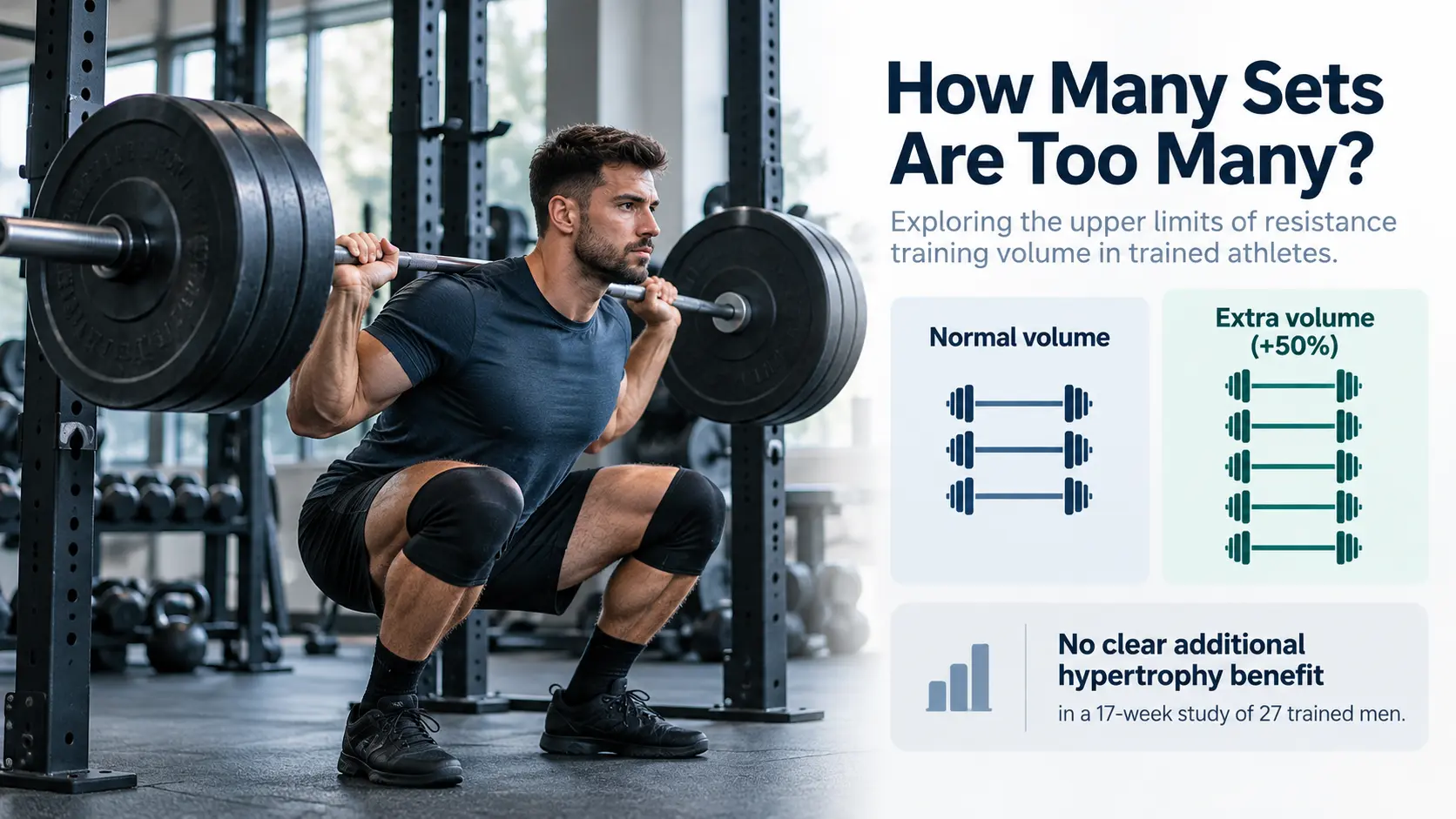
A 2026 study published in the Journal of Science in Sport and Exercise examined this question in 27 strength-trained male athletes. Researchers compared a normal-volume program with one involving approximately 50% more weekly sets. After seven weeks of additional training, the higher-volume group did not achieve statistically significant greater muscle growth or overall strength improvements [1].
The findings suggest that increasing an already demanding training volume may offer little additional benefit, although the study does not establish a universal maximum number of sets for hypertrophy.
For experienced lifters, the useful question is how much productive training they can perform and recover from, rather than how many sets they can fit into a week.
What Is Training Volume in Resistance Training?
Training volume describes the amount of resistance exercise performed over a specified period. Coaches commonly measure it using the number of working sets completed per muscle group each week.
For example, someone who performs four sets of squats, three sets of leg presses, and three sets of leg extensions has completed ten exercise sets involving the quadriceps. However, those exercises differ in how much loading they distribute across the quadriceps, glutes, and other involved muscles.
This makes set counting useful but imperfect.
Training volume can also be expressed as volume load, calculated by multiplying sets, repetitions, and weight lifted. That measurement provides different information because two programs with identical set counts may involve substantially different total loads.
For hypertrophy programming, weekly hard sets are commonly used because they are relatively easy to track. Their value depends on how the sets are performed.
A challenging set of squats and a light warm-up set should not automatically be treated as equivalent. Exercise selection, range of motion, proximity to failure, and the muscles involved also influence the training stimulus.
The distinction becomes especially relevant when interpreting research involving unusually high set volumes.
How the 17-Week Study Was Designed
Aapo Räntilä and Juha P. Ahtiainen investigated whether exceptionally high resistance training volumes would improve muscle hypertrophy and strength in trained male athletes [1].
The study lasted 17 weeks and involved two phases.
All 27 participants completed an initial ten-week resistance training intervention.
The program emphasized lower-body training, including back squats, deadlifts, and accessory exercises. Weekly training volume increased across the intervention, with planned reductions during selected weeks to facilitate recovery.
The researchers assessed muscle thickness and several measures of strength and performance.
This initial phase also allowed them to identify participants whose vastus lateralis muscle thickness had not increased beyond the study’s measurement-error threshold.
The Final Seven Weeks: Normal vs. Extra Volume
Following the initial phase, participants were divided into two groups:
- Normal volume (NOR): 12 athletes continued with the lower-volume training condition.
- Extra volume (XTR): 15 athletes performed approximately 1.5 times as many weekly sets.
The extra-volume condition progressed toward approximately 58–63 weekly sets in the researchers’ training-volume accounting.
This was an exceptionally high workload for a longitudinal resistance training intervention.
Importantly, the reported set totals came from a program involving multiple exercises and overlapping muscle demands. They should not be interpreted as 60 separate isolation sets for each individual muscle.
The researchers measured vastus lateralis and biceps femoris thickness using ultrasound. Strength and performance assessments included back squat, deadlift, isometric squat, broad jump, and peak power.
Upper-body training was also included in the participants’ routines, but upper-body hypertrophy was not an outcome of this investigation.
What Happened During the First 10 Weeks?
Before the two volume conditions were compared, the participants had already made measurable progress during the initial training intervention.
Vastus lateralis thickness increased by an average of approximately 7.0% from baseline to the ten-week measurement, while biceps femoris thickness increased by approximately 8.6% [1].
Back squat and deadlift strength also improved substantially.
The researchers reported average improvements of approximately 19.1% in back squat and 12.5% in deadlift strength during the initial phase.
These findings establish that the participants were responding to the training program before the additional volume was introduced.
They also provide context for the later results. The athletes were not moving from a minimal exercise routine to a moderately demanding program. They had already completed ten weeks of structured training with considerable weekly volume.
Increasing training volume under these conditions may produce a different response from increasing it in someone performing only a few sets per muscle each week.
Did 50% More Training Volume Produce More Muscle Growth?
During the final seven weeks, the extra-volume group showed an average vastus lateralis thickness increase of 2.1%, compared with 0.6% in the normal-volume group [1].
Although the numerical change was larger in the extra-volume group, the difference between groups was not statistically significant.
Biceps femoris thickness also showed a numerical tendency toward greater improvement in the extra-volume group, but this difference was not statistically significant.
The results therefore did not demonstrate that the additional training volume produced greater hypertrophy.
This distinction matters when interpreting small experimental studies. A numerical difference between group averages does not automatically establish that one intervention is superior.
Individual results varied considerably, and the relatively small sample limited the researchers’ ability to detect smaller differences reliably.
The study supports a narrower conclusion: in these trained athletes, the substantial increase in weekly sets did not produce a clearly demonstrated hypertrophy advantage over seven weeks.
It does not prove that the two approaches would produce identical results in every population or over a longer period.
Did Higher Volume Improve Strength?
The strength findings followed a similar pattern, with one notable exception.
Back squat strength improved by approximately 5.8% in the normal-volume group and 5.7% in the extra-volume group during the final intervention [1].
The difference between groups was negligible.
Deadlift performance, however, favored the normal-volume condition.
The researchers reported a 6.3% improvement in deadlift strength in the normal-volume group compared with 4.25% in the extra-volume group. The between-group difference was statistically significant.
This result suggests that adding substantial training volume did not improve deadlift performance and may have been less favorable than maintaining the lower workload under the conditions tested.
One possible explanation is that additional fatigue affected the ability to express or develop maximal strength. However, the study did not directly establish fatigue as the cause of the difference.
The researchers also did not demonstrate that lower volume is always superior for deadlift training.
Strength adaptations depend on several programming variables, including loading intensity, exercise practice, technical proficiency, and recovery. Set volume is only one part of that process.
Can Extra Sets Help Athletes Who Are Not Growing?
One of the study’s more unusual questions concerned participants who showed little measurable muscle growth during the first ten weeks.
The researchers classified participants according to whether changes in vastus lateralis thickness exceeded twice the typical measurement error.
Fourteen of the 27 athletes did not exceed this threshold during the initial phase.
These participants were classified as non-responders for that particular measurement and period.
The classification does not mean that their bodies were incapable of building muscle. It means their measured vastus lateralis thickness did not change enough to exceed the predefined threshold.
Among these participants, increasing training volume did not produce statistically significant greater vastus lateralis growth.
The normal-volume group showed an average increase of 3.8% during the additional intervention, compared with 3.2% in the extra-volume group [1].
The extra workload therefore did not reliably convert previously low-response participants into greater hypertrophy responders.
This finding is relevant to lifters who automatically add more sets when their progress stalls.
A lack of measurable progress can have several possible explanations, including insufficient training stimulus, limited recovery, nutritional factors, or ordinary variation in measurements.
The correct adjustment depends on the reason progress has slowed.
Does This Mean More Than 20 Sets per Week Is Too Much?
No. The study does not establish 20 sets, 30 sets, or any other single number as the upper limit for muscle hypertrophy.
Its participants were trained athletes completing a demanding program, and the investigators compared two relatively high training-volume conditions.
The study did not directly compare every possible weekly set range.
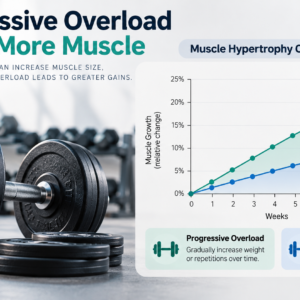
Research on resistance training volume has generally found that performing more sets can increase hypertrophy, particularly when comparing lower and moderate workloads.
A 2017 systematic review and meta-analysis by Schoenfeld and colleagues found evidence of a dose-response relationship between weekly resistance training volume and muscle growth [2].
A more recent dose-response meta-regression by Pelland and colleagues also examined how weekly volume and training frequency relate to hypertrophy and strength adaptations, while emphasizing diminishing returns as volume increases [3].
These findings are compatible with the 2026 experiment.
Increasing volume from a relatively low starting point may provide a meaningful additional stimulus. Increasing an already high workload by another 50% may have a much smaller effect.
The exact point at which additional sets become less productive will vary between individuals and training programs.
Why Additional Sets May Produce Diminishing Returns
Each challenging resistance training set contributes some combination of muscular loading, fatigue, and recovery demand.
Early sets in a workout are generally performed when the athlete is relatively fresh. As training continues, the ability to maintain repetition performance may decline.
Additional sets can still provide a useful stimulus, but they also require time and recovery resources.
Consider a lifter performing four challenging sets of squats.
Adding another two sets may be manageable, particularly if the original workload was relatively low.
Adding ten more demanding sets after an already extensive lower-body session creates a different situation. The additional work may affect exercise performance and recovery across subsequent sessions.
This example illustrates a programming consideration rather than a numerical threshold established by the featured study.
The relationship between training volume and hypertrophy is unlikely to remain linear indefinitely.
At higher workloads, the benefit of each additional set may become progressively smaller. Some athletes may also experience declining performance if their training demands exceed their ability to recover.
However, the 2026 study did not directly measure a universal fatigue threshold or establish the exact biological mechanism responsible for the observed results.
How Many Weekly Sets Should You Actually Perform?
The appropriate number of weekly sets depends on training experience, exercise selection, effort, recovery, and the muscle groups being trained.
For many lifters, a moderate starting volume is easier to evaluate than immediately adopting an unusually high-volume program.
A commonly used programming approach is to begin with a manageable number of challenging sets per muscle group and adjust based on results.
For example, approximately 10–15 weekly sets per muscle group can serve as a reasonable starting range for some intermediate hypertrophy programs. This is a coaching example, not an optimum established by the 2026 experiment.
Some individuals may progress with fewer sets, while others may benefit from more.
The researchers themselves discussed a possible effective range around 9–15 weekly sets in the context of their findings, but this should not be interpreted as a definitive recommendation for every muscle or athlete [1].
A better method is to evaluate whether the current workload is producing progress before increasing it.
If muscle size, repetition performance, or strength is improving consistently, adding volume may be unnecessary.
If progress has slowed over several weeks, reviewing the existing program is more informative than immediately adding sets.
For a broader explanation of how sets, repetitions, intensity, and frequency fit together, see our guide to building a bodybuilding program.
How to Tell When Your Training Volume Is Too High
Excessive training volume does not always produce one obvious symptom.
A demanding workout can cause temporary fatigue without indicating that the overall program is inappropriate.
More useful information comes from patterns observed across several training sessions.
Repeated declines in performance, difficulty completing previously manageable workloads, and persistent soreness that interferes with subsequent sessions may indicate that training demands need adjustment.
Recovery outside the gym also matters.
Sleep, nutritional intake, other physical activities, and psychological stress can influence how much training an athlete tolerates.
A lifter performing physically demanding work throughout the day may recover differently from someone with a less active routine.
Before increasing weekly sets, consider whether the existing sets are performed with consistent technique and sufficient effort.
Also examine whether the program distributes demanding exercises sensibly throughout the week.
A high number of sets concentrated into one session may create different fatigue demands from a similar workload distributed across multiple sessions.
These factors were not isolated experimentally in the featured study, so they should be treated as broader programming considerations.
What the Study Means for High-Volume Programs
High-volume methods remain popular in bodybuilding, particularly among lifters who associate long workouts with greater muscle-building potential.
German Volume Training, for example, traditionally emphasizes ten sets of ten repetitions for selected exercises.
Such programs can create substantial training demands, but their popularity does not establish that they are superior to lower-volume alternatives.
The 2026 findings provide another reason to examine whether additional sets produce measurable improvements rather than assuming they are necessary.
For readers interested in a specific high-volume approach, our German Volume Training guide explains the structure of 10×10 training and its programming considerations.
The new study did not directly test German Volume Training, so its results should not be presented as a head-to-head comparison with that method.
Its relevance is the broader observation that exceptionally high training volumes did not produce additional measurable benefits in the athletes studied.
A Better Way to Adjust Weekly Training Volume
Training volume should be adjusted using performance and recovery information collected over time.
Suppose an intermediate lifter completes twelve challenging weekly sets for the quadriceps and has followed the same program consistently for several weeks.
If strength and muscle measurements are improving, there may be little reason to increase the workload.
If progress has genuinely stalled, the lifter can first review exercise execution, training intensity, nutrition, and recovery.
When those factors are reasonably consistent, a small increase in weekly volume may be worth testing.
For example, increasing from twelve to fourteen sets provides a more controlled adjustment than immediately doubling the workload.
The lifter can then observe whether the change improves performance or muscle development over an appropriate period.
This gradual approach makes it easier to identify useful changes without introducing unnecessary fatigue.
The example is not a protocol validated by the featured study. It is a way of applying its findings cautiously to ordinary resistance training.
Training logs can help identify trends, but changes in muscle size should not be judged from day-to-day appearance alone.
Body weight, hydration, exercise performance, and measurement conditions can all influence how progress appears over short periods.
Important Limitations of the Research
The study provides direct experimental evidence in trained athletes, but its conclusions require several qualifications.
Only 27 male participants completed the intervention, with 12 assigned to normal volume and 15 to extra volume. These group sizes limited the ability to detect small differences.
Muscle hypertrophy was assessed using ultrasound measurements of the vastus lateralis and biceps femoris. Changes in other muscles or at different regions of the same muscles may not have been captured.
The researchers did not control dietary intake, which could have influenced adaptation and recovery.
Participants also continued sport-specific practices outside the resistance training program, introducing additional physical demands that were not fully controlled.
The allocation process included some nonrandom assignment when participant numbers were uneven, and the researchers were not blinded to group allocation.
The final comparison lasted seven weeks. Longer interventions might produce different results.
Finally, the study quantified training volume primarily through set counts. This does not fully capture differences in load, movement distance, or total mechanical work.
These limitations do not invalidate the findings. They define what the experiment can reasonably tell us.
The absence of statistically significant hypertrophy differences does not prove that the two programs are equivalent, particularly given the small sample and variability in individual responses.
Frequently Asked Questions
Is 20 Sets per Muscle per Week Too Much?
Not necessarily. Twenty weekly sets may be manageable for some experienced lifters, depending on exercise selection, effort, and recovery. The featured study did not establish 20 sets as an upper limit for hypertrophy.
Will Doing More Sets Always Build More Muscle?
No. The 2026 study found no statistically significant additional hypertrophy benefit when already high training volume was increased by approximately 50%. The benefit of extra sets depends on the starting workload and individual response [1].
Can High Training Volume Reduce Strength Gains?
It may under some conditions. In the featured study, deadlift strength improved more in the normal-volume group than in the extra-volume group. The researchers did not establish whether fatigue or another factor caused this difference.
Should You Increase Volume When Muscle Growth Stalls?
Increasing volume is one possible adjustment, but it should not be automatic. Review training consistency, load progression, exercise technique, nutrition, and recovery first. The study found that extra volume did not reliably improve outcomes among participants classified as low responders.
What Is the Best Weekly Training Volume for Hypertrophy?
There is no universally established optimum. Research supports the value of sufficient weekly training volume, but individual needs vary. A moderate workload that produces measurable progress and allows recovery is generally a more useful starting point than immediately adopting extreme set counts.
Finding the Point Where More Training Stops Helping
The experiment by Räntilä and Ahtiainen adds useful evidence to the discussion of resistance training volume.
Its athletes made substantial progress during the initial ten weeks. When the researchers increased an already demanding workload by approximately 50%, the additional sets did not produce a statistically significant hypertrophy advantage or greater overall strength development. Deadlift improvements favored the lower-volume condition [1].
The findings are especially relevant to experienced lifters who respond to stalled progress by continually adding exercises and sets.
A training program needs enough work to stimulate adaptation, but the value of additional volume should be judged by what it produces.
When an athlete is already training hard, improving recovery, adjusting exercise selection, or refining progression may be more useful than increasing the number of sets.
The aim is to find a workload that produces continued improvement without requiring more training than the athlete can use productively.
References
- Räntilä, A., & Ahtiainen, J. P. (2026). Exploring the Upper Limits of Resistance Training Volume for Muscle Hypertrophy and Strength in Trained Athletes. Journal of Science in Sport and Exercise. Published July 13, 2026. DOI: https://doi.org/10.1007/s42978-026-00387-7
- Schoenfeld, B. J., Ogborn, D., & Krieger, J. W. (2017). Dose-response relationship between weekly resistance training volume and increases in muscle mass: A systematic review and meta-analysis. Journal of Sports Sciences, 35, 1073–1082. https://doi.org/10.1080/02640414.2016.1210197
- Pelland, J. C., Remmert, J. F., Robinson, Z. P., Hinson, S. R., & Zourdos, M. C. (2026). The Resistance Training Dose Response: Meta-Regressions Exploring the Effects of Weekly Volume and Frequency on Muscle Hypertrophy and Strength Gains. Sports Medicine, 56, 481–505. https://doi.org/10.1007/s40279-025-02344-w