Full-range repetitions have long been a standard recommendation in resistance training. Moving through a complete, controlled range of motion develops strength across different joint positions and gives lifters a consistent way to perform and track an exercise.
But does every repetition need to cover the full range to stimulate muscle growth?
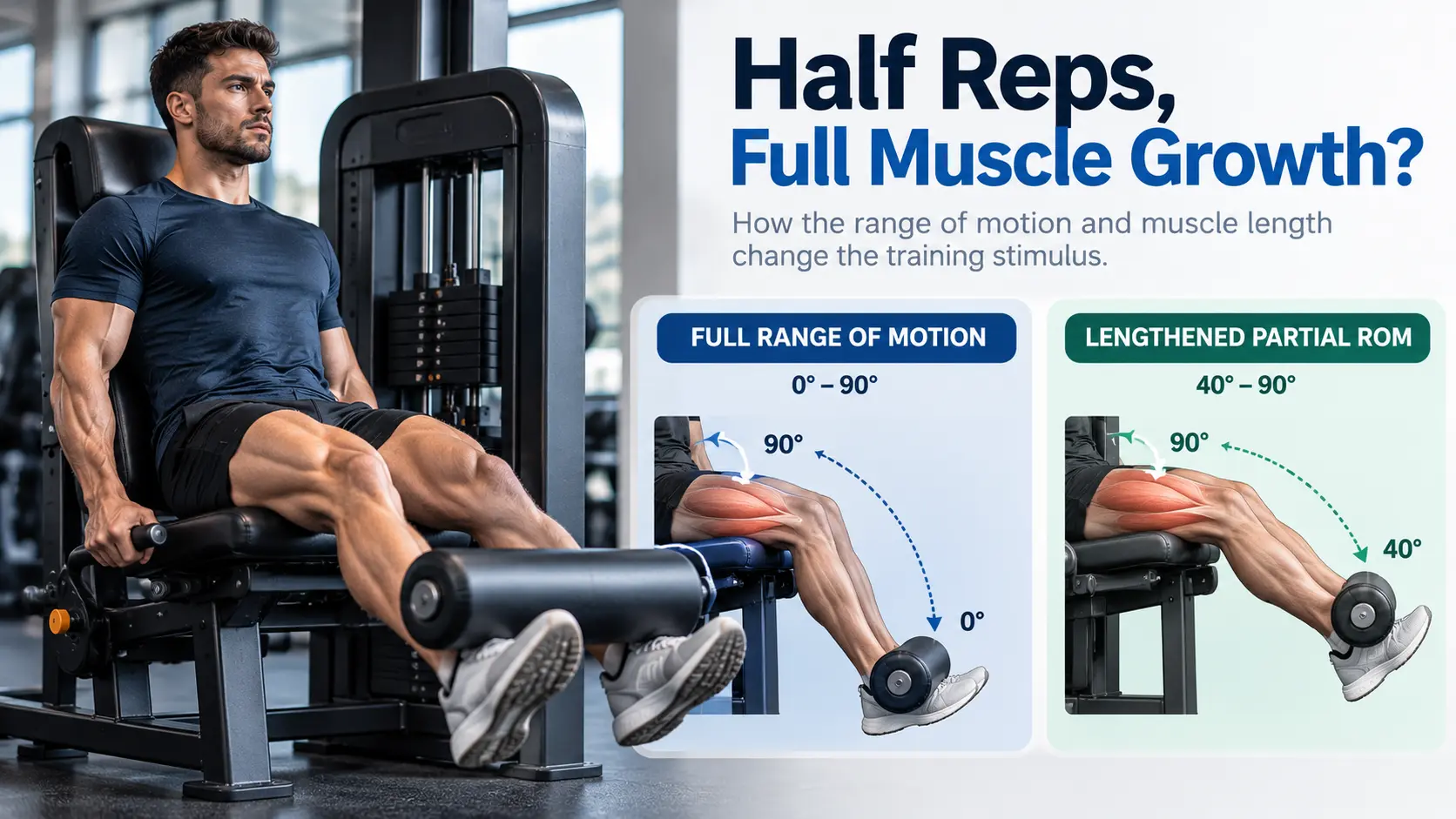
Recent research suggests that lengthened partials, or repetitions performed primarily where the target muscle is stretched, can produce muscle growth comparable to full-range training in certain exercises. The important distinction is not simply whether a repetition is complete. It is which portion of the movement is being trained and how much mechanical tension the muscle experiences there.
What Are Lengthened Partials?
A lengthened partial is a repetition performed through a limited range of motion while keeping the target muscle relatively elongated.
Consider a biceps curl. Instead of curling the weight all the way toward the shoulder, you work through the lower portion of the movement, where the elbow is more extended and the biceps are generally longer.
This differs from shortened partials, which emphasize the opposite end of the movement.
Both approaches reduce the distance the weight travels, but they do not necessarily produce the same training stimulus. Muscle length, joint angle, exercise mechanics and resistance all influence how demanding a partial repetition becomes.
A lengthened partial is therefore not just an incomplete repetition. It is a deliberate choice to train a particular region of an exercise’s range of motion.
What Does the Latest Research Show?
A 2026 study by McMahon and colleagues investigated whether training at longer muscle lengths could produce adaptations similar to conventional full-range resistance training.
Forty-five participants were assigned to four groups: lengthened partials, shortened partials, full-range training or a control condition. The training groups performed knee-extension exercise over eight weeks.
The researchers used different loading conditions. The lengthened-partial group trained at 55% of one-repetition maximum, while the full-range and shortened-partial groups used 80%.
Muscle thickness and architectural characteristics of the vastus lateralis, a major quadriceps muscle, were measured at multiple locations along the thigh.
The findings were notable. Lengthened partials and full-range repetitions produced no statistically significant differences in muscle-thickness changes at the measured sites. Both approaches also outperformed shortened partials at certain measurement locations.
Lengthened partials produced greater increases in muscle fascicle length than full-range training at two measured sites, suggesting that the adaptations were not identical even when muscle-thickness outcomes were similar.
These results challenge the assumption that full-range repetitions are always necessary for substantial hypertrophy.
However, the study does not establish that lighter lengthened partials are universally equivalent to heavier full-range training. The groups differed in both movement range and load, and the findings concern a particular muscle and exercise over eight weeks.
Why Might Training at Longer Muscle Lengths Be Effective?
Muscles generate force under different mechanical conditions throughout an exercise. Their ability to produce tension changes with muscle length, joint position and the external resistance.
In some movements, the stretched portion creates substantial mechanical demands on the target muscle. Training repeatedly in that position may provide a strong hypertrophic stimulus without requiring the entire movement.
A 2026 systematic review and meta-analysis by Strey and colleagues examined eight studies comparing partial repetitions at longer and shorter muscle lengths.
Overall, training at longer muscle lengths produced a modest advantage in muscle hypertrophy over training at shorter lengths. Some regional measurements also favored the longer-length approach.
This supports an important distinction: where a partial repetition occurs matters more than simply calling it a half rep.
Still, training a muscle in a stretched position does not automatically guarantee superior growth. Some exercises provide relatively little resistance at their longest muscle lengths. The external load must create meaningful tension in the relevant portion of the movement.
Are Lengthened Partials Better Than Full Range of Motion?
The available evidence does not justify a universal answer.
A 2025 study by Wolf and colleagues compared lengthened partials with full-range repetitions in 30 resistance-trained participants. Over eight weeks, both approaches produced similar improvements in the measured upper-body muscle thickness and strength-endurance outcomes.
More recently, a 2026 investigation by Plotkin and colleagues examined lower-body training in experienced lifters. Sixteen men completed an eight-week intervention in which one leg trained through a full range and the other used lengthened partials across several exercises.
Both approaches increased vastus lateralis muscle size, with no clear difference between conditions. The study was exploratory, however, and its relatively small sample limits how confidently the findings can be generalized.
Taken together, these studies suggest that lengthened partials can be a legitimate hypertrophy strategy rather than merely a shortcut used when a lifter cannot complete another full repetition.
That does not make full-range training obsolete.
Full-range repetitions expose the body to a broader set of joint angles, allow strength to be practiced across more of the movement and remain useful for developing exercise-specific performance.
For someone whose primary goal is muscle size, lengthened partials may be an alternative in selected exercises. For someone who also wants to improve full-range strength, removing full repetitions entirely would be harder to justify.
How Can You Use Lengthened Partials in Your Workouts?
The most practical approach is to treat lengthened partials as a training option rather than an automatic replacement for every exercise.
Choose movements with meaningful tension in the stretched position. A cable curl, for example, may allow the lifter to emphasize the more extended elbow position, although the exact resistance depends on cable placement.
Keep the repetitions controlled. A shorter movement is not permission to bounce aggressively at the bottom or force a joint beyond a comfortable range.
Use an appropriate load. The weight used for full-range repetitions may not be suitable for partials. Select resistance that allows you to maintain control and consistent positioning.
Track progression within the same movement range. If you use lengthened partials, keep their range reasonably consistent so that changes in repetitions or load represent meaningful progress.
Consider combining both methods. Full-range sets can remain the foundation of an exercise, while selected lengthened-partial sets provide additional work at longer muscle lengths.
There is currently insufficient evidence to prescribe one universally optimal number of lengthened-partial sets or repetitions. Total training volume, proximity to failure, exercise selection and recovery still matter.
What About Strength, Mobility and Injury Risk?
Muscle hypertrophy is only one possible outcome of resistance training.
Strength adaptations are partly specific to the joint angles and movement ranges practiced. Someone training exclusively through a shortened portion of an exercise should not assume that their strength will improve equally across the entire range.
Full-range resistance training may therefore remain especially valuable when the goal includes movement proficiency and strength through a broad range of motion.
Lengthened partials also require sensible progression. Challenging a muscle under load near a stretched position can be demanding, particularly when the movement or range is unfamiliar.
Start with manageable resistance, avoid forcing painful positions and increase training demands gradually. The existing studies do not establish that lengthened partials are inherently safer or more dangerous than full-range repetitions.
Should You Replace Full Reps With Half Reps?
Not necessarily.
The strongest practical message from the research is that full range of motion is not the only effective way to stimulate muscle growth. Lengthened partials can produce comparable hypertrophy in some settings, and partials emphasizing longer muscle lengths generally appear more promising than those restricted to shorter lengths.
But these findings are exercise-specific, and many studies remain relatively short. They do not prove that every muscle, movement or training population will respond identically.
For most lifters, controlled full-range repetitions remain a useful starting point. Lengthened partials can then be introduced where they fit the exercise, training goal and individual’s ability to tolerate the movement.
The question is no longer simply whether half repetitions work. It is whether the portion of the movement being trained provides the stimulus needed for the adaptation you want.
References
- McMahon G, et al. (2026). Moderate Intensity Resistance Training With Partial Range-of-Motion at Long Muscle Lengths Elicits Similar Hypertrophy and Architectural Adaptations as High Intensity Resistance Training Using Full Range-of-Motion. Journal of Strength and Conditioning Research. https://doi.org/10.1519/JSC.0000000000005561
- Strey B, et al. (2026). Muscle hypertrophy from partial repetition at long vs. short muscle length: A systematic review and meta-analysis. Sport Sciences for Health. https://doi.org/10.1007/s11332-025-01586-5
- Wolf M, et al. (2025). Lengthened partial repetitions elicit similar muscular adaptations as full range of motion repetitions during resistance training in trained individuals. PeerJ. https://doi.org/10.7717/peerj.18904
- Plotkin DL, et al. (2026). Acute Molecular and Chronic Vastus Lateralis Adaptations to Lengthened Partial versus Full Range of Motion Resistance Training in Trained Men. Medicine & Science in Sports & Exercise. https://doi.org/10.1249/MSS.0000000000004183