
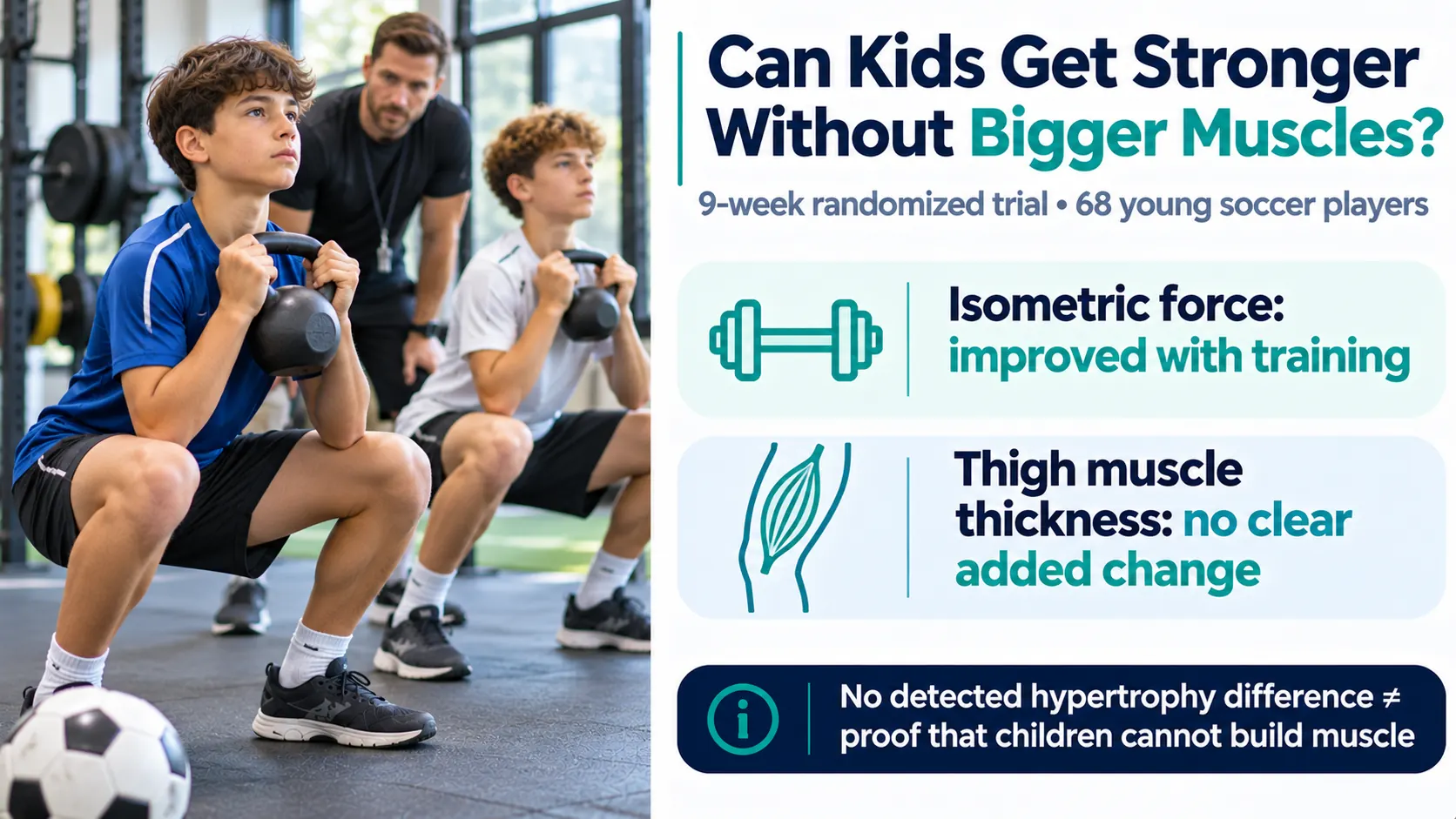
A young footballer returns to training after the summer break. At first, he struggles to hold a strong position during a squat or produce force against a heavy resistance. Several weeks later, the same movements look more controlled, and his strength tests improve.
Has he built bigger muscles?
Possibly. But muscle growth is not the only reason someone becomes stronger.
This question is particularly interesting in children, whose bodies are still developing. Strength gains during childhood have traditionally been attributed largely to changes in coordination, motor learning and the nervous system’s ability to activate muscle. Muscle hypertrophy, meanwhile, has often been treated as something that becomes important only after puberty.
Research has made that explanation less straightforward.
A randomized controlled trial published in the Journal of Strength and Conditioning Research on October 5, 2026, investigated how nine weeks of lower-body resistance training affected strength and muscle thickness in boys before and during puberty [1].
The training groups improved their isometric force production more than boys who continued their usual football training. Yet the researchers did not detect a significant additional increase in the thickness of the thigh muscles they measured.
The result raises an important point for coaches and parents: a child can make measurable progress in strength without showing a corresponding change in muscle size over a short training period.
It does not mean that children are incapable of building muscle.
Why Strength and Muscle Size Don’t Always Change Together
Muscle strength is influenced by more than the amount of muscle tissue a person has.
Muscle size contributes to force-producing capacity, but the nervous system must also coordinate the contraction. The timing of muscle activation, the recruitment of motor units and the ability to stabilize joints all affect how much force someone can express.
Technique matters too.
A child learning a squat may initially have difficulty coordinating the hips, knees and trunk. After repeated practice, the movement becomes more familiar. The child may produce more force simply because the movement is performed more effectively.
These changes can occur before an obvious increase in muscle size.
Adults experience neuromuscular and technical adaptations as well. They are not exclusive to children. However, developing movement skills can be particularly relevant when young athletes are introduced to structured resistance training.
That is why a strength test and a muscle-thickness measurement provide different information.
A strength test asks how much force the athlete can produce under specific conditions.
A muscle-thickness measurement asks whether the dimensions of a particular muscle have changed.
The two outcomes may develop together, but they do not have to change at the same rate.
How the Researchers Designed the Trial
Yannik Komm and colleagues recruited 68 male youth football players and classified them into prepubertal and pubertal groups.
The classification was based on estimated maturity offset, a method used to estimate biological maturation in relation to peak height velocity.
The younger group averaged approximately 11.6 years of age, while the older group averaged 14.3 years.
Within each maturity category, participants were randomly allocated to resistance training or an active control condition.
| Group | Participants |
|---|---|
| Prepubertal resistance training | 19 |
| Prepubertal active control | 20 |
| Pubertal resistance training | 14 |
| Pubertal active control | 15 |
| Total | 68 |
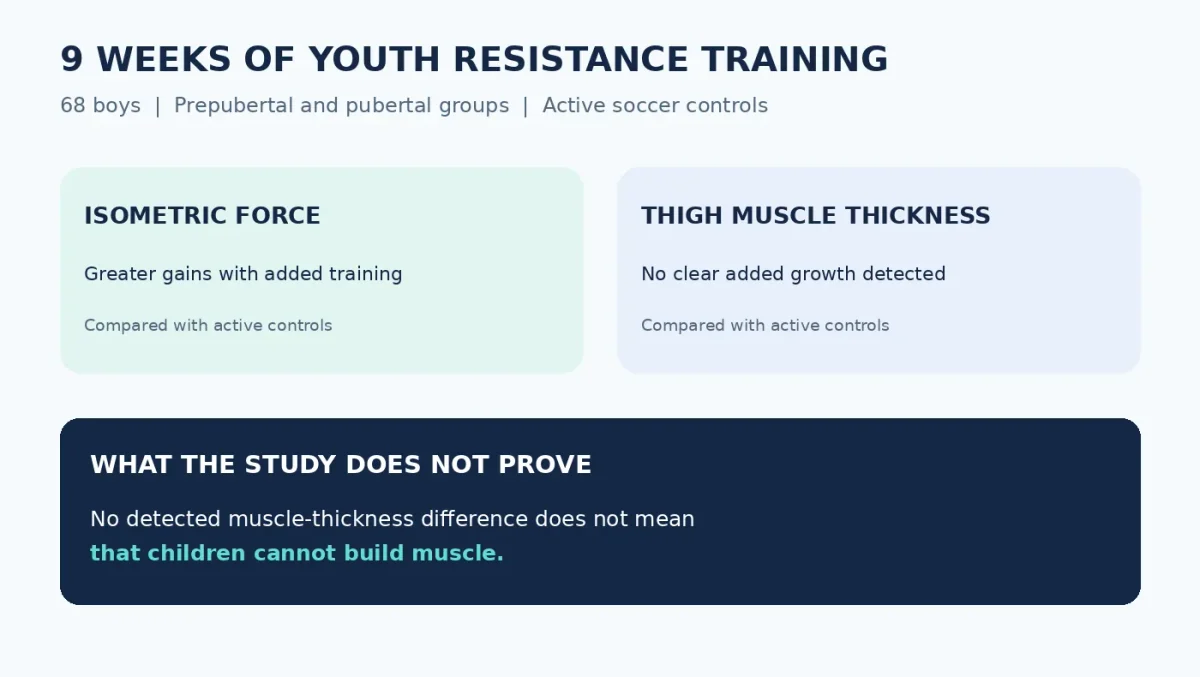
The intervention lasted nine weeks.
Boys in the resistance-training groups completed two lower-body resistance-training sessions each week in addition to their regular football activities.
The active control groups continued their usual football training without the additional resistance-training intervention.
Using active controls was valuable because the researchers were not simply comparing exercise with complete inactivity.
All participants were involved in sport. The central question was whether adding structured resistance training produced adaptations beyond those associated with their regular football activity.
How Strength and Muscle Growth Were Measured
The researchers assessed maximal isometric force using the isometric mid-thigh pull.
During this test, an athlete adopts a standardized pulling position and attempts to produce as much force as possible against an immovable bar.
Because the bar does not move, the test evaluates force production without requiring the athlete to complete a conventional deadlift repetition.
It can be useful for assessing lower-body strength qualities, although performance is influenced by factors such as body position, familiarity with the test and the ability to exert maximal effort.
Muscle thickness was assessed in three quadriceps muscles:
- Rectus femoris
- Vastus intermedius
- Vastus lateralis
These muscles contribute to knee-extension function, while rectus femoris also crosses the hip joint.
The researchers used muscle-thickness measurements as indicators of local morphological adaptation.
Such measurements are useful for detecting changes at specific anatomical sites, but they do not describe the entire muscular system.
A child could potentially experience changes elsewhere that would not be captured by measurements of these three muscles.
What Improved After Nine Weeks?
The most convincing difference appeared in the strength results.
The researchers found a statistically significant interaction between time and intervention for peak isometric force.
The reported p-value was 0.042.
This indicates that the resistance-training groups improved peak force more than the active control groups over the intervention.
The muscle-thickness results were different.
| Outcome | Time × intervention p-value | Interpretation |
|---|---|---|
| Isometric mid-thigh pull peak force | 0.042 | Significant additional strength improvement |
| Rectus femoris and vastus intermedius thickness | 0.295 | No significant additional thickness change |
| Vastus lateralis thickness | 0.711 | No significant additional thickness change |
The results support the effectiveness of the additional resistance-training program for improving the measured isometric force outcome.
They do not establish a corresponding hypertrophy advantage during the nine-week period.
The authors did not conclude that muscle growth is biologically impossible before puberty. Their conclusion was limited to the absence of a significant muscle-thickness effect under the conditions studied.
That distinction is essential.
A statistically non-significant finding does not prove that the true effect is exactly zero.
The study may have been too short or too small to reliably detect modest changes in muscle size.
Did Boys Before Puberty Respond Differently?
The researchers also investigated whether biological maturation changed the response to resistance training.
They examined interactions involving time, maturity status and intervention.
No statistically significant three-way interactions were detected for absolute strength, relative strength or the measured muscle-thickness outcomes.
For example, the p-value for the three-way interaction in absolute strength was 0.289, while the corresponding value for relative strength was 0.656.
The muscle-thickness interaction p-values were 0.451 for rectus femoris and vastus intermedius and 0.731 for vastus lateralis.
In other words, the study did not establish that the training effects differed reliably between the prepubertal and pubertal groups.
That does not prove that biological maturation has no influence on resistance-training adaptations.
The maturity subgroups were relatively small, particularly the pubertal resistance-training group, which contained 14 participants.
The authors acknowledged that the analyses examining maturity-related differences had limited statistical power.
A larger study might detect differences that this trial could not establish.
For coaches, the immediate implication is more modest: both prepubertal and pubertal boys can improve the measured strength outcome when appropriately structured resistance training is added to their sporting activities.
Why Stronger Doesn’t Necessarily Mean More Muscular
The distinction between strength and hypertrophy is sometimes lost in discussions about youth training.
A child who becomes stronger may not look noticeably more muscular.
That does not make the improvement less meaningful.
Greater force production can reflect improved movement coordination, better use of existing muscular capacity and greater familiarity with the demands of a task.
These adaptations may be particularly valuable in sports that require athletes to accelerate, jump, decelerate and maintain stable positions.
However, the Komm trial did not directly measure motor-unit recruitment, neural activation or movement-learning mechanisms.
It would therefore be too strong to claim that the investigators proved the strength gains were caused primarily by neural adaptations.
The results are consistent with that explanation, but the study did not isolate the mechanism.
Muscle thickness was measured, and no significant additional change was detected. Other physiological adaptations could still have occurred.
The safest conclusion is that the boys improved their ability to produce isometric force without a detectable training-related advantage in the measured thigh-muscle thickness.
Does This Contradict the Research Showing Children Can Build Muscle?
Not at all.
In September 2026, several of the same researchers published a systematic review and meta-analysis examining resistance-training-induced hypertrophy in children and adolescents [2].
That review included 23 studies involving 1,443 participants.
Across the available evidence, resistance training produced a small but statistically significant increase in muscle mass compared with passive controls.
The pooled effect size was Cohen’s d = 0.22, with a 95% confidence interval from 0.06 to 0.37.
The effect was larger when resistance training was compared with active controls, although the uncertainty was also greater.
The review therefore challenged the absolute claim that children cannot develop muscle hypertrophy through resistance training.
FitnessProgramer examined that evidence in Can Kids Really Build Muscle With Strength Training? What 23 Studies Reveal.
So why did the new randomized trial fail to detect additional muscle growth?
The answer may lie partly in the difference between a single experiment and a broader collection of studies.
The new trial followed 68 boys for nine weeks and measured thickness at selected quadriceps sites.
The meta-analysis pooled studies involving different ages, training programs, intervention durations and muscle measurements.
A pooled effect across multiple studies can be detectable even when an individual trial is too small to identify a modest difference.
The control conditions also matter. A study comparing resistance training with inactivity may produce a different estimate from one comparing additional resistance training with ongoing sport participation.
The findings are therefore compatible.
Children and adolescents may experience hypertrophy from resistance training, but that adaptation is not guaranteed to be measurable in every muscle after every short training program.
What Puberty May Change About Muscle Development
Puberty brings substantial changes in body composition, hormonal regulation and physical development.
These processes can influence muscle size, strength and the capacity to tolerate increasing training demands.
But chronological age is an imperfect substitute for biological maturity.
Two boys of the same age may be at different stages of physical development.
The new study attempted to account for that difference by classifying participants according to estimated maturity offset.
This approach is practical in sports-science research, but it has limitations.
Maturity offset estimates are not equivalent to direct clinical assessments of pubertal development. Individual estimates can be imprecise, particularly when used to categorize participants into distinct maturity groups.
The study also did not establish a significant difference in training responsiveness between the two maturity categories.
It would be inappropriate to turn that result into a universal statement that puberty does not affect strength or hypertrophy adaptations.
The broader meta-analysis found some evidence that hypertrophy responses varied with maturational stage, particularly in comparisons with active control groups.
Taken together, the studies suggest that biological maturation deserves attention, but they do not support a simple rule that muscle growth begins only at puberty.
What This Means for Young Football Players
Football training already exposes young athletes to running, accelerating, braking, jumping and repeated lower-body efforts.
Adding resistance training introduces a different type of physical challenge.
Depending on the program, athletes may practice producing force against external resistance, controlling joint positions and developing strength through a range of movements.
The Komm trial showed that adding two weekly lower-body resistance-training sessions improved isometric peak force more than regular football training alone.
That is relevant for youth coaches considering whether structured strength work belongs alongside technical and tactical practice.
However, the study did not establish that the additional strength gains produced faster sprint times, higher jumps, fewer injuries or better match performance.
Those outcomes were not the primary measurements reported in the trial.
Strength is one component of athletic development, not a direct substitute for sport-specific performance testing.
Another 2026 randomized trial examined suspension training and conventional bodyweight resistance training in untrained adolescent boys [3].
Both training approaches improved countermovement jump and 30-meter sprint performance relative to a control condition, without a significant difference between the exercise groups.
FitnessProgramer covered that investigation in TRX vs. Bodyweight Training: Which Helps Teenagers Jump Higher and Sprint Faster?.
The two trials studied different interventions and outcomes, but they reinforce a practical point: young athletes can improve through relatively straightforward, appropriately supervised resistance-training methods.
Specialized equipment is not necessarily required for every training goal.
Should Children Train for Muscle Size?
The existence of hypertrophic adaptations in children does not mean that youth programs should imitate adult bodybuilding routines.
For young athletes, resistance training is better understood as part of broader physical development.
That may include learning fundamental movement patterns, improving strength, developing coordination and preparing for the demands of sport.
Muscle growth can occur, but it does not need to be the central measure of success.
A young athlete who learns to squat with control, improves force production and develops confidence with resistance exercise may be making meaningful progress even without a visible change in muscle size.
Exercise selection should reflect the athlete’s ability, maturity, sporting demands and access to qualified supervision.
For beginners, appropriately modified squats, lunges, hinges, pushes and pulls can provide a foundation.
FitnessProgramer’s 101 Calisthenics Exercises explains how bodyweight movements can be organized across different difficulty levels.
That article includes advanced skills as well as introductory movements. It should not be interpreted as a youth-specific prescription or a recommendation that children attempt advanced calisthenics exercises without appropriate preparation.
The aim is to develop competent movement, not to make every session maximally difficult.
How Coaches Should Evaluate Progress
The new trial provides a reminder that muscle size is only one possible outcome of resistance training.
In youth sport, progress can be evaluated through several complementary measures.
Strength tests may help monitor force production, provided the procedures are standardized and the athlete is familiar with the task.
Movement assessments can reveal whether an athlete performs exercises with improved control and consistency.
Sport-specific tests may help determine whether changes in physical capacity are accompanied by improvements in sprinting, jumping or other relevant tasks.
These measures should not be treated as interchangeable.
A higher isometric mid-thigh pull result does not automatically demonstrate better sprint performance.
Similarly, unchanged muscle thickness does not mean that a strength-training program failed.
The appropriate assessment depends on the program’s purpose.
If the objective is to improve force production, a reliable strength test may be more informative than measuring the circumference of the thigh.
If the objective is to study hypertrophy, direct measurements of muscle morphology are more relevant.
For young athletes, consistent coaching observations and appropriate performance testing may provide a more useful picture than appearance-based judgments.
The Study’s Limitations
The trial had several strengths, including random allocation within maturity categories and the use of active control groups.
However, its findings should be interpreted within the boundaries of the design.
First, the sample included only boys who participated in football. The results may not apply to girls, children who do not play organized sport or athletes from other sporting backgrounds.
Second, the intervention lasted nine weeks. That duration was sufficient to detect a difference in isometric force, but it may not have been long enough to reveal smaller changes in muscle thickness.
Third, the researchers measured selected quadriceps muscles. The results do not describe hypertrophy across the entire body.
Fourth, maturity status was estimated rather than established through direct clinical assessment. That introduces uncertainty into comparisons between prepubertal and pubertal participants.
Fifth, the maturity-related analyses had limited statistical power. A non-significant interaction should not be interpreted as proof that the groups respond identically.
Finally, the study did not directly measure the neural mechanisms that may have contributed to the strength improvements.
The findings support a training effect on force production. They do not establish exactly how that effect occurred.
Can Children Become Stronger Without Bigger Muscles?
In this nine-week randomized trial, the answer was yes—at least when strength was assessed through isometric mid-thigh pull force and muscle size through thickness measurements at selected thigh sites.
Boys who received additional resistance training improved peak force more than those who continued regular football training alone.
The researchers did not detect a corresponding significant advantage in muscle thickness, and they found no reliable evidence that the response differed between the prepubertal and pubertal groups.
That is not a contradiction of research showing that children can develop muscle hypertrophy.
It is a reminder that strength and muscle size are related but distinct adaptations, and that a short study may reveal one without detecting the other.
For coaches and parents, the most useful implication is that youth resistance training does not need to be judged by visible muscle growth.
Better force production, improved movement competence and appropriate progression are worthwhile goals in their own right.
References
[1] Komm YN, Held S, Gavanda S, Comfort P, Faigenbaum AD, Geisler S, Augste C. (2026). Effects of Resistance Training on Isometric Force and Muscle Thickness in Prepubertal and Pubertal Boys: A Randomized Controlled Trial. Journal of Strength and Conditioning Research. Published online October 5, 2026. https://doi.org/10.1519/JSC.0000000000005680
[2] Komm Y, Zeiler L, Held S, Comfort P, Faigenbaum A, Geisler S, Augste C. (2026). Effects of Resistance Training on Muscle Hypertrophy in Children and Adolescents: A Systematic Review and Meta-Analysis. Sports Medicine. https://doi.org/10.1007/s40279-026-02499-0
[3] Wang Y, Sun M, Yang Y, Xu W, Batrakoulis A. (2026). Effects of suspension training and bodyweight resistance training on neuromuscular power, sprint, and agility performance in untrained male adolescents: a three-arm randomized controlled trial. BMC Sports Science, Medicine and Rehabilitation. https://doi.org/10.1186/s13102-026-02106-9