
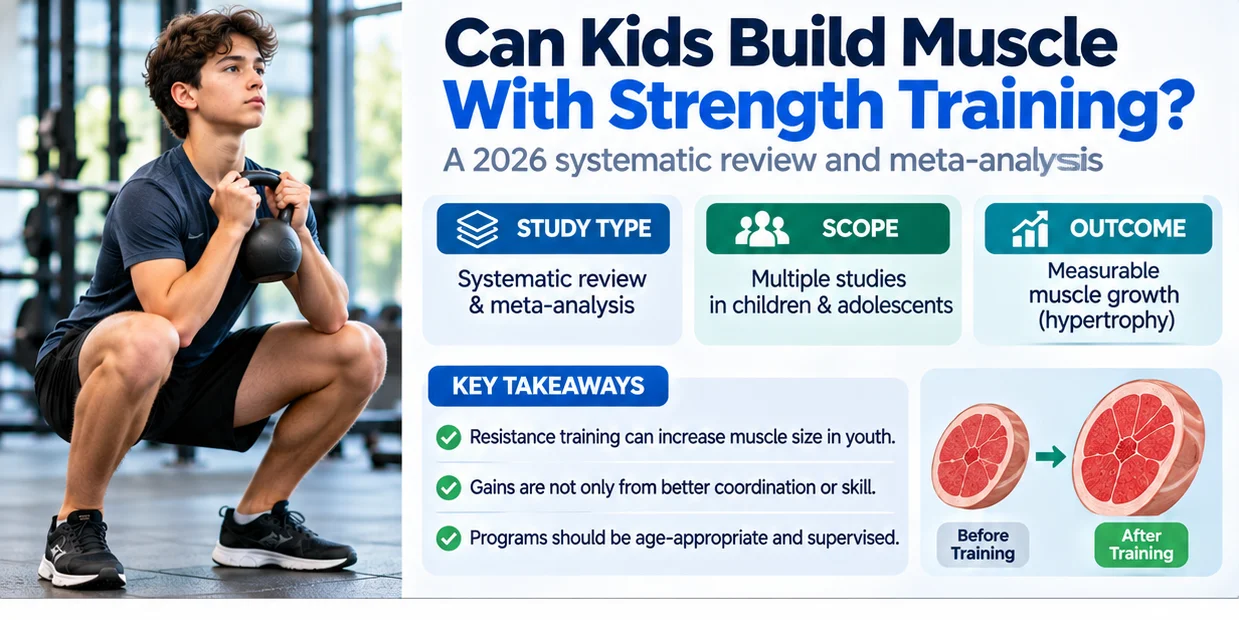
For years, a familiar explanation has followed discussions about children lifting weights: young people become stronger because their nervous systems learn to use their muscles more efficiently, not because their muscles actually grow.
Motor learning and neuromuscular adaptations certainly contribute to strength development. A child who learns to squat, push or pull with better coordination can produce more force without a substantial increase in muscle size. But that does not mean muscle growth is biologically impossible before adulthood.
A systematic review and meta-analysis published in Sports Medicine on September 17, 2026, examined this question using 23 controlled studies involving 1,443 children and adolescents [1]. The researchers compared resistance-training interventions with both inactive control groups and groups participating in other physical activities.
The overall results showed a small but statistically significant increase in muscle mass compared with inactive controls. Larger effects appeared in comparisons with active controls, although those results varied considerably between studies.
The evidence challenges the claim that strength training in youth produces only neural adaptations. It also reveals why age, puberty, training design and the way muscle growth is measured cannot be ignored.
Why Muscle Growth in Children Has Been Difficult to Establish
Strength development is not a single biological process.
An athlete may improve performance through better coordination, motor-unit recruitment, movement technique or increased muscle size. The relative contribution of these adaptations changes with training experience and physical development.
During childhood, improvements in movement skill and neuromuscular coordination are especially relevant. A beginner may become substantially better at performing a resistance exercise simply by learning the movement.
Puberty introduces further changes. Hormonal development, body size and natural muscle growth can influence the adaptations observed during training.
This creates a methodological challenge: when a young athlete gains muscle over several months, how much of that change resulted from resistance training, and how much would have occurred through normal growth?
A controlled study helps answer that question by comparing trained participants with others undergoing development over a similar period.
Measuring muscle size accurately is equally important. An increase in arm circumference, for example, does not necessarily demonstrate an increase in skeletal muscle tissue.
The 2026 review therefore focused on studies using instrumented assessments of muscle size or body composition rather than relying exclusively on simple circumference and skinfold measurements [1].
How the Researchers Examined Youth Muscle Hypertrophy
Komm and colleagues searched PubMed, Scopus, Web of Science and Google Scholar in April 2025. Their review protocol was registered in PROSPERO under CRD420251025605.
The analysis included 23 randomized and non-randomized controlled studies involving healthy participants aged 8–17 years.
Training interventions lasted between 8 and 40 weeks, generally involving two or three sessions per week.
Programs used several forms of resistance, including free weights, machines, elastic bands and bodyweight exercises. These are different ways of applying muscular resistance, and each can be adjusted to an individual’s ability.
The researchers accepted direct assessments such as ultrasound, MRI and CT, along with indirect methods including DXA and bioelectrical impedance. Outcomes included muscle thickness, cross-sectional area, skeletal muscle mass and lean body mass.
These measurements are not interchangeable. Muscle thickness and cross-sectional area describe local muscle morphology, while lean body mass includes tissues other than skeletal muscle.
The review also examined whether results differed according to biological maturation, sex and how closely the training programs matched established hypertrophy-oriented principles.
Resistance Training Produced a Small Overall Hypertrophy Effect
When resistance training was compared with passive control groups, the pooled effect on muscle growth was:
Cohen’s d = 0.22; 95% confidence interval: 0.06–0.37.
The confidence interval remained above zero, indicating a statistically significant average effect. Between-study heterogeneity was relatively low, with I² = 18%.
Cohen’s d is a standardized measure of effect size. A value of 0.22 does not mean that muscle mass increased by 22%. It describes the difference between groups relative to the variability in the measurements.
The result supports a modest advantage for resistance training over inactivity in the included youth populations.
Comparisons with active control groups produced a larger pooled effect:
Cohen’s d = 0.61; 95% confidence interval: 0.03–1.20.
However, heterogeneity was substantial (I² = 84.9%). The effect sizes differed considerably across studies, and one study with particularly large results influenced the pooled estimate.
An active control group might participate in sports or another physical activity rather than resistance training. The type, intensity and volume of that alternative activity can affect the size of the observed difference.
The two pooled estimates therefore should not be interpreted as proof that resistance training works better against active controls than against inactive ones under otherwise identical conditions. They come from different sets of comparisons.
Can Children Build Muscle Before Puberty?
The review examined three broad developmental categories: prepubertal, peripubertal and postpubertal participants.
Against passive controls, the estimated effects were:
| Maturational stage | Cohen’s d | 95% confidence interval |
|---|---|---|
| Prepubertal | 0.16 | −0.04 to 0.36 |
| Peripubertal | 0.30 | 0.01 to 0.58 |
| Postpubertal | 0.01 | −0.31 to 0.33 |
The peripubertal subgroup showed a small statistically significant effect. The confidence intervals for the prepubertal and postpubertal subgroups crossed zero.
Differences between the three subgroups were not statistically significant (p = 0.4268).
This does not establish that prepubertal children cannot build muscle. It means the available studies did not provide a sufficiently precise estimate to demonstrate a clear effect within that subgroup.
The distinction becomes particularly important when discussing childhood development. A non-significant subgroup result is not evidence of biological impossibility.
The evidence supports the possibility of muscle growth before puberty, while leaving uncertainty about how large and consistent that response is.
Why the Results Look Different After Puberty
When the researchers compared resistance training with active control groups, the pattern changed.
Postpubertal adolescents showed a large pooled effect:
Cohen’s d = 1.50; 95% confidence interval: 0.46–2.54.
The prepubertal and peripubertal subgroups had much smaller, non-significant estimates. The difference between maturation subgroups was statistically significant (p = 0.0227).
One possible explanation is that biological maturation creates a more favorable environment for substantial muscle growth, particularly as hormonal and musculoskeletal development progresses.
Yet the confidence interval around the postpubertal estimate was wide. The active-control analysis also had substantial heterogeneity, and some individual studies exerted considerable influence.
Coaches should not interpret the large effect as a prediction that every postpubertal athlete will experience dramatically greater muscle growth.
Biological maturation is more informative than chronological age alone. Two adolescents of the same age may be at different developmental stages, with different movement abilities and capacities to tolerate training.
A practical youth program should accommodate those differences rather than assigning identical training demands solely according to age.
Do Boys and Girls Respond Differently?
The researchers also examined sex-related differences.
Against passive controls, the estimated effects were small or trivial and were not statistically significant within the male, female or mixed-sex subgroups.
Comparisons with active controls produced a large effect in male participants (d = 1.26), while the female subgroup showed a non-significant estimate (d = −0.12).
The female active-control subgroup included only two studies. Its confidence interval ranged from −1.05 to 0.81, leaving considerable uncertainty.
The available evidence cannot support the claim that resistance training produces muscle growth in boys but not girls.
Sex-related comparisons are further complicated by biological maturation, initial muscle mass and whether researchers report absolute or relative changes.
An adolescent with more muscle at baseline may gain a larger absolute amount while experiencing a similar proportional change.
For practical programming, sex alone is a poor substitute for assessing an individual’s training experience, movement competence and developmental stage.
Does a Youth Program Need to Resemble Bodybuilding Training?
The review classified training interventions according to how closely their design matched established hypertrophy-oriented recommendations.
Programs judged moderately suitable showed some of the larger estimated effects, but the subgroup findings were inconsistent and influenced by relatively few studies.
No clear pattern established that a more bodybuilding-oriented program was necessarily better for children or adolescents.
This is particularly relevant because adult hypertrophy recommendations are not automatically appropriate for younger populations.
Youth resistance training can pursue several objectives simultaneously: learning fundamental movement patterns, developing strength, improving physical competence and supporting participation in sport.
Muscle growth may occur as one adaptation without becoming the primary objective of every session.
A child learning a controlled squat or push-up does not need an advanced bodybuilding split to benefit from resistance exercise.
Fitnessprogramer’s bodyweight exercise guide illustrates movements such as squats, lunges and push-ups. Those exercises can be adapted for different ability levels, although the guide itself is not a pediatric training prescription.
What the Previous Velocity-Based Training Studies Add
Two other September 2026 investigations help place these findings within the wider resistance-training literature.
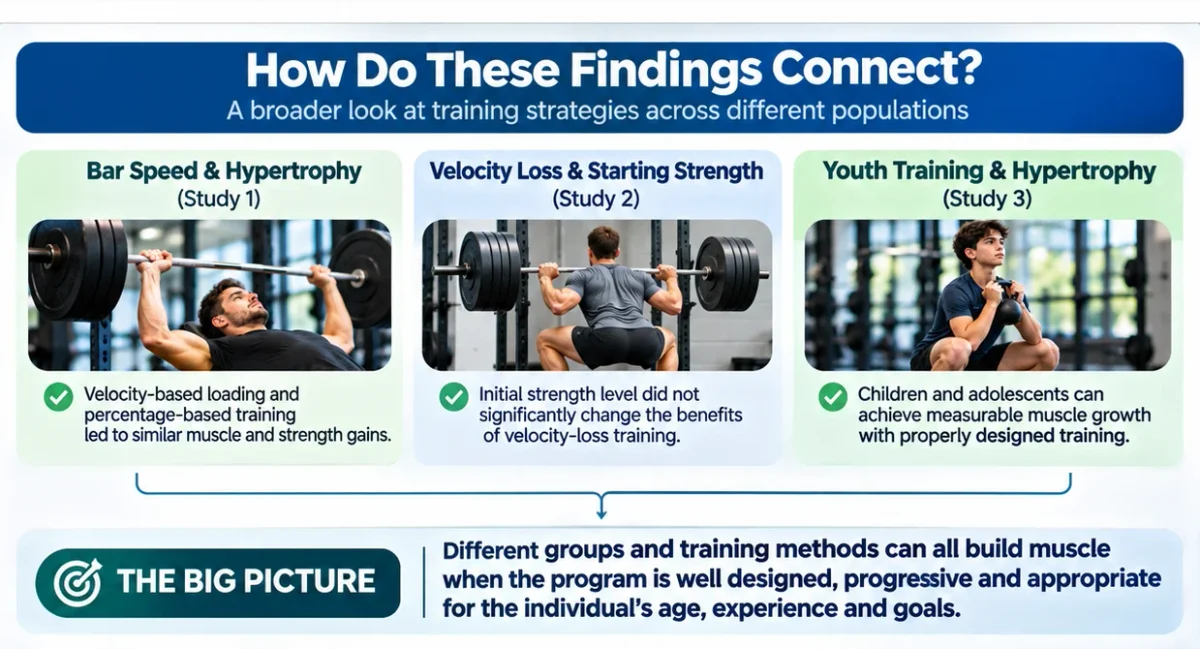
The first compared velocity-based loading with percentage-based programming during a 10-week bench press intervention involving 19 trained young men. Both groups increased pectoralis major size and maximum bench press strength by approximately 15%, without a significant between-group advantage [2].
The second was a meta-regression of velocity-loss-based resistance training. It examined 16 studies and found that baseline strength did not significantly explain differences in strength and power adaptations [3].
Neither study investigated children or adolescents, so their results cannot be directly applied to youth training.
Together, the three investigations address different parts of program design. One examines how training loads are selected, another investigates whether starting strength predicts responses to velocity-loss thresholds, and the youth review asks whether resistance exercise produces measurable morphological adaptations during development.
They do not establish a universal training method.
Instead, they illustrate why the outcome being measured matters. More sophisticated load monitoring does not automatically produce greater hypertrophy, while a population previously assumed to adapt mainly through neural mechanisms may still experience measurable muscle growth.
For youth coaches, the immediate priority remains selecting suitable exercises, providing competent supervision and progressing training according to the individual’s abilities.
How to Structure Resistance Training for Children and Adolescents
The review was designed to investigate muscle growth, not to identify one optimal youth training program. It should not be used as a source of precise prescriptions for maximum loads, repetitions or training to failure.
Nevertheless, several practical principles follow from the characteristics of the included interventions and established youth resistance-training practice.
Begin With Movement Competence
A young participant should learn to control basic movements before resistance is increased substantially.
Bodyweight squats, supported lunges, modified push-ups and controlled pulling exercises can introduce common movement patterns.
The Fitnessprogramer exercise library provides exercise demonstrations, but selection and progression for children should be supervised by a qualified professional familiar with youth development.
Increase Difficulty Gradually
Progression does not always require heavier weights.
An exercise may become more demanding through improved range of motion, greater control, additional repetitions or a modest increase in external resistance.
The appropriate progression depends on technique, experience and the athlete’s response.
The 23 studies used varied programs, so the meta-analysis does not justify a single universal progression rate.
Keep Supervision and Safety Central
Resistance training is not inherently inappropriate for children, but safety depends on the environment, equipment, instruction and exercise selection.
Supervision should be appropriate to the child’s age and experience. Equipment must fit the participant, and technique should remain controlled.
Pain, unusual symptoms or a suspected injury require assessment rather than attempts to train through discomfort.
Young athletes with medical conditions or rehabilitation needs may require individualized guidance. The review primarily examined healthy participants, so its conclusions should not be generalized to every clinical population.
The findings also do not justify aggressive bodybuilding routines, unsupervised maximal lifting or the use of performance-enhancing substances in minors.
What the Meta-Analysis Cannot Establish
The 23 studies differed in several important ways.
Participants ranged from 8 to 17 years old, and not every study assessed biological maturation directly. Some classified participants using chronological age, which may not accurately represent pubertal development.
Training interventions varied from 8 to 40 weeks, with different exercises, equipment, loading strategies and levels of supervision.
The review combined direct muscle measurements with indirect body-composition methods. DXA-derived lean mass, for example, should not be treated as identical to measured skeletal muscle hypertrophy.
Many studies also reported absolute rather than relative changes, making comparisons across developmental stages more difficult.
Several subgroup analyses were based on limited numbers of studies. Large estimates in small subgroups can be unstable, especially when confidence intervals are wide.
The review excluded nutrition-focused interventions to better isolate resistance-training effects. Consequently, it cannot establish how specific dietary strategies modify hypertrophy during childhood or adolescence.
Finally, the findings concern muscle morphology. They do not establish the long-term effects of different resistance-training programs on injury risk, psychological well-being, sporting success or adult muscle development.
What Parents and Coaches Should Take From the Evidence
The old claim that children become stronger only through neural adaptations is too absolute.
Across 23 controlled studies, resistance training produced a small average increase in muscle mass compared with inactivity. Larger effects appeared in some comparisons with other physical activities, particularly among postpubertal adolescents, although those estimates were less consistent.
For parents, the evidence supports viewing properly supervised resistance training as a legitimate form of physical activity rather than something that must automatically be postponed until adulthood.
For coaches, it provides a reason to recognize muscle growth as a possible adaptation without turning hypertrophy into the main goal of every youth program.
Children and adolescents benefit from learning to move well, building confidence with resistance exercises and progressing at a rate appropriate to their development. Measurable muscle growth can be part of that process, but the quality and suitability of the training matter more than chasing an adult-style physique outcome.
References
- [1] Komm Y, Zeiler L, Held S, Comfort P, Faigenbaum A, Geisler S, Augste C. (2026). Effects of Resistance Training on Muscle Hypertrophy in Children and Adolescents: A Systematic Review and Meta-Analysis. Sports Medicine. https://doi.org/10.1007/s40279-026-02499-0
- [2] Fitas A, et al. (2026). Effects of velocity-based hypertrophy training on pectoralis major morphology, neuromuscular activation and bench press maximal strength. European Journal of Applied Physiology. https://doi.org/10.1007/s00421-026-06428-x
- [3] Tao J, et al. (2026). Does baseline strength influence adaptations to velocity loss threshold-based resistance training? BMC Sports Science, Medicine and Rehabilitation. https://doi.org/10.1186/s13102-026-02067-z