
A player can feel ready to train while producing less force than usual. Another may record a lower strength score yet complete the day’s running session without difficulty. These situations expose a problem in sports performance monitoring: a test result does not necessarily describe everything an athlete can do on the field.
Isometric strength testing offers a relatively quick way to assess force production without requiring a joint to move through a full range of motion. Teams can use these measurements to track changes in specific muscle groups, but their relationship with subsequent training performance is less straightforward.
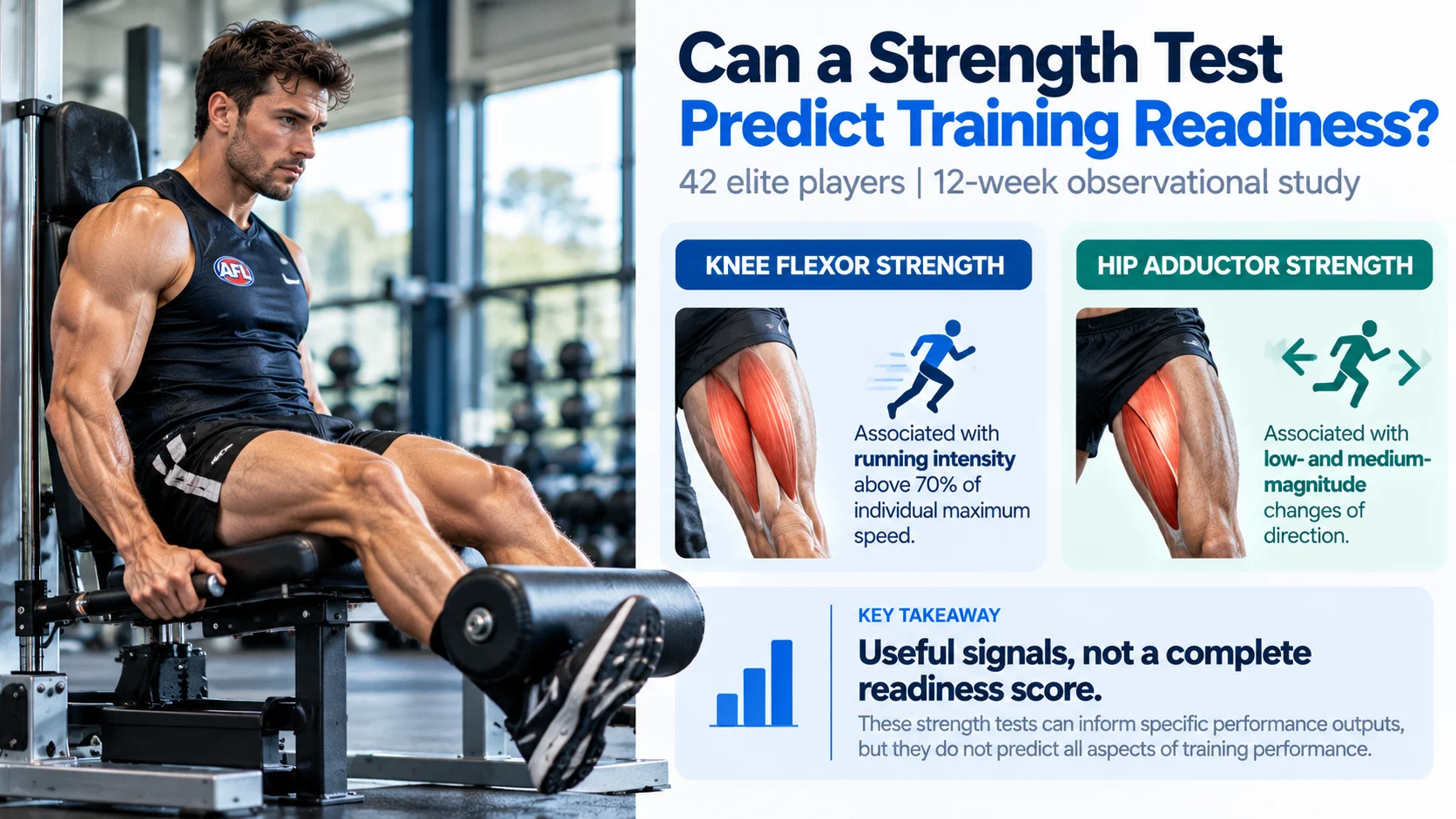
A 2026 observational study involving 42 elite Australian rules football players examined whether changes in lower-limb isometric strength were associated with physical outputs during subsequent field training. The findings suggest that hamstring and hip adductor measurements may provide information about particular activities, although neither test offers a complete picture of training readiness.
Why Coaches Measure Isometric Strength Before Training
An isometric contraction occurs when a muscle produces force without a visible change in joint position. In testing, an athlete pushes or pulls against a fixed device while a dynamometer or force sensor measures the force generated.
These assessments can be completed relatively quickly and repeated under standardized conditions. For professional teams, that makes them useful when monitoring athletes across demanding training schedules.
Two muscle groups are particularly relevant to running and multidirectional field sports.
The hamstrings contribute to hip extension and knee flexion and are heavily involved in sprinting. The hip adductors help control the position and movement of the thigh, especially during lateral movements and changes of direction.
Exercises such as the Nordic hamstring curl and Copenhagen adduction target these muscle groups during strength training. However, performing these exercises is different from measuring maximal isometric force with a testing device.
A change in test performance might reflect fatigue, adaptation, testing variability or several factors acting together. Its usefulness depends on whether that change relates to something the coach needs to know.
Inside the 12-Week Study
The research, published in Sports Medicine – Open on September 7, 2026, followed 42 professional male Australian rules football players during a 12-week preseason period.
The dataset included 22 training days and 746 individual observations.
Researchers examined changes in lower-limb isometric strength before field training and compared them with physical outputs recorded during the subsequent sessions.
The analysis focused on knee flexor and hip adductor strength. Field training outputs included running intensity and movement demands such as acceleration, deceleration and changes of direction.
This was a prospective observational study. The researchers did not randomly assign players to different strength levels or manipulate their training readiness. The results therefore describe associations rather than demonstrating that a change in isometric strength caused a particular field performance outcome.
Hamstring Strength Was Linked to Higher-Intensity Running
The researchers found an association between changes in knee flexor isometric strength and subsequent running intensity above 70% of each player’s individual maximum speed.
This is a relatively specific finding.
The relationship concerned running performed above an individualized speed threshold. It did not establish that knee flexor strength could predict every running measure, overall session performance or the player’s ability to tolerate training.
Hamstring force production is relevant to high-speed running mechanics, so the association has a plausible physiological basis. During faster running, the hamstrings contribute to controlling lower-limb movement and producing force across the stride cycle.
However, a plausible mechanism does not establish causation. The study did not show that increasing an athlete’s pre-training knee flexor score would directly improve the amount of high-speed running completed that day.
For practitioners, a change in knee flexor strength may be worth examining alongside the planned high-speed running demands, recent training exposure and the athlete’s individual testing history.
Hip Adductor Strength Was Associated With Change-of-Direction Demands
Changes in hip adductor isometric strength were associated with low- and moderate-magnitude change-of-direction outputs.
The adductor muscles help stabilize and control the hip during multidirectional movement. Their contribution becomes particularly relevant when athletes shift their center of mass, reposition the leg or generate force during lateral actions.
The study’s findings suggest that monitoring adductor strength may provide information related to certain change-of-direction demands.
The association was not universal across every movement intensity or training variable. It would therefore be inappropriate to interpret an adductor strength score as a direct measurement of agility, cutting performance or overall readiness for multidirectional activity.
Coaches interested in developing this muscle group can use exercises such as side plank hip adduction as part of a structured strength program. The exercise trains the adductors, but improvements in exercise performance should not be assumed to produce the same relationships observed in the professional players’ monitoring data.
Why One Test Cannot Describe Total Training Readiness
The most useful lesson from the study may be the limits of individual measurements.
Knee flexor strength changes were associated with one running-intensity outcome. Hip adductor strength changes were associated with particular change-of-direction outputs. Neither measure reliably accounted for the full range of running, acceleration and deceleration demands examined.
Training readiness is influenced by more than maximal force production in one muscle group.
An athlete’s performance during a session may also depend on recent workload, soreness, sleep, psychological state, movement skill and the structure of the training session itself.
A maximal isometric test captures force production under a specific set of conditions. Field training involves repeated, coordinated movements performed at different speeds, often while the athlete is accumulating fatigue.
These are related physical qualities, but they are not interchangeable.
This distinction matters when a team uses monitoring software to assign a single readiness score. Combining several measurements into one number may simplify reporting, yet that number can conceal differences between the physical qualities being assessed.
How Coaches Can Interpret Changes in Strength Scores
The study supports a targeted approach to monitoring.
If a coach is interested in high-speed running demands, knee flexor strength may offer relevant supplementary information. If the concern is change-of-direction loading, hip adductor measurements may provide a different perspective.
Neither result should automatically determine whether a player trains.
Compare Athletes With Their Own Baselines
Absolute strength values differ between athletes because of body size, training history, technique and other characteristics.
Repeated measurements are generally more informative when testing procedures remain consistent and changes are interpreted against the individual’s previous results.
A single unusually low score deserves context. It may represent a meaningful change, but it may also reflect measurement variability or an inconsistent maximal effort.
Consider the Demands of the Planned Session
A session involving repeated high-speed running places different demands on an athlete than a lower-speed technical session.
The relevance of a knee flexor strength change may therefore depend on the activities planned for that day.
Similarly, an adductor measurement may be more informative when the session includes substantial multidirectional movement.
This does not mean that a particular test result provides a validated threshold for restricting training. The study did not establish universal cutoffs for such decisions.
Use More Than One Source of Information
Strength measurements can be considered alongside recent running exposure, training history, symptoms, athlete feedback and coaching observations.
The purpose is to understand whether different indicators tell a consistent story.
For example, a reduction in knee flexor force accompanied by unusual soreness and a recent increase in high-speed running volume may warrant closer examination. The same force reduction in an otherwise well-recovered athlete could have a different interpretation.
The study does not validate a specific decision-making algorithm, so these examples should be treated as coaching applications rather than experimentally proven rules.
What the Study Cannot Tell Us
Several limitations affect how widely the findings can be applied.
First, the participants were professional male Australian rules football players from one club. Their training schedules, physical preparation and field demands differ considerably from those of recreational athletes or people exercising for general fitness.
Second, the observation period covered one 12-week preseason. Relationships between strength and performance may differ during competitive periods, after injuries or across longer monitoring periods.
Third, some baseline comparisons used rolling seasonal averages. The way a baseline is calculated can influence the apparent size and direction of a change.
Maximal voluntary testing also depends on participant effort. Even with standardized procedures, it is difficult to guarantee that every athlete produces a true maximal contraction on every occasion.
Finally, the observational design prevents causal conclusions. The analysis cannot establish whether changes in strength directly altered training output or whether both were influenced by other factors.
The 746 observations also should not be interpreted as 746 independent athletes. Multiple measurements came from the same 42 players, making appropriate handling of repeated observations important.
Should Recreational Athletes Monitor Isometric Strength?
Most recreational athletes do not need specialized force-testing equipment to manage an ordinary strength or conditioning program.
Progressive training records, exercise performance, symptoms and recovery patterns can provide useful information without a laboratory-style monitoring system.
For athletes participating in sprinting, football or other multidirectional sports, structured hamstring and adductor strengthening may be worthwhile within a broader program.
Fitnessprogramer’s exercise library includes lower-body movements that can be selected according to equipment and training experience.
Still, the findings from this study should not be converted into general advice that everyone needs daily hamstring or adductor testing.
The potential benefit of monitoring depends on whether the measurement is reliable, relevant to the sport and capable of informing a useful decision.
The Difference Between a Useful Signal and a Readiness Verdict
An isometric strength test can identify changes in a specific physical quality. The 2026 study suggests that some of those changes are associated with particular demands in elite football training.
That makes the measurements potentially useful, but only within their demonstrated scope.
A knee flexor score may help a practitioner interpret high-intensity running demands. An adductor score may contribute information about certain change-of-direction activities. Neither should be treated as a complete assessment of an athlete’s capacity to train.
The more appropriate question for coaches is which decision a particular measurement can help inform, and whether the evidence is strong enough to support that use.
Research Reference
Examining the Relationship Between Changes in Lower-Limb Isometric Strength and Subsequent Physical Training Outputs in Elite Australian Rules Football Players. (2026). Sports Medicine – Open. DOI: https://doi.org/10.1186/s40798-026-01105-Published: September 7, 2026.