
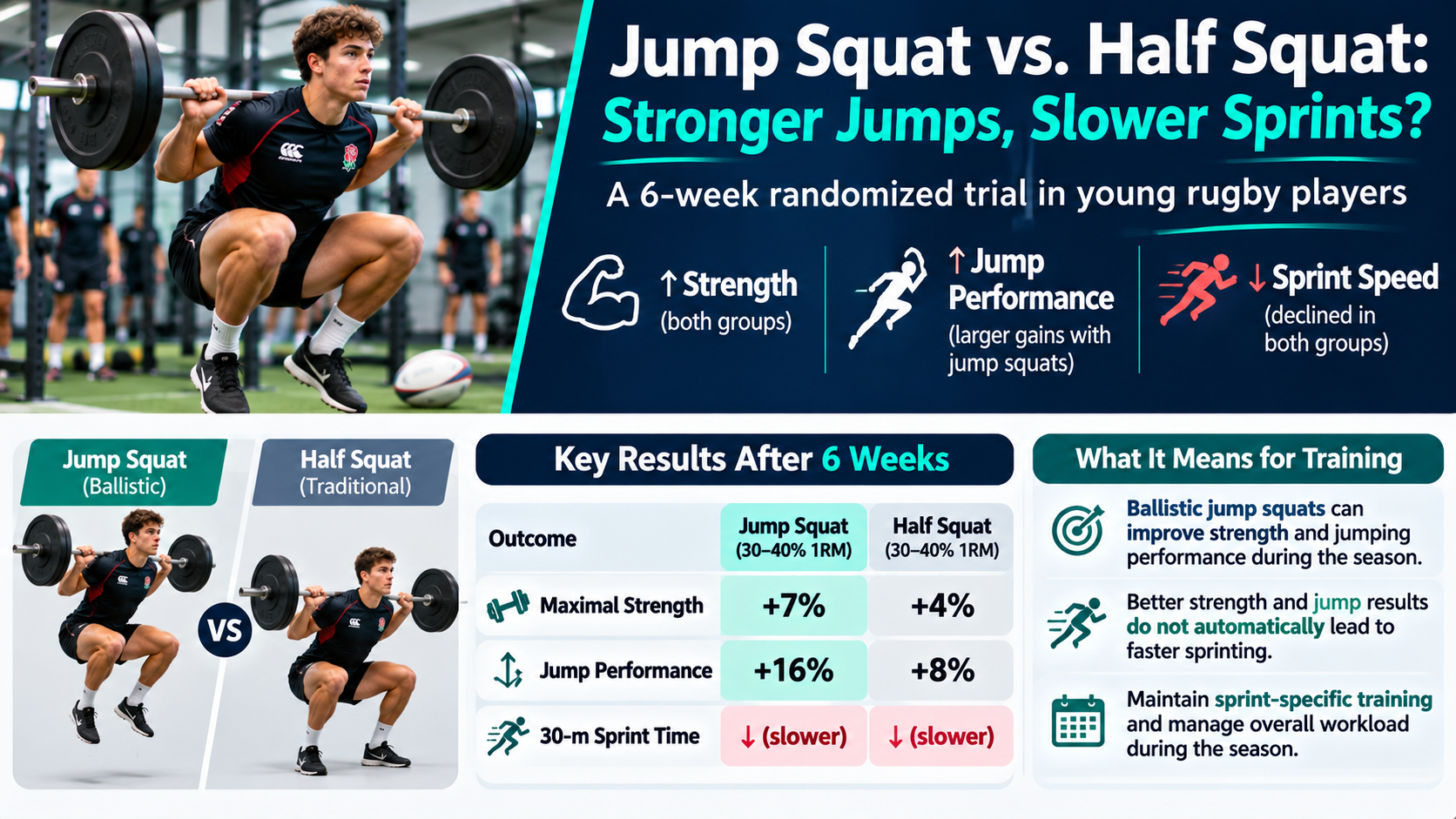
Six weeks into a rugby season, a player walks into the gym and sets a personal best on the squat. His jumping performance has improved too. By the usual measures of strength and power, the training program appears to be working.
Then he runs a 30-metre sprint.
He’s slower than he was before.
It’s the kind of result that can leave a strength coach questioning whether the gym program delivered what the team actually needed. Surely stronger legs and a more powerful jump should translate into faster acceleration?
Not necessarily.
A randomized controlled trial published in the International Journal of Sports Physiology and Performance on October 29, 2026, compared two ways of training the squat with light loads during the rugby season [1]. One group performed ballistic jump squats. The other completed conventional half squats.
Both groups improved strength and jumping ability. The jump-squat group generally recorded the larger gains, including a statistically significant advantage in countermovement jump development.
But neither training method protected the players’ sprint performance. Over the six-week intervention, 30-metre sprint performance declined in both groups.
The results offer a useful reminder that the adaptations we measure in the weight room are not always the same ones an athlete needs on the field.
Two Squat Exercises, Two Different Ways to Produce Force
A conventional half squat and a loaded jump squat can look almost identical at the beginning of a repetition.
The athlete stands with a barbell across the upper back, bends the hips and knees, and then pushes upward.
The difference emerges near the end of the movement.
In a conventional squat, the athlete must remain on the ground and eventually stop the upward movement. Even when the intention is to lift quickly, the body has to control and decelerate the load before standing fully upright.
A jump squat allows the athlete to continue accelerating through takeoff.
Rather than ending the repetition in a standing position, the athlete leaves the ground and subsequently absorbs the landing forces.
This is what makes the exercise ballistic.
The load is accelerated through the movement rather than deliberately brought to a stop before takeoff.
At relatively light loads, that difference can influence the force and velocity characteristics of the exercise.
Why the distinction might matter
Power involves producing force at speed. Developing maximal force is useful, but the ability to express that force quickly is a separate consideration.
A heavy squat may provide an effective stimulus for maximal strength because substantial muscular force is required to overcome the resistance.
A lighter ballistic movement provides a different demand. The athlete must accelerate the load rapidly and complete an explosive takeoff.
Neither approach trains every part of athletic performance.
The question is whether their different mechanical demands produce different adaptations when both are used during a competitive season.
That was the central issue examined by Zabaloy and colleagues.
The Study: Six Weeks During the Rugby Season
The researchers recruited 25 highly trained young rugby players.
Unlike an introductory strength-training experiment involving beginners, these players were already participating in structured rugby activity and competition.
They were randomly assigned to two exercise conditions.
The ballistic group performed loaded jump squats, while the traditional group performed half squats.
Both interventions used relatively light resistance, corresponding to approximately 30–40% of one-repetition maximum (1RM).
The players trained three times per week for six weeks, alongside their usual rugby practices and competitive commitments.
The researchers evaluated performance at three time points using a battery of tests:
| Performance test | Quality assessed |
|---|---|
| Half-squat 1RM | Maximal dynamic strength |
| Mean propulsive velocity | Movement speed during the propulsive phase |
| Squat jump | Explosive jumping performance |
| Countermovement jump | Jump performance involving a preceding downward movement |
| 30-metre sprint | Linear sprint performance |
The study did not compare resistance training with complete inactivity.
Both groups received additional strength and conditioning work. The experiment was designed to examine which of the two squat strategies produced more favorable adaptations.
That distinction is useful when interpreting the results. We can compare the effects of the two approaches, but we cannot determine from this trial what would have happened if the players had completed no additional gym training.
The Jump-Squat Group Made Larger Strength Gains
Both groups improved their maximal strength over the six-week intervention.
The approximate increases were:
| Outcome | Ballistic jump squat | Traditional half squat |
|---|---|---|
| Maximal strength | +7% | +4% |
| Jump performance | +16% | +8% |
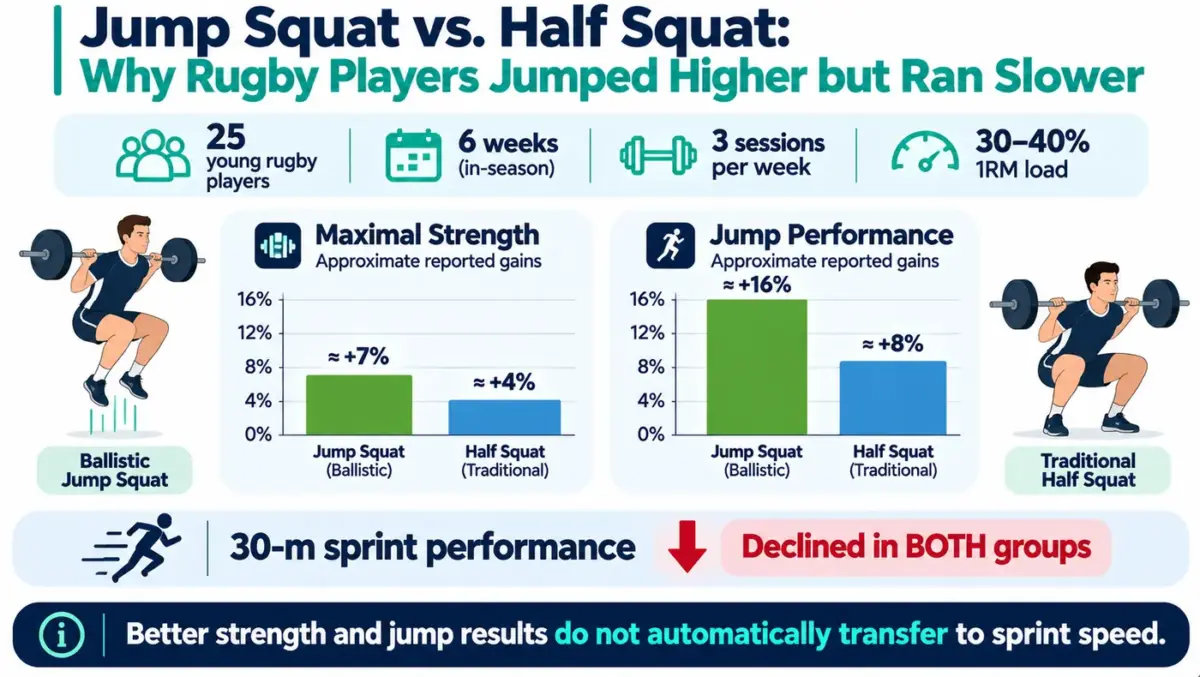
These figures are approximate summaries reported by the authors, rather than a guarantee that every individual improved by the same amount.
The jump-squat condition produced the numerically larger gains in both categories.
The study also reported improvements in relative strength and mean propulsive velocity against heavier testing loads in the ballistic group.
The conventional half-squat group, meanwhile, improved mean propulsive velocity at lighter loads.
Those patterns suggest that the two interventions did not produce identical adaptations.
However, it would be misleading to treat every numerical difference as statistically established superiority.
The clearest reported group-by-time interaction favoring the ballistic condition concerned countermovement jump performance.
The practical interpretation is that ballistic training appeared particularly favorable for several strength-power outcomes, while some of the reported differences remain more appropriately described as observed patterns.
Why Jump Squats May Have Produced Greater Improvements
The explanation may begin with how each exercise encourages the athlete to produce force.
During a ballistic jump squat, the athlete attempts to accelerate the body and external load rapidly enough to leave the ground.
The movement makes high-speed force production an unavoidable part of a successful repetition.
A conventional squat performed with the same light load allows an athlete to complete the movement without jumping.
Although the concentric phase may be performed quickly, the movement still ends with the load controlled in a standing position.
The difference could influence the neural and mechanical demands of training.
Repeated ballistic efforts may improve the coordination and timing of rapid force production. They may also provide a stimulus more closely related to explosive jumping tests.
These explanations are physiologically plausible, but the experiment did not directly demonstrate which neural or muscular mechanisms caused the observed differences.
The study measured performance outcomes. It was not designed to isolate every adaptation responsible for them.
It also did not show that light-load jump squats are superior to all traditional strength-training methods.
The comparison involved two specific exercises performed with loads of 30–40% 1RM. Heavy squats, mixed loading programs, and other power-training methods were not directly tested.
A Stronger Player Is Not Necessarily a Faster Player
The sprint results are arguably the most useful part of the study.
Despite improvements in strength and jumping performance, both groups experienced a decline in 30-metre sprint performance.
The researchers found no significant difference between groups in that outcome.
This challenges a common assumption in strength and conditioning: that improving lower-body power automatically produces faster running.
Strength, jumping and sprinting share some physiological requirements. They all depend on the ability to generate force, but the movements impose different demands.
A vertical jump requires the athlete to direct force primarily to elevate the body.
Sprinting requires repeated ground contacts, coordinated horizontal and vertical force production, efficient limb movement, and rapid transitions between steps.
The force applied during a jump is not expressed in exactly the same way as force applied during early sprint acceleration.
An athlete may become better at one task without improving another to the same degree.
The rugby players’ results illustrate that problem particularly well.
Their weight-room performance improved while their sprint test performance moved in the opposite direction.
Could the Competitive Season Explain the Sprint Decline?
The trial took place during the competitive season.
That context matters.
Rugby players do not arrive at strength sessions completely recovered from all other activity. They may be carrying fatigue from matches, contact training, tactical sessions, sprint work, and general conditioning.
When fixtures are closely scheduled, physical demands accumulate.
That can influence how athletes perform during testing, even if certain underlying physical qualities are improving.
The authors discussed the possibility that a congested competitive schedule contributed to the decline in sprint performance.
It is a reasonable explanation.
It is not a mechanism the study conclusively isolated.
Without a group following a different competition schedule, or a controlled experiment manipulating accumulated match fatigue, the researchers could not determine precisely how much of the sprint decline came from rugby demands.
The training interventions themselves may also have interacted with recovery and fatigue.
A six-week in-season study cannot fully separate those influences.
The important observation is that improving gym-based strength and power was insufficient to prevent the decline in measured sprint performance under the conditions of this trial.
Why Sprint Training Still Needs Its Own Place
A rugby player needs more than the ability to produce force against a barbell.
Acceleration, top-speed mechanics, running rhythm, and efficient ground contact all require specific practice.
Strength training can support those qualities by developing the athlete’s physical capacity.
But a player who wants to run faster still needs exposure to appropriately planned high-speed running.
That may include acceleration drills, short sprints with sufficient recovery, technical work, and sport-specific running tasks.
The appropriate combination depends on positional demands, player experience, match scheduling, and current fatigue.
FitnessProgramer’s guide to improving sprint speed discusses several aspects of sprint development, including acceleration mechanics, lower-body strength, and plyometric training.
The rugby study gives that discussion additional context.
Even when a gym program improves explosive strength and jumping, sprint speed should be evaluated directly.
A coach cannot assume that better squat numbers will protect an athlete’s running performance throughout the season.
Why Light Loads Can Still Develop Strength
One potentially surprising result is that both groups increased maximal strength despite training with loads of only 30–40% 1RM.
Heavy resistance is commonly associated with maximal strength development, and for good reason. Training with substantial loads provides a specific stimulus for improving performance against heavy resistance.
But strength adaptations are not determined by load alone.
An athlete’s training history, the movement performed, the intended speed of execution, total training exposure, and existing strength characteristics all influence the response.
Highly trained team-sport athletes may also improve their ability to express force through neuromuscular adaptations associated with explosive training.
The trial demonstrates that both light-load programs were accompanied by improvements in maximal squat strength over six weeks.
It does not demonstrate that light-load training is superior to heavy resistance for developing maximal strength.
No heavy-load comparison group was included.
For a team-sport coach, that distinction is essential. Ballistic training may be useful in a program with limited recovery opportunities, but the study does not establish that heavy strength work can be permanently removed without consequences.
FitnessProgramer’s Power Training Guide explains how conventional strength work, ballistic movements, and plyometric exercises can be organized around different power-development goals.
The specific exercise must serve the athlete’s needs rather than simply be selected because it can be performed explosively.
How This Connects to the Recent Plyometric Meta-Analysis
The previous article in our research series examined a systematic review and meta-analysis involving 609 adult female team-sport athletes [2].
That review found improvements in jumping, reactive strength, sprint performance, and planned change-of-direction tests following plyometric training.
At first glance, the findings may appear inconsistent with the rugby trial.
One body of research found favorable sprint outcomes from explosive training. The other found that sprint performance declined despite improved jumping ability.
But the studies did not investigate identical interventions or populations.
The meta-analysis combined numerous studies of plyometric jump training in adult women across several team sports.
The rugby trial compared two light-load squat strategies in a much smaller group of highly trained young players during a competitive season.
The interventions, training environments, athlete characteristics, and testing contexts differed.
The meta-analysis also compared plyometric programs with control conditions, while the rugby study compared two active resistance-training approaches.
A favorable average sprint effect across multiple plyometric studies does not guarantee that every explosive exercise program will improve sprinting during every competition period.
The findings are better understood as complementary evidence about the conditions under which training adaptations may transfer to sport-specific performance.
What About Bar Speed and Set Structure?
Another recent FitnessProgramer article examined a network meta-analysis comparing traditional sets with cluster sets and rest-redistribution methods [3].
That review found that alternative set structures generally preserved movement velocity better during resistance training.
The findings are relevant here because bar speed is an important part of many power-oriented programs.
However, the cluster-set review measured acute velocity responses during training sessions.
The rugby trial measured adaptations over six weeks.
A method that preserves repetition speed within a session does not automatically produce better strength, jumping, or sprint outcomes over time.
Conversely, improvements in jump performance after several weeks do not establish that every repetition was performed faster or with less fatigue.
The studies address different levels of the training process.
Coaches can use movement velocity to monitor the execution of a session, but they still need outcome testing to establish whether the program is improving the athletic qualities they care about.
Readers can find the earlier discussion in Cluster Sets vs. Traditional Sets: Do Shorter Sets Really Keep You Lifting Faster?.
How Coaches Can Apply the Findings During the Season
A busy competitive schedule often forces coaches to make difficult programming choices.
There may be limited time for gym sessions, and athletes may arrive with varying degrees of fatigue.
The rugby trial suggests that light-load ballistic jump squats could be one useful way to target strength and explosive performance during this period.
That does not make them a universal replacement for conventional squatting.
The training method should reflect the specific quality the coach wants to develop or maintain.
For a player whose jump performance or rapid force production is a priority, a ballistic exercise may be appropriate.
For an athlete who needs greater maximal force capacity, conventional heavy resistance may still have an important role.
For a player whose sprint performance is declining, additional jump squats alone may not solve the problem.
Sprint exposure, accumulated fatigue, match demands, and recovery should also be examined.
The study used three weekly strength sessions alongside normal rugby activity. That frequency should not be copied automatically into every team program.
A player with a particularly congested match schedule may tolerate a different workload from someone with more recovery time.
Loaded jump squats also require appropriate technique, equipment, landing control, and supervision. They are not simply ordinary squats performed carelessly at greater speed.
For younger or less experienced athletes, the ability to perform controlled bodyweight jumping and landing tasks should be established before progressing to more demanding loaded ballistic exercises.
The Questions This Trial Cannot Answer
The sample was small, with 25 young rugby players completing the intervention.
That limits how confidently the findings can be generalized to other athletes.
The experiment lasted only six weeks. It cannot establish the effects of ballistic and traditional squat training over an entire season or several years.
The participants were highly trained rugby players, not recreational gym users. Their responses may differ from those of complete beginners, female athletes, or older adults.
Both interventions used light loads. The study therefore cannot determine whether ballistic training would outperform a well-designed program involving heavy squats or a combination of heavy and explosive exercises.
The report also cannot establish that ballistic training produces less fatigue under all circumstances. Although this is a potentially useful application, fatigue depends on the overall workload, exercise execution, and recovery demands.
Finally, the decline in sprint performance occurred during a competitive rugby schedule.
It would be inappropriate to interpret the result as proof that jump squats or half squats directly impair sprint speed.
The players improved in several strength-power measures while sprinting deteriorated. The exact causes of that divergence remain uncertain.
The Real Lesson From the Squat Comparison
The six-week trial gives coaches two pieces of information that belong together.
Light-load ballistic jump squats appeared particularly effective for improving several strength and jumping outcomes in highly trained young rugby players. The countermovement jump result provided the clearest statistical support for an advantage over traditional half squats.
But better strength and jump performance did not prevent sprint performance from declining.
That result changes the practical question.
Instead of asking whether jump squats are better than half squats in every situation, a coach should ask what the athlete needs to improve, what other training demands are present, and whether the chosen exercises are producing the intended outcome.
The barbell can tell us something about the athlete’s ability to produce force.
The jump test can tell us something about explosive performance.
Neither can replace measuring how quickly the player actually runs.
References
[1] Zabaloy S, Zmijewski P, Freitas TT, García Botta S, Maggiolo JF, Aparicio J, Vega F, Comyns T, Azevedo PHSM, Pereira LA, Loturco I. (2026). Effects of Ballistic and Traditional Half-Squat Training With Light Loads on Strength, Jump, and Sprint Performance in Young Rugby Players: A Randomized Controlled Trial. International Journal of Sports Physiology and Performance. Published online October 29, 2026. https://doi.org/10.1123/ijspp.2026-0228
[2] Lane A, et al. (2026). Female Team-Sport Athletes’ Physical Fitness and Jump Performance Kinematics After Plyometric Jump Training: A Systematic Review and Meta-analysis. Sports Medicine – Open. https://doi.org/10.1186/s40798-026-01136-4
[3] Nagatani T, et al. (2026). The Effectiveness of Cluster vs. Rest-Redistribution Set Configurations to Maintain Movement Velocity During Resistance Training: A Systematic Review and Bayesian Network Meta-analysis. Sports Medicine – Open. https://doi.org/10.1186/s40798-026-01106-w