For some women, the first noticeable changes during the menopause transition have little to do with hot flashes. A familiar word takes longer to recall. Concentrating on several things at once becomes frustrating. A conversation that would once have been easy to follow suddenly requires more effort.
These experiences are often described as brain fog, although the term covers several different problems. Forgetfulness, difficulty concentrating and slower mental processing are not interchangeable, and they do not necessarily share the same cause.
Exercise is frequently recommended during menopause to help maintain muscle strength, bone health and physical function. Its potential effects on the brain have received growing attention, but relatively few controlled trials have examined women during the transition itself.
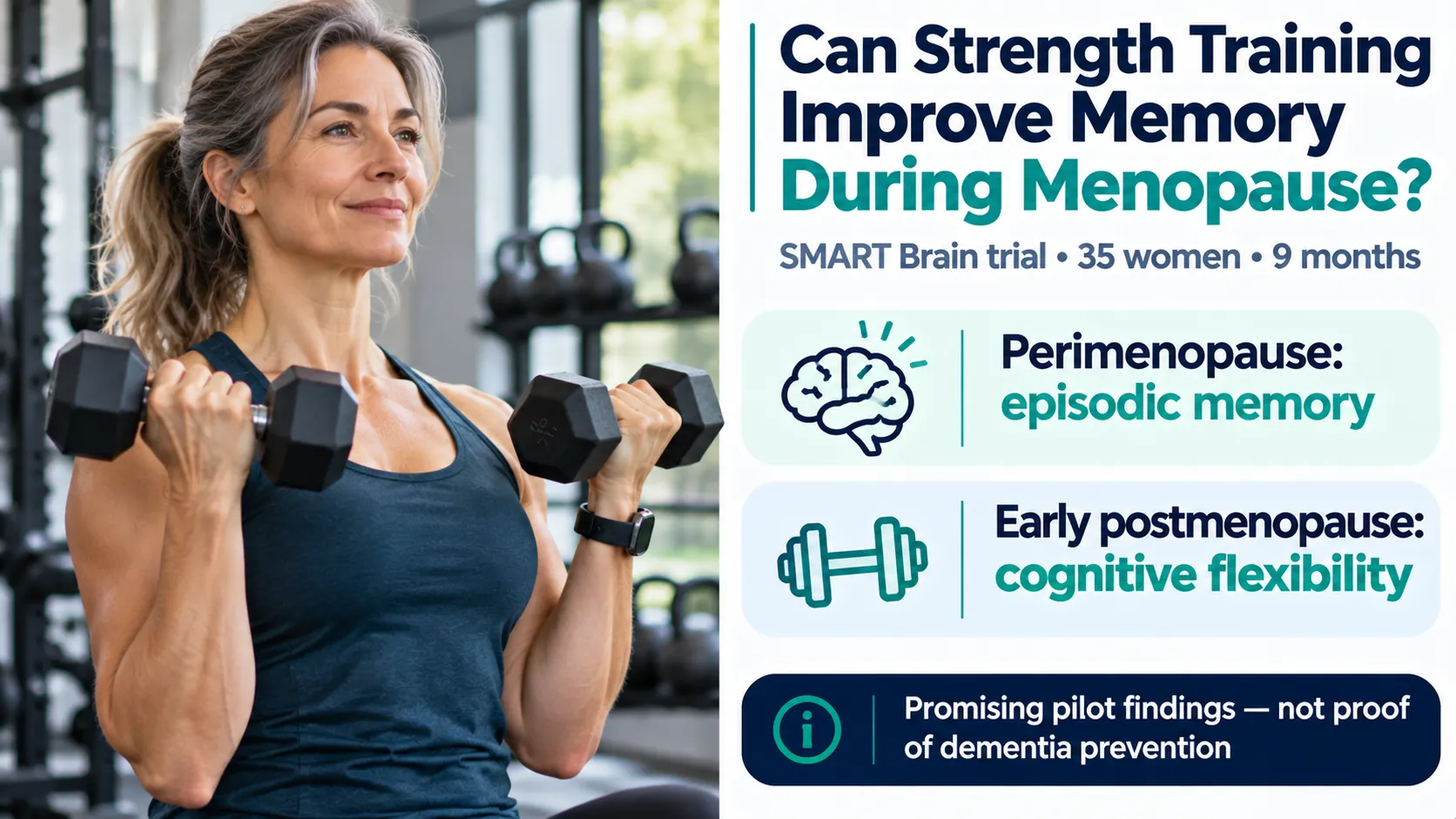
A randomized controlled trial published in BMC Medicine on September 30, 2026, offers an intriguing early result. Researchers at the University of Calgary investigated whether nine months of progressive resistance training could influence memory, executive function and brain hemodynamic responses in women experiencing perimenopause or early postmenopause [1].
The results differed depending on reproductive stage. Women in perimenopause showed improvements in episodic memory, while those in early postmenopause improved on a test of cognitive flexibility. The researchers also observed a change in task-related prefrontal brain hemodynamics in the early postmenopausal group.
These findings deserve attention, but the trial was small. It provides a reason to investigate resistance training as a possible contributor to brain health—not proof that lifting weights prevents dementia.
Why Menopause Can Affect More Than Physical Health
Menopause is not a single event that happens overnight.
Perimenopause describes the transition leading up to the final menstrual period, when reproductive hormones fluctuate and menstrual cycles become less predictable. Early postmenopause follows the final menstrual period and involves a different hormonal environment.
Those stages can overlap with changes in sleep, mood, temperature regulation and cognitive complaints.
The brain is sensitive to physiological changes throughout life. Estrogen, for example, participates in processes involving neural signaling, metabolism and vascular function. Changes in estrogen availability are therefore among the mechanisms researchers investigate when studying cognition during menopause.
But it would be inaccurate to attribute every memory complaint to declining estrogen.
Sleep disruption, stress, depressive symptoms, medication use and other health conditions can also affect attention and recall. Some women report substantial difficulties during the transition; others experience few noticeable cognitive symptoms.
This variation creates a problem for research.
If perimenopausal and postmenopausal participants are placed into one broad category, differences between reproductive stages may become harder to detect.
The SMART Brain researchers designed their analysis around that possibility.
What the SMART Brain Trial Investigated
The study was a pilot sub-study of a larger assessor-blinded randomized controlled trial.
The parent study involved 40 women aged 45–60 years who were in perimenopause or early postmenopause. Thirty-five volunteered for the brain-health sub-study.
Of those 35 participants, 17 were assigned to progressive resistance training and 18 to a wait-list control group.
The training intervention lasted nine months, with two supervised sessions each week.
Participants were allocated with attention to reproductive stage and menopausal hormone therapy status. The researchers assessed cognitive performance and measured changes in brain hemodynamics during cognitive tasks.
The primary outcome was cognition. The secondary outcome was the task-related hemodynamic response measured with functional near-infrared spectroscopy, or fNIRS.
This distinction matters because a cognitive test and a brain-imaging measurement do not answer the same question.
A participant may perform better on a memory task without showing a detectable change in the particular hemodynamic measure being recorded. Likewise, a change in the brain’s hemodynamic response does not automatically establish improved everyday cognition.
The researchers analyzed the results using statistical models that accounted for baseline performance and relevant covariates. They also examined whether the effects of training interacted with reproductive stage.
The Results Were Different Across Menopause Stages
The most interesting finding was not a uniform improvement across every cognitive test.
Instead, the researchers detected statistically significant interactions between training assignment and reproductive stage for specific outcomes.
| Reproductive stage | Cognitive outcome showing improvement | Brain hemodynamic finding |
|---|---|---|
| Perimenopause | Episodic memory | No significant hemodynamic effect detected |
| Early postmenopause | Cognitive flexibility, measured through set-shifting | Increased task-induced total hemoglobin in the left dorsolateral prefrontal cortex |
These were findings from planned comparisons following significant group-by-stage interactions. They should not be interpreted as evidence that one reproductive stage benefits more from exercise overall.
The trial did not demonstrate that every cognitive domain improved.
Nor did it establish that the changes would translate into fewer everyday memory complaints or a lower risk of neurological disease.
The pattern nevertheless raises a worthwhile question: could the brain respond differently to resistance training at different points in the menopause transition?
Why Episodic Memory Matters During Perimenopause
Episodic memory allows us to remember experiences and information associated with particular events.
Remembering details from a conversation, recalling something learned earlier or retrieving information from a previous experience can all involve episodic memory processes.
In the SMART Brain trial, the perimenopausal participants assigned to resistance training showed an improvement in the relevant episodic-memory measure compared with the control condition.
That is encouraging because subjective memory concerns are commonly reported during the menopause transition.
But a laboratory memory test cannot tell us exactly how a person’s daily life changed.
The study did not establish that participants stopped experiencing brain fog, became more productive at work or experienced a clinically meaningful reduction in memory complaints.
It also does not identify which physiological pathway produced the observed improvement.
Regular resistance training may influence several systems relevant to brain function, including cardiovascular regulation, metabolic health, sleep and psychological well-being. Those are plausible areas of investigation, not mechanisms proven by this particular trial.
The finding is best understood as an early indication that memory performance may respond to structured resistance training during perimenopause.
Early Postmenopause Showed a Different Cognitive Response
The early postmenopausal participants showed improvements in set-shifting, a component of executive function.
Set-shifting refers to the ability to adjust behavior when a task changes or when a different rule becomes relevant.
Imagine sorting objects according to color and then being asked to sort the same objects according to shape. Successfully switching between those rules requires cognitive flexibility.
Outside the laboratory, executive function contributes to planning, adapting to changing circumstances and managing competing demands.
The SMART Brain trial found that resistance training improved performance on a set-shifting task in the early postmenopausal subgroup.
The researchers did not establish an equivalent improvement in that outcome during perimenopause.
That difference is interesting, but the subgroups were small. A significant result in one subgroup and a non-significant result in another is not, by itself, sufficient to establish that the two populations respond differently.
Here, the researchers also reported significant group-by-reproductive-stage interactions, providing statistical support for the stage-specific pattern. Even so, the precision and reproducibility of those effects remain uncertain because this was a pilot study.
Larger trials will be needed to determine whether the same pattern appears consistently.
What the Prefrontal Cortex Measurement Actually Means
The researchers also examined brain hemodynamics using functional near-infrared spectroscopy.
This noninvasive technique uses near-infrared light to estimate changes in oxygenated and deoxygenated hemoglobin in superficial cortical tissue during a task.
In the early postmenopausal subgroup, resistance training was associated with an increase in task-induced total hemoglobin concentration in the left dorsolateral prefrontal cortex.
The dorsolateral prefrontal cortex participates in several executive processes, including aspects of working memory, attention and cognitive control.
The result provides a physiological observation alongside the improvement in set-shifting performance.
However, increased total hemoglobin is not the same as directly measuring greater neuronal activity or proving that the brain became healthier.
Hemodynamic signals are indirect. They reflect changes related to the vascular response accompanying a task, and their interpretation depends on measurement conditions and the underlying physiology.
The study also did not demonstrate that the hemodynamic change caused the cognitive improvement.
No significant hemodynamic effects were observed in the perimenopausal subgroup.
That is another reason not to reduce the results to a general statement that resistance training increases blood flow to the brain during menopause.
The observed response was specific to the measured region, task and subgroup.
Why Nine Months of Training Is Worth Noticing
Many exercise interventions last only a few weeks.
The SMART Brain program continued for nine months, with supervised progressive resistance training twice weekly.
That duration gave participants sustained exposure to a structured exercise routine rather than a brief series of isolated workouts.
Progressive resistance training involves adjusting the training challenge over time as a participant develops the ability to perform the exercises.
It does not necessarily require maximal lifting or a bodybuilding-style program.
For women beginning resistance training during midlife, the practical starting point may be learning familiar movements, selecting manageable loads and developing consistency before pursuing more demanding progressions.
FitnessProgramer’s Strength and Muscle Building Workout Program for Women illustrates how resistance exercises can be organized across different muscle groups. It is a general fitness program, however, not the exact intervention used in SMART Brain and not a validated protocol for improving cognition.
The trial also cannot establish whether nine months is the minimum effective duration, whether one weekly session would work or whether additional sessions would produce larger cognitive changes.
Those questions remain open.
Does Strength Training Protect Against Alzheimer’s Disease?
The researchers discussed their work in the context of brain aging and Alzheimer’s disease risk.
That context is scientifically relevant. Changes associated with neurodegenerative disease can begin long before a clinical diagnosis, and midlife is an important period for studying potentially modifiable health factors.
But this trial did not measure whether participants developed Alzheimer’s disease.
It did not assess dementia incidence, demonstrate a reduction in Alzheimer’s pathology or follow participants long enough to establish protection against later cognitive decline.
Improving performance on selected cognitive tests over nine months is not equivalent to preventing a neurodegenerative disease.
This distinction is particularly important in health writing. A promising intervention can be worth studying without being presented as a proven preventive treatment.
The SMART Brain findings support further investigation of resistance training during the menopause transition. They do not justify promising that lifting weights will prevent Alzheimer’s disease.
What Other Exercise Research Adds to the Picture
The SMART Brain trial is not the only investigation to examine exercise and cognition after menopause.
A separate randomized crossover study published in 2025 compared acute isometric resistance exercise and high-intensity interval exercise in postmenopausal women [2].
That study found changes in prefrontal oxygenation associated with exercise but did not demonstrate an immediate improvement in the cognitive outcomes measured.
The two investigations differed substantially.
One examined responses to individual exercise sessions. SMART Brain examined changes following nine months of progressive training.
Their results are therefore not directly contradictory. An acute hemodynamic response does not guarantee an immediate cognitive benefit, and longer-term training may produce effects that cannot be inferred from a single session.
The distinction also helps explain why measuring the brain’s vascular response and measuring cognitive performance are complementary rather than interchangeable approaches.
How This Connects to Strength Training Research in Women
Earlier in this series, FitnessProgramer examined a 12-week study comparing strength and muscle-thickness adaptations between physically active men and women.
That research found that apparent sex differences in strength gains depended partly on whether progress was expressed in kilograms or percentages. Muscle-thickness increases did not differ significantly between the groups.
Readers can explore that work in Do Women Gain Strength Faster Than Men?.
The SMART Brain trial investigated a very different population and outcome.
It did not compare women with men or establish that cognitive improvements depend on the amount of muscle gained.
The connection is broader: resistance training can be evaluated through multiple outcomes, and the choice of measurement shapes what researchers can conclude.
Strength, muscle size, memory and executive function should not be treated as interchangeable markers of success.
A person may benefit from a training program in one domain without showing an equally strong response in another.
What Women Can Take From This Research
For women considering resistance training during perimenopause or early postmenopause, the study provides another reason to regard strength exercise as a worthwhile area of health research.
It does not provide a prescription specifically designed to treat brain fog.
The most practical approach is to begin with a program that suits current ability, medical circumstances and training experience.
A beginner may start with simple pushing, pulling, squatting and hip-hinge movements, progressing gradually as technique and confidence improve.
FitnessProgramer’s workout plan library contains examples of resistance-training structures for different goals. These can help readers understand exercise organization, but they should not be mistaken for clinically tested cognitive-health interventions.
Women experiencing persistent or worsening memory problems should also seek appropriate medical assessment.
Cognitive symptoms may have multiple causes, including sleep disturbances, mood disorders, medication effects and other medical conditions. Exercise should not replace investigation of symptoms that interfere with daily life.
For those already exercising, there is no evidence from this pilot trial that an established, suitable program must be replaced with a specialized menopause-branded routine.
The study supports the potential value of regular progressive resistance training, not a particular commercial method.
The Limitations Behind the Encouraging Results
The main limitation is the sample size.
Only 35 women participated in the sub-study, with 17 in resistance training and 18 in the wait-list control group.
Dividing those participants by reproductive stage left even smaller groups for the comparisons of greatest interest.
That makes the findings vulnerable to imprecision and the influence of individual participants.
The researchers also examined multiple cognitive outcomes and hemodynamic measures. When many statistical comparisons are performed, the possibility of false-positive findings increases.
Although the investigators used baseline-adjusted analyses and examined interactions, those methods cannot fully compensate for a small sample.
The wait-list design also means the control group did not receive a matched alternative activity with equivalent supervision and social interaction.
Consequently, the trial cannot completely separate the specific effects of resistance exercise from other aspects of participating in a supervised program.
The assessors were blinded, but participants knew whether they were exercising.
Another limitation concerns generalizability. The participants were women aged 45–60 in perimenopause or early postmenopause. The findings may not apply to women decades beyond menopause, those with diagnosed cognitive disorders or those with different health characteristics.
Finally, the study did not establish how long the cognitive changes persisted after training ended.
The authors appropriately described their findings as preliminary.
What Should Future Studies Investigate?
A larger randomized trial could test whether the stage-specific findings are reproducible.
It would also be useful to compare resistance training with another structured activity, such as aerobic exercise or an active control program, rather than relying only on a wait-list comparison.
That could help determine whether the observed effects are specific to resistance exercise or reflect broader benefits of regular physical activity and supervised participation.
Researchers could also investigate whether changes in sleep, menopausal symptoms, cardiovascular function or physical strength help explain cognitive responses.
Longer follow-up would be needed to determine whether improvements persist and whether they have meaningful consequences for everyday functioning.
The most ambitious question—whether resistance training during the menopause transition reduces later dementia risk—would require substantially larger studies and much longer observation.
The present trial is a starting point, not an answer to all of those questions.
A Different Reason to Consider Resistance Training During Menopause
Strength training is already relevant to midlife physical health. The SMART Brain study suggests that its potential effects may extend to selected aspects of cognition.
After nine months, perimenopausal participants showed improved episodic-memory performance, while early postmenopausal participants improved on a test of cognitive flexibility. A task-related prefrontal hemodynamic change was also observed in early postmenopause.
Those outcomes were not uniform across the two reproductive stages.
That is what makes the study interesting. Rather than treating menopause as one undifferentiated category, it raises the possibility that the timing of an intervention may influence which cognitive outcomes respond.
For now, the evidence is too preliminary to promise better memory or dementia prevention.
But it provides a credible reason to study resistance training more closely as women move through menopause—and to evaluate its effects on the brain with the same care researchers already apply to strength, muscle and bone.
References
[1] Faridi W, Burma SJ, Nel HJ, et al. (2026). Study of Menopause and Resistance Training for Brain Health (SMART brain): a randomized controlled trial. BMC Medicine. https://doi.org/10.1186/s12916-026-05258-0
[2] The acute effect of two exercise modalities on neurocognitive responses in postmenopausal women: A randomized controlled trial. (2025). https://pubmed.ncbi.nlm.nih.gov/40448657/
[3] Smith S, Behan FP, Nolan D, Egan B. (2026). Changes in Strength and Muscle Thickness in Physically Active Males and Females in Response to Resistance Exercise Training: Comparison of Absolute and Relative Change Scores. Journal of Strength and Conditioning Research. https://doi.org/10.1519/JSC.0000000000005640