The first thing some people notice after starting creatine isn’t a heavier bench press. It’s a heavier reading on the bathroom scale.
For anyone trying to lose fat, that can be unsettling. A kilogram gained over a short period might look like progress going in the wrong direction, even when training performance is improving. For someone trying to build muscle, the same increase may seem encouraging. Neither reaction tells us much about what actually changed.
Creatine has been studied for decades, but the distinction between body weight, lean mass and body fat still gets lost in conversations about supplementation. A new meta-analysis published in the Journal of the International Society of Sports Nutrition on September 21, 2026, offers a useful way to examine those changes.
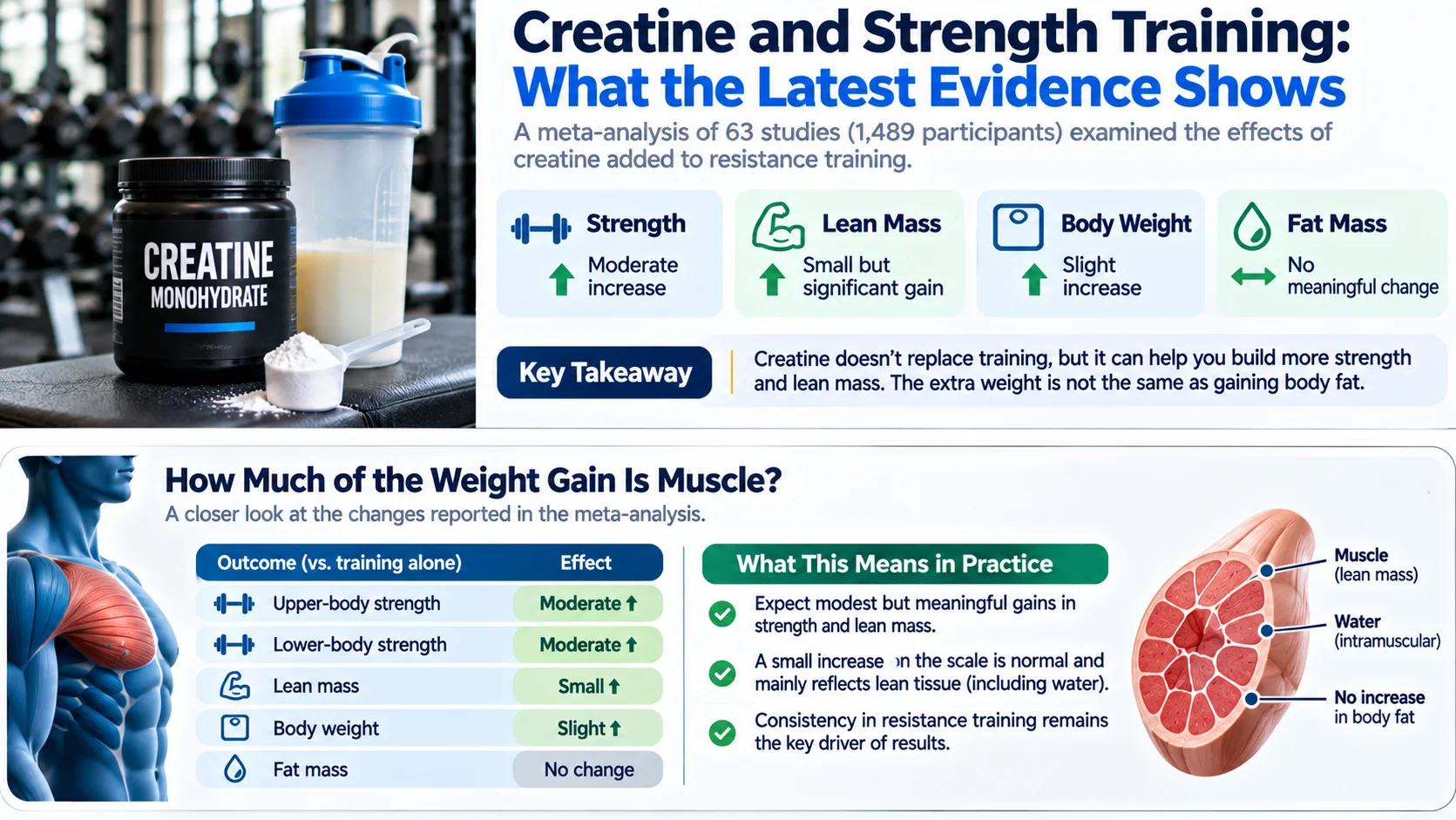
Researchers pooled evidence from 63 studies involving 1,489 participants. Their question was straightforward: when people combine creatine with resistance training, how do their strength and body-composition results compare with people who train without creatine?
The advantage was clearest for strength. Lean mass also increased more with creatine, although the effect was smaller. Total body weight rose slightly, while the difference in fat mass was not statistically significant [1].
A higher number on the scale, in other words, did not translate into evidence of greater fat accumulation.
Why Creatine Can Change Body Weight
Creatine is a naturally occurring compound stored primarily in skeletal muscle. Its phosphorylated form, phosphocreatine, helps regenerate adenosine triphosphate (ATP) during brief, demanding efforts.
That energy system is particularly relevant when lifting heavy weights, sprinting or repeating high-intensity efforts with limited recovery.
Supplementation increases muscle creatine availability, although the magnitude of that increase varies between individuals. Over time, having more creatine available may support training performance and the amount of productive work someone can complete.
Creatine can also increase water retained within muscle cells. That response helps explain why body weight sometimes rises before any substantial change in muscle tissue could reasonably occur.
But water is not body fat.
Nor should every increase in lean mass be labeled new muscle. Most common body-composition methods classify water as part of the fat-free compartment. An increase in that compartment may reflect several physiological changes, including hydration and actual tissue growth.
The 2026 meta-analysis measured the outcomes reported by existing trials. It did not directly determine how much of the additional lean mass consisted of newly formed muscle tissue.
What the Researchers Examined
Hai Wang and colleagues searched five scientific databases, including PubMed, Web of Science, the Cochrane Library, Embase and EBSCO, through April 21, 2025. They also examined reference lists to identify additional studies.
The final review included 63 studies with participants aged 18 to 75 years. Some were experienced resistance trainees, others were beginners, and a proportion were competitive athletes.
Training interventions generally lasted four to twelve weeks, with participants exercising three to five times weekly. All included studies used creatine monohydrate, although supplementation protocols differed.
The researchers examined six outcomes: upper-body strength, lower-body strength, lean mass, fat mass, body-fat percentage and total body mass.
Rather than treating every reported measurement as independent, they used a three-level random-effects model. This approach accounts for the fact that one trial may contribute several related outcomes.
For example, a study measuring bench press strength, leg press strength and several body-composition variables does not provide the same amount of independent information as several entirely separate trials.
Handling that dependence is a methodological strength of the review.
It doesn’t eliminate variation in the underlying studies, but it makes better use of their data.
Creatine Produced a Clearer Advantage in Strength Than in Body Composition
The pooled results favored adding creatine to resistance training for both upper- and lower-body strength.
Upper-body strength showed a standardized effect of Hedges’ g = 0.54, with a 95% confidence interval of 0.37 to 0.71.
Lower-body strength showed a similar effect: g = 0.55.
Both results were statistically significant (p < 0.001) [1].
Hedges’ g expresses the difference between groups on a standardized scale. It does not mean creatine increased strength by 54% or 55%.
A standardized effect around 0.5 is commonly described as moderate, although its practical meaning depends on the strength tests, participants and training programs involved.
For someone lifting regularly, the finding supports creatine as a potentially useful addition to a well-designed program. It doesn’t promise a particular number of kilograms added to a squat or bench press.
The review’s prediction interval for upper-body strength also crossed zero, indicating that future studies in different settings might find smaller benefits or no clear advantage.
That uncertainty belongs alongside the favorable average result.
What About Muscle Growth?
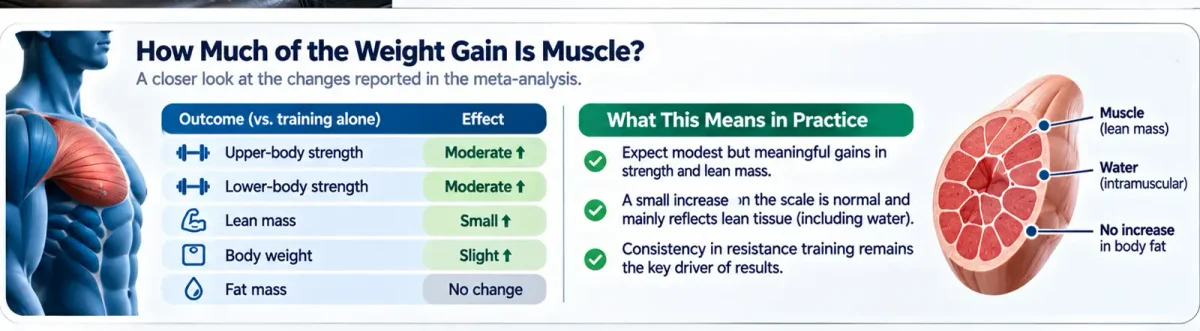
Lean mass increased more in the creatine groups, with a pooled effect of g = 0.30 and a 95% confidence interval of 0.18 to 0.41 (p < 0.001).
The estimate was smaller than the strength effects.
That difference makes physiological sense without proving a specific mechanism. Improvements in lifting performance can involve changes in technique, neural adaptation, muscle size and the ability to sustain demanding exercise.
Lean-mass measurements capture a different outcome. They do not tell us how much stronger someone became, and they cannot always distinguish contractile tissue from changes in body water.
A lifter may therefore experience a meaningful improvement in performance without seeing an equally dramatic change in measured lean mass.
The meta-analysis supports an additional lean-mass benefit from creatine, but it cannot assign that entire benefit to muscle hypertrophy.
Did Creatine Increase Body Fat?
Fat mass was examined in 35 studies contributing 41 effect sizes.
The pooled estimate was g = −0.10, with a 95% confidence interval from −0.23 to 0.03 and a p-value of 0.14.
That result was not statistically significant.
The direction of the estimate slightly favored creatine, but the confidence interval included zero. The evidence therefore did not establish a reliable difference in fat-mass change between groups.
Body-fat percentage told a somewhat different story.
The creatine groups experienced a small but statistically significant reduction relative to resistance training alone: g = −0.14, p = 0.02.
There is no contradiction here.
Body-fat percentage represents fat mass as a proportion of total body mass. If lean mass increases while fat mass stays relatively stable, fat will account for a smaller percentage of the body.
Consider a simplified example. Someone weighing 80 kg with 16 kg of fat has a body-fat percentage of 20%. If that person gains 2 kg of lean mass without changing fat mass, their weight becomes 82 kg and their body-fat percentage falls to approximately 19.5%.
They have not lost fat in this example. The percentage changed because the denominator increased.
That distinction is essential when interpreting body-composition reports, especially those produced by devices that estimate lean mass and fat mass indirectly.
Why the Scale Can Rise Without Fat Gain
The meta-analysis found a small but statistically significant increase in total body mass with creatine: g = 0.12, p = 0.04.
Taken together, the outcomes describe a pattern: modestly higher body weight, greater lean mass and no established increase in fat mass.
They do not reveal the exact composition of each additional kilogram.
Creatine-related water retention can contribute to early changes in weight. Longer-term resistance training may also increase muscle tissue, particularly when training provides sufficient stimulus and recovery.
The proportions are not necessarily the same for everyone.
Training history, diet, initial muscle creatine stores and individual responses can all affect what happens.
Someone beginning creatine and resistance training at the same time may also experience changes that would have occurred from training alone. That’s why the comparison with resistance-training control groups is valuable: it helps estimate what creatine adds beyond the exercise program.
Even so, an individual’s bathroom scale cannot separate those components.
Tracking strength, body weight over several weeks, waist measurements and—where appropriate—consistent body-composition assessments provides more useful context than reacting to one weigh-in.
Does Age Change the Response?
The researchers explored whether participant characteristics or supplementation protocols influenced the results.
Age was the only moderator showing a statistically significant between-subgroup difference for strength outcomes.
In the upper-body analysis, younger and older adults showed favorable effects, while the middle-aged subgroup did not demonstrate a significant advantage.
That may sound surprising. It should not be interpreted as evidence that creatine works for young and older people but not for middle-aged adults.
The groups were unevenly represented, and the middle-aged subgroup contributed relatively little information. Multiple moderator analyses also increase the chance of finding an apparently significant relationship by chance.
The authors appropriately described these age-related observations as exploratory.
No consistent moderator was identified for the body-composition outcomes.
The review also did not establish clear differences based on sex, training experience, intervention duration, weekly training frequency or the supplementation strategies examined.
That absence of significant moderation does not mean every protocol produces identical results. It means the available data did not reliably identify those characteristics as explanations for differences in outcomes.
What the Review Cannot Tell Us About Creatine
Sixty-three studies provide a substantial evidence base, but the quality of a meta-analysis still depends on the studies it includes.
Most interventions lasted no longer than twelve weeks. That limits conclusions about changes over several years of training.
Dietary intake and training history were incompletely reported in some trials. Those omissions make it harder to examine how nutrition, experience and program quality might influence supplementation effects.
The participant distribution was also uneven. Of the 1,489 individuals, 970 were reported as male, 248 as female and 271 had no reported sex classification.
The researchers rated 41 trials as low risk of bias, 16 as moderate risk and six as high risk. Across outcomes, certainty of evidence ranged from low to moderate.
For upper-body strength, publication-bias analyses suggested that smaller or unfavorable findings may have been underrepresented. An adjustment reduced the pooled estimate from g = 0.54 to g = 0.36, although the result remained statistically significant.
That doesn’t invalidate the overall finding. It does suggest that the true average benefit may be smaller than the unadjusted estimate.
The review was not designed as a comprehensive long-term safety assessment. It should not be used to claim that creatine is appropriate for every individual, particularly people with medical conditions that require individualized advice.
Creatine Supports Training; It Doesn’t Replace It
The comparison in this meta-analysis was creatine plus resistance training versus resistance training without creatine.
Both groups were training.
That detail can disappear when supplement findings are reduced to headlines about gaining muscle or becoming stronger.
Creatine may help someone perform more high-quality work or adapt more effectively to repeated training. But those advantages depend on the training stimulus being present.
A supplement cannot substitute for progressive exercise, sufficient recovery or adequate nutrition.
For someone building a routine, choosing appropriate exercises and following a manageable progression remains the starting point. Fitnessprogramer’s exercise library offers movement demonstrations that can help readers understand exercise selection and technique.
The earlier 2026 research on velocity-based hypertrophy training also provides useful context. In that study, adjusting bench press loads using bar speed did not produce greater chest muscle growth or maximum strength than conventional percentage-based loading over ten weeks [2].
The two studies investigate different interventions, so their effect estimates cannot be compared directly. One evaluates a nutritional supplement; the other examines load prescription.
Together, they show why a training decision should be judged by the outcome it actually changes rather than by how sophisticated or popular the intervention appears.
Should You Worry About Gaining Weight on Creatine?
The answer depends partly on why body weight matters to you.
For someone whose main goal is strength or muscle development, a small increase in body weight is not necessarily undesirable. The meta-analysis suggests that creatine can improve strength and lean mass without a corresponding increase in fat mass.
For someone monitoring weight during a fat-loss phase, the scale may become harder to interpret immediately after starting supplementation. An increase does not automatically mean the calorie deficit has stopped working.
Athletes in weight-class sports face a different problem. Even weight gained through water retention may affect competition eligibility or weigh-in planning. The review did not test weight-cutting strategies, so it offers no basis for recommending rapid weight manipulation.
And if a person has kidney disease, takes medication affecting kidney function or has another relevant medical condition, supplementation decisions should be discussed with a qualified healthcare professional rather than inferred from trials involving generally healthy participants.
There is also no need to treat creatine as mandatory. Resistance training can produce meaningful improvements without it.
What the Evidence Leaves Us With
Creatine monohydrate has a measurable advantage when added to resistance training. Across 63 studies, the clearest differences appeared in upper- and lower-body strength. Lean mass increased more modestly, and total body weight rose slightly.
Fat mass did not show a statistically significant difference.
For the person watching the scale, that last result is the practical point: weight gained during creatine supplementation should not automatically be classified as fat.
Some of the increase may reflect changes in muscle water, and some may accompany longer-term training adaptations. The available body-composition measurements cannot reliably separate every component.
The useful question isn’t simply whether creatine makes the scale move. It’s whether the combination of training, performance and body-composition changes is moving in the direction you actually want.
References
[1] Wang H, Wang H, Xin X, Yi Z. (2026). Resistance training combined with creatine supplementation: a three-level meta-analysis of multidimensional outcomes from strength enhancement to body composition remodeling. Journal of the International Society of Sports Nutrition, 23(sup1), 2718316. https://doi.org/10.1080/15502783.2026.2718316
[2] Fitas A, et al. (2026). Effects of velocity-based hypertrophy training on pectoralis major morphology, neuromuscular activation and bench press maximal strength. European Journal of Applied Physiology. https://doi.org/10.1007/s00421-026-06428-x