Two lifters are performing squats with a bar-speed sensor. One has a 180 kg one-repetition maximum; the other can squat 90 kg. Both begin their working sets with the same relative load, but their repetition speeds gradually decline.
Should the stronger lifter stop sooner simply because they can lift more weight?
Velocity-loss training offers a way to regulate sets according to changes in movement speed rather than prescribing a fixed number of repetitions. Coaches can use this method to control the amount of fatigue accumulated during resistance exercise. Choosing the right velocity-loss threshold, however, remains a practical challenge.
A systematic review and three-level meta-regression published in BMC Sports Science, Medicine and Rehabilitation in September 2026 examined whether starting strength influences adaptations to velocity-loss-based resistance training [1].
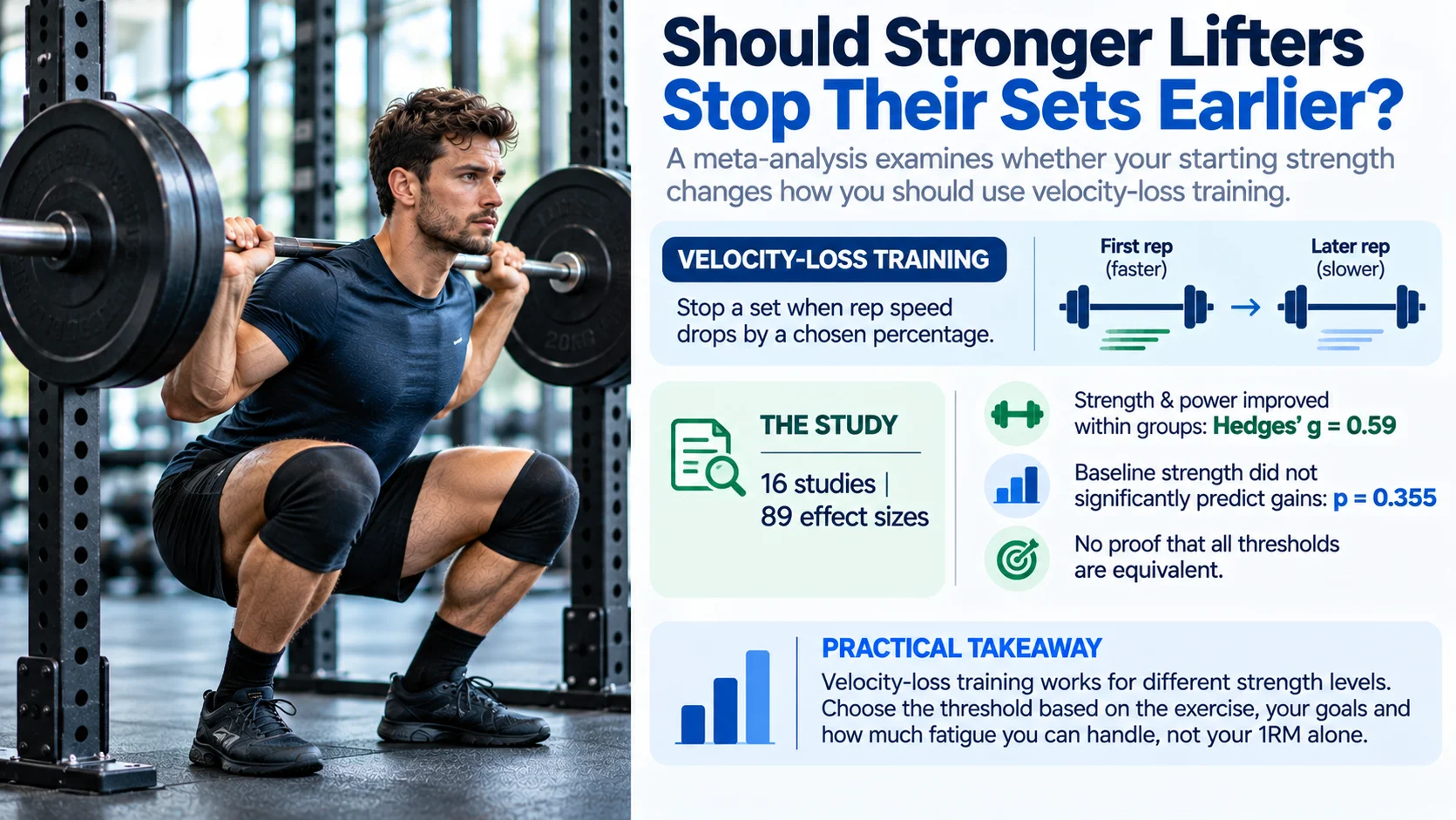
Across 16 randomized controlled trials and 89 effect sizes, the researchers found improvements in strength and power. Baseline strength and training status did not significantly explain differences in those improvements.
That result questions the assumption that stronger athletes automatically require a different velocity-loss threshold. It does not establish that one threshold is equally effective for everyone.
What Does Velocity Loss Mean in Resistance Training?
Repetition speed generally decreases as fatigue develops during a demanding set. Velocity-loss training measures that decline and uses a predefined percentage as a stopping point.
Consider a lifter whose fastest repetition in a set is performed at 0.60 meters per second.
A 20% velocity-loss threshold would correspond to a repetition speed of 0.48 m/s. Once the measured speed reaches the prescribed threshold, the set ends.
This example illustrates the calculation rather than a universal prescription. Actual measurement procedures depend on the device and protocol.
A lower velocity-loss threshold generally stops a set earlier, limiting the decline in repetition performance. A higher threshold allows more slowing and often more repetitions before termination.
The method differs from prescribing three sets of eight repetitions regardless of how quickly the bar moves.
It also differs from using bar speed to select the starting weight. Velocity-based load prescription adjusts resistance according to the load–velocity relationship; velocity-loss thresholds determine when a set should stop.
Both methods use velocity measurements, but they answer different programming questions.
Why Starting Strength Might Affect the Best Threshold
A coach working with beginners and experienced athletes may reasonably question whether both groups should use identical fatigue limits.
Stronger lifters typically handle greater absolute loads. Their movement efficiency, training history and ability to tolerate demanding sets may also differ from those of less experienced trainees.
These differences provide reasons to investigate individualized velocity-loss prescriptions. They do not establish that a stronger athlete necessarily needs a lower or higher threshold.
Starting strength can also be measured in different ways.
A 1RM test provides an exercise-specific estimate of maximum dynamic strength. The result may be expressed as an absolute load or relative to body mass.
The 2026 review used absolute baseline 1RM values, standardized across its dataset, to examine whether initial strength was associated with subsequent improvements [1].
That choice made quantitative comparisons possible, although combining measurements from different exercises introduced an additional source of variation.
Inside the 16-Study Meta-Analysis
Junjie Tao and colleagues searched PubMed, Web of Science, SPORTDiscus and Embase for relevant studies published through January 29, 2026 [1].
Eligible trials used predefined velocity-loss thresholds to terminate resistance-training sets, lasted at least three weeks and reported baseline strength alongside subsequent strength or power outcomes.
The final analysis included 16 randomized controlled trials contributing 89 effect sizes.
Ten studies, accounting for 48 effect sizes, involved participants classified as having a higher training level. These included trained athletes and experienced resistance-training participants.
Six studies, contributing 41 effect sizes, involved participants with a lower training level, including novices, physical education students and recreationally active individuals.
Interventions primarily used exercises such as the squat and bench press. Velocity-loss thresholds ranged from 0% to 50%, while the average intervention lasted 7.4 weeks.
The researchers applied a three-level random-effects model to account for multiple measurements coming from the same studies. They also used sensitivity analyses to examine whether the main findings depended heavily on particular studies or statistical assumptions.
An important methodological detail deserves attention: the pooled effects represented changes within training groups from before to after their interventions. The primary analysis did not pool comparisons against conventional training or non-training control groups.
Strength and Power Improved, but the Comparison Has Limits
The meta-analysis reported a moderate overall improvement in strength and power outcomes:
Hedges’ g = 0.59, 95% CI 0.40–0.77, p < 0.001 [1].
Hedges’ g is a standardized effect size. A value of 0.59 indicates the magnitude of the pooled pre-to-post change on a standardized scale; it does not mean that participants became 59% stronger.
The authors reported a significant amount of residual heterogeneity, indicating that outcomes varied beyond what would be expected from sampling error alone.
These findings establish that participants generally improved during velocity-loss-based resistance-training programs.
They cannot determine how much of that improvement was specifically caused by using velocity-loss thresholds instead of another reasonable resistance-training method.
Strength and power commonly improve during structured training. Without incorporating between-group comparisons into the primary pooled estimate, the analysis cannot isolate the additional benefit attributable to the velocity-loss approach.
For a coach deciding whether to adopt velocity tracking, that limitation changes the interpretation of the headline result. The review provides evidence about adaptation patterns among people using velocity-loss training, not proof that the method outperforms conventional programming.
Did Stronger Lifters Respond Differently?
Baseline strength was the review’s primary moderator.
The researchers examined whether participants who entered a training intervention with higher 1RM values experienced systematically different improvements.
The association was not statistically significant:
β = −0.076, 95% CI −0.237 to 0.085, p = 0.355 [1].
The negative coefficient represents the estimated direction of the relationship, but the confidence interval included both negative and positive values. The analysis therefore did not establish a reliable association between starting strength and adaptation magnitude.
Training status, categorized as higher or lower, was also not a significant moderator (p = 0.988).
The interaction between baseline strength and training status was similarly non-significant (β = 0.045, p = 0.775).
Taken together, the results offer no clear statistical basis for selecting different velocity-loss thresholds solely because one lifter begins stronger than another.
The conclusion is narrower than saying that strength level never matters. A meta-regression with 16 studies may lack the precision needed to identify small or context-dependent differences.
Was One Velocity-Loss Threshold Better Than Another?
Velocity-loss threshold itself was included as an additional moderator.
Its association with adaptation magnitude was not statistically significant (β = 0.001, p = 0.807). The overall moderator test was also non-significant (QM(4) = 1.09, p = 0.896) [1].
These analyses did not identify a clear relationship between the tested moderators and the variation in strength and power improvements.
They were not designed to establish that 10%, 20%, 30% and 40% velocity loss produce identical outcomes.
Thresholds influence how a set is performed. Stopping at a relatively small reduction in speed can limit accumulated repetition fatigue, while permitting greater slowing may increase the number of repetitions and the amount of work performed.
The appropriate trade-off depends on the intended training outcome.
A program emphasizing explosive performance may prioritize maintaining repetition speed. A hypertrophy-oriented session may tolerate more slowing, depending on the exercise, volume and overall program design.
Those are programming considerations, not threshold recommendations proven by this particular meta-regression.
What Coaches Can Actually Change
The most defensible application is to avoid assigning velocity-loss thresholds from 1RM alone.
Imagine two athletes preparing for a lower-body strength session. One has a much higher squat maximum, but both need to perform demanding training again within the next 48 hours.
A coach may choose a conservative velocity-loss target for both athletes to manage session fatigue. Their different maximum strengths, by themselves, do not provide evidence that they must use different stopping thresholds.
Now consider a session designed to accumulate more resistance-training volume. The coach might permit greater velocity loss, provided the exercise remains technically controlled and the workload fits the athlete’s recovery capacity.
The 2026 review does not validate either example as an optimal protocol. It helps identify what should not drive the decision automatically: a lifter’s baseline strength classification.
Match the Threshold to the Exercise
A velocity-loss target applied to a barbell squat should not automatically be transferred to a bench press.
Different exercises involve different movement mechanics, muscle groups, loads and velocity profiles. The included studies used exercise-specific 1RM measurements, but the review did not establish universal thresholds that transfer across movements.
Exercise selection should remain part of the prescription.
Account for the Rest of the Training Week
Velocity loss is one component of training load.
A low threshold may reduce the work completed in an individual set. Whether that produces a desirable weekly stimulus depends on the number of sets, loading intensity, exercise selection and other sessions.
An athlete performing frequent sprinting, jumping and resistance training may have different fatigue-management needs from a recreational lifter training three times per week.
Coaches should evaluate the complete program rather than treating a single velocity-loss percentage as a complete fatigue-management system.
Track the Athlete’s Response Over Time
A standardized starting threshold can be adjusted when repeated training observations provide a reason.
Relevant information might include changes in performance, completed volume, recovery between sessions and whether the athlete consistently meets the intended training objective.
This is a practical framework for individualization, not evidence that the meta-analysis identified a superior adjustment algorithm.
The Statistical Limitations Behind the Findings
The authors used several procedures to test whether the results were robust.
The interaction between baseline strength and training status remained non-significant under alternative estimation approaches, including robust variance estimation and wild bootstrap procedures.
A sensitivity analysis restricted to countermovement jump outcomes also found no significant interaction (p = 0.969). Its confidence interval was wide, however, leaving considerable uncertainty about the size of any potential relationship.
Removing individual studies did not materially alter the main conclusions. Excluding three studies rated at high overall risk of bias likewise left the moderator results non-significant.
These checks reduce concern that the primary finding depended on a single influential study. They do not eliminate the limitations of the underlying evidence.
Most trials were relatively short, and the samples were predominantly male. The findings may not generalize to longer training periods, female athletes or specialized populations.
Baseline strength was standardized from exercise-specific absolute 1RM values. This allowed the researchers to analyze different studies together but did not fully resolve differences between upper- and lower-body strength measurements. Body-mass-adjusted strength could not be examined consistently because the required data were unavailable.
The review also identified possible small-study effects. Egger’s regression test showed funnel-plot asymmetry (p = 0.0007), although this test is difficult to interpret confidently with only 16 studies and within-group effect sizes.
Finally, meta-regression examines patterns across study-level data. It cannot establish that individual athletes with different starting strength levels respond identically.
Does Every Lifter Need a Bar-Speed Sensor?
Velocity tracking can be useful when a coach wants objective information about repetition speed and set termination.
That does not make it essential for every resistance-training program.
Someone training primarily for general strength or muscle development can still use conventional methods to monitor load, repetitions, sets and progress. Fitnessprogramer’s exercise library provides movement options for building such programs without requiring velocity-measurement equipment.
A sensor becomes more valuable when its measurements support a specific decision that cannot be made as consistently through simpler methods.
For example, a strength and conditioning coach managing multiple athletes may want standardized information about repetition-speed decline. A recreational lifter with limited equipment and a straightforward progression plan may gain less practical value from the same investment.
This review did not compare the cost-effectiveness of velocity-tracking devices or demonstrate that sensor-based training produces better outcomes than well-designed conventional programming.
A Better Question Than “How Strong Is the Athlete?”
The 2026 meta-analysis found moderate improvements in strength and power during velocity-loss-based training, but no statistically detectable relationship between starting strength and the magnitude of those improvements.
The practical decision is therefore less about assigning thresholds according to a lifter’s 1RM category and more about defining what each set is supposed to accomplish.
Exercise selection, desired adaptation, accumulated workload and recovery demands provide the context in which a velocity-loss threshold becomes useful.
Stronger athletes do not automatically need to stop their sets earlier. Neither does the available evidence establish one ideal threshold for everyone.
A velocity measurement is most useful when the coach knows what action to take with it.
References
[1] Tao J, He T, Chen X, Xie L, He J, Huo K. (2026). Does baseline strength influence adaptations to velocity loss threshold-based resistance training? BMC Sports Science, Medicine and Rehabilitation, 18, 458. https://doi.org/10.1186/s13102-026-02067-z