A strength coach watches an athlete complete a series of hang power cleans. At 50% of their one-repetition maximum, the bar moves quickly. At 70%, the lift is slower but looks considerably more forceful. By 85%, the athlete has to work harder to accelerate the weight, yet the movement still looks explosive.
Which load produced the most power?
It’s tempting to pick the weight that moved fastest. Another coach might choose the heaviest successful lift, reasoning that more resistance requires greater force. Neither assumption tells the whole story.
Power depends on both force and velocity. Increasing the weight generally raises the force requirement while reducing the speed at which the movement can be performed. The combination determines the mechanical power produced.
Coaches have spent years looking for the loading percentage that best balances those demands.
A systematic review and meta-analysis published in Physiological Reports in November 2026 offers a more flexible answer [1]. Researchers examined 14 studies involving 197 people experienced in Olympic weightlifting derivatives, comparing acute peak power across different loads in the power clean and hang power clean.
Loads above 40% of one-repetition maximum generally produced greater peak power than lighter loads. But once resistance exceeded that level, the researchers found no statistically reliable advantage for one heavier loading zone over another.
Instead of identifying a single optimal percentage, the evidence pointed toward a relatively broad range in which high mechanical power could be expressed.
For coaches, that may be more useful than another rigid loading prescription.
Why the Fastest Bar Isn’t Necessarily the Most Powerful
Power is often described as the ability to produce force quickly.
In mechanical terms, power is calculated from force multiplied by velocity.
An athlete lifting a relatively light barbell may accelerate it rapidly, but the force required is lower than when moving a heavier load.
As resistance increases, force demands rise. Eventually, however, the reduction in movement velocity can offset the advantage of producing more force.
That relationship explains why peak power does not necessarily occur with the lightest or heaviest weight someone can lift.
Consider a hypothetical athlete performing hang power cleans at 40%, 60%, and 80% of their maximum.
The lightest lift might be the fastest. The heaviest might demand the greatest force. The middle load could produce the highest power, depending on how force and velocity combine.
But that’s only an example. Actual values depend on the athlete, exercise technique, movement phase, and measurement method.
The relationship is also not necessarily a perfectly smooth curve with one unmistakable peak.
Two or more loading conditions may produce similar power outputs, particularly when measurement variability and individual differences are considered.
That possibility motivated the new meta-analysis.
Power Clean and Hang Power Clean Are Related, but Not Identical
Both exercises belong to a family of weightlifting derivatives used in strength and conditioning.
During a power clean, the athlete begins with the barbell on the floor, lifts it through a coordinated pulling movement, and receives it on the shoulders in a partial squat rather than a full-depth squat.
A hang power clean begins from a standing or partially flexed position with the bar already held above the floor, commonly around the thigh or knee depending on the variation.
The athlete accelerates the bar and receives it in a similar front-rack position.
Both require coordinated extension of the hips, knees, and ankles, followed by a rapid transition into the receiving phase.
The hang variation removes the initial lift from the floor. That changes the starting conditions, range of motion, and demands of the pull.
The exercises are often used to train explosive force production, but technical proficiency is essential.
An athlete who struggles to coordinate the pull or receive the bar may produce inconsistent results regardless of the loading percentage.
FitnessProgramer’s Power Clean exercise guide illustrates the movement and its basic execution.
The study examined athletes already experienced with these exercises, not beginners learning them for the first time.
How the Researchers Examined the Power–Load Relationship
Jiaxuan Sun and colleagues searched PubMed, Web of Science, Embase, and EBSCO for relevant research published through December 14, 2025.
The review included studies in which participants performed power cleans or hang power cleans at multiple loads expressed relative to one-repetition maximum.
The researchers focused on acute peak mechanical power: the highest power output recorded during individual exercise testing.
This was not a review of training programs that followed athletes for several months.
It examined how much power participants produced when performing the lifts under different loading conditions.
Fourteen studies met the inclusion criteria.
Together, they involved 197 participants aged approximately 16–29 years. All had experience performing weightlifting derivatives.
Of those participants, 121 performed the hang power clean and 76 performed the power clean.
The sample was also heavily male: 189 participants were identified as men, while sex was not reported for the remaining eight.
That imbalance becomes important when considering how confidently the findings can be generalized.
The four loading zones
Rather than attempting to identify one exact percentage, the researchers organized resistance into four categories.
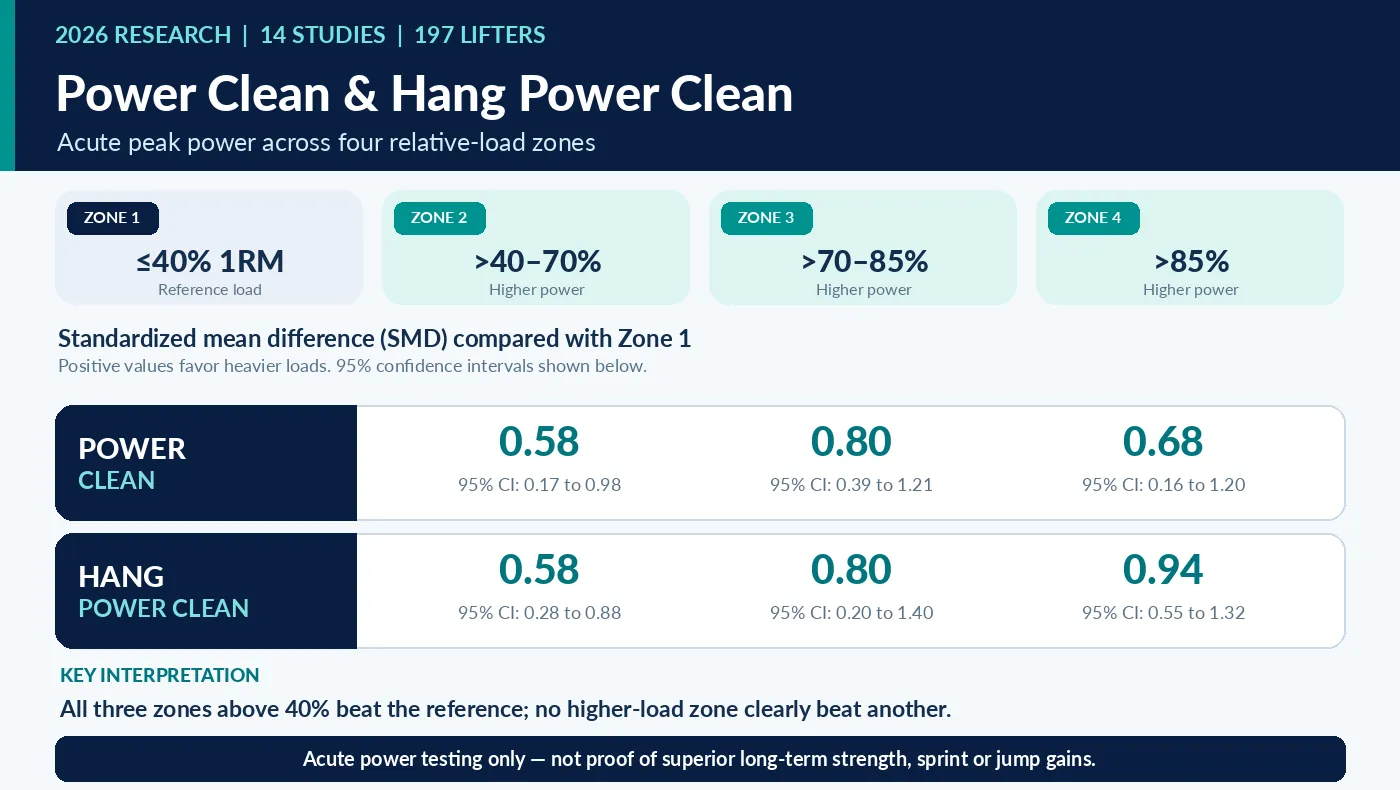
| Loading zone | Relative intensity |
|---|---|
| Zone 1 | Up to and including 40% 1RM |
| Zone 2 | Above 40% to 70% 1RM |
| Zone 3 | Above 70% to 85% 1RM |
| Zone 4 | Above 85% 1RM |
The categories made it possible to combine studies that tested different combinations of loads.
They also imposed a limitation.
The difference between 45% and 70% 1RM could be practically meaningful for an individual athlete, yet both loads fall into the same category.
Similarly, 86% and 95% are grouped together despite being different training demands.
The authors recognized that broad categories may obscure finer differences in the power–load relationship.
What the Meta-Analysis Found
The clearest result came from comparing the lightest loading zone with the three heavier zones.
For both power clean variations, loads above 40% 1RM produced significantly greater acute peak power than loads at or below 40%.
The researchers expressed the differences using standardized mean differences (SMD).
An SMD describes how far apart the conditions were relative to the variation in the underlying measurements. It is not a percentage increase in power.
| Loading zone compared with ≤40% 1RM | Power clean SMD | Hang power clean SMD |
|---|---|---|
| Above 40% to 70% | 0.58 | 0.58 |
| Above 70% to 85% | 0.80 | 0.80 |
| Above 85% | 0.68 | 0.94 |
All six comparisons were statistically significant, with p-values below 0.01.
The confidence intervals also favored the heavier loading conditions.
For example, the power clean comparison between Zone 3 and Zone 1 produced an SMD of 0.80, with a 95% confidence interval from 0.39 to 1.21.
For the hang power clean, the Zone 4 comparison produced an SMD of 0.94, with a confidence interval from 0.55 to 1.32.
At first glance, those numbers might encourage choosing the heaviest zone for hang power cleans.
But the next set of analyses changed that interpretation.
Why the Heavier Loads Didn’t Produce One Clear Winner
The researchers also compared Zones 2, 3, and 4 directly.
Those comparisons produced relatively small differences, none of which reached statistical significance.
For the power clean, standardized differences between heavier zones ranged from approximately 0.06 to 0.23.
For the hang power clean, they ranged from approximately −0.21 to 0.18.
The authors described this pattern as consistent with a plateau in the power–load relationship.
That word deserves attention.
A plateau does not mean every athlete produces exactly the same number of watts at 50%, 75%, and 90% 1RM.
It means the pooled evidence did not identify a reliably superior zone within the broader range above 40%.
An individual athlete might still show a clear peak at a particular load. Another might achieve nearly identical peak power across several loading conditions.
The meta-analysis estimates the average pattern across multiple studies, rather than identifying the ideal weight for every lifter.
The researchers also did not conduct an equivalence trial establishing that all heavier zones produce exactly the same power.
The lack of a significant difference means that superiority was not demonstrated—not that the zones are mathematically or physiologically identical.
Is 40% 1RM a Magic Threshold?
No.
The 40% boundary came from the way the researchers categorized loads.
It should not be interpreted as a biological switch where power suddenly increases once an athlete moves from 40% to 41% 1RM.
The study supports a broader observation: loading conditions above the lightest category generally produced higher acute peak power.
Exactly where the highest point occurs for an individual remains uncertain.
Consider an athlete with a 100 kg hang power clean maximum.
Under the study’s classification, 40 kg belongs to Zone 1, while 50 kg and 70 kg fall into Zone 2. An 80 kg lift is in Zone 3, and a 90 kg lift is in Zone 4.
These numbers simply illustrate how the categories work; they are not a prescribed training session.
The research does not establish that 50 kg is automatically better than 40 kg for every athlete with this maximum.
Nor does it mean a coach should select loads above 85% simply because those loads sometimes produced the highest numerical power values.
The categories are useful for describing the evidence. They are less useful as rigid boundaries for every training decision.
Why Power Measurement Methods Matter
Peak power is not as straightforward to measure as the number of kilograms on a barbell.
Researchers may use force plates, motion-capture systems, linear position transducers, or other equipment to estimate mechanical power.
Different devices and calculation methods can produce different values.
One issue is whether the measurement includes only the barbell or the combined movement of the athlete and external load.
During a power clean, the body contributes substantially to the movement. Ignoring body mass can change the interpretation of mechanical power.
The 2026 review attempted to reduce this source of inconsistency.
All included studies measured peak power using force plates, and the eligibility criteria required body mass to be incorporated into the power calculations.
That methodological choice helped make comparisons more consistent.
However, differences in technique, data processing, equipment setup, and testing procedures could still influence results.
The review’s findings therefore refer to peak power measured under those specific experimental conditions.
They should not automatically be treated as interchangeable with peak barbell power recorded by every commercial velocity-tracking device.
A coach using a different measurement system may observe a different power–load profile.
Does Maximum Power Output Mean the Best Training Load?
This is where the interpretation becomes more complicated.
The review examined what happened during individual lifting trials.
It did not examine whether athletes who trained for eight or twelve weeks at one loading zone developed greater strength, jumping ability, or sprint performance than athletes training at another zone.
Those are different questions.
Imagine two athletes producing similar peak power during hang power cleans at 65% and 85% 1RM.
The immediate power measurements may be similar, but the training demands are not necessarily identical.
The heavier load requires greater force and may involve different fatigue, technical, and recovery demands.
The lighter load may allow the athlete to perform the movement faster or maintain consistent technique across more repetitions.
Both could have a place in a training program.
What neither result tells us is which choice will produce the greatest long-term sporting improvement.
Training adaptations depend on repeated exposure, progression, total workload, recovery, and the interaction with other exercise.
The load that maximizes one laboratory measurement is not necessarily the load that maximizes adaptation over an entire season.
The authors explicitly limited their practical recommendations to acute peak-power assessment and the selection of loads based on immediate responses.
What Previous Research Found
The idea that power clean loading might favor relatively heavy weights is not new.
A 2015 meta-analysis by Soriano and colleagues examined peak power during several lower-body resistance exercises, including squats, jump squats, power cleans, and hang power cleans [2].
That review reported exercise-specific differences in the loading ranges associated with high power output.
The squat and jump-squat findings did not necessarily resemble those for weightlifting derivatives.
This is understandable because the exercises involve different movement patterns and mechanical constraints.
A jump squat allows the athlete to accelerate through takeoff. A power clean involves an explosive pull followed by receiving the bar in the front-rack position.
Even when both are described as power exercises, they do not necessarily produce the same power–load relationship.
The 2026 review offers a more focused analysis of the clean variations, examining four relative-load zones rather than seeking one optimal range across several very different exercises.
Its conclusion is less restrictive than a single-percentage recommendation.
High acute peak power was observed across a relatively wide range of loads above 40% 1RM, without reliable superiority among the heavier categories.
How This Connects to the Jump Squat vs. Half Squat Study
A recent randomized trial examined light-load ballistic jump squats and traditional half squats in 25 highly trained young rugby players [3].
Over six weeks, both groups improved strength and jumping performance. The ballistic jump-squat group generally recorded larger gains.
However, 30-metre sprint performance deteriorated in both groups.
FitnessProgramer covered the study in Jump Squat vs. Half Squat: Stronger Jumps, Slower Sprints.
There is a useful connection between the two investigations.
The clean meta-analysis examines immediate mechanical power output under different loads.
The rugby trial examines adaptations over six weeks to two different exercise methods.
Neither can answer the other’s main question.
A power clean load associated with high peak power cannot automatically be considered superior for developing sprint speed.
Similarly, larger jump improvements in a ballistic squat program do not identify the ideal load for peak power during hang power cleans.
The studies illustrate why coaches should choose training methods according to the outcome they are trying to develop.
How Coaches Can Use the Findings Without Overprescribing
For athletes already competent in power cleans and hang power cleans, the research provides some flexibility.
There may be little reason to insist that every explosive lifting session uses one exact percentage of 1RM solely to maximize measured peak power.
A coach could select from several loads above 40% depending on the athlete’s current ability, movement quality, and the demands of the training week.
A moderate load may be useful when the goal is to maintain fast, technically consistent repetitions.
A heavier load may be appropriate when greater force demands are desired and the athlete can maintain acceptable lifting mechanics.
The review does not establish which of those approaches produces better long-term adaptation.
It simply indicates that both can fall within loading ranges associated with high acute peak power.
For a more complete discussion of power-oriented training methods, FitnessProgramer’s Power Training Guide examines explosive resistance exercises, strength development, and the relationship between force and velocity.
The new meta-analysis adds evidence specifically about the clean variations. It should be used to refine practical decisions rather than replace all existing programming principles.
Technical Proficiency Comes Before Loading Precision
Power cleans and hang power cleans are technically demanding movements.
Effective execution requires coordination between the initial pull, explosive extension, bar path, turnover, and receiving position.
An athlete who cannot perform those phases consistently is unlikely to benefit from choosing a supposedly optimal loading percentage.
Technique also affects measurement.
If someone performs one repetition with an efficient bar path and another with excessive forward displacement, the recorded mechanical outcome may change for reasons unrelated to muscular power capacity alone.
For beginners, learning the movement under qualified supervision should come before attempts to identify a precise power-maximizing load.
This is particularly relevant because the meta-analysis included experienced participants.
The participants were accustomed to weightlifting derivatives, and most were young men.
Those characteristics may have influenced their ability to produce high power with heavier loads.
The results should not be applied without qualification to children, older adults, beginners, or female athletes whose responses were not adequately represented.
The Limitations Behind the Broad Loading Range
Fourteen studies and 197 participants provide useful evidence, but the available research remains limited.
The most obvious limitation is the population.
Of the 197 participants, 189 were reported as male, and sex was unspecified for eight.
There is insufficient evidence from this synthesis to establish the same power–load relationship specifically in women.
Training experience also matters.
All participants had experience with weightlifting derivatives. An athlete unfamiliar with the clean may have difficulty producing high power at heavier loads because the technique itself is limiting performance.
The studies also used different testing protocols and participant groups.
Although the researchers standardized the type of power measurement, differences in exercise execution, familiarization, and recovery between trials may have affected the results.
The broad loading categories are another limitation.
Grouping loads into percentage ranges makes meta-analysis possible, but it can conceal smaller differences between closely spaced loads.
A final limitation is the nature of the evidence.
These were predominantly acute power-testing studies, not long-term randomized training interventions.
Consequently, the review cannot establish that a particular loading zone produces superior improvements in maximal strength, rate of force development, sprinting, or sport-specific performance after weeks or months of training.
The authors also noted that more high-quality longitudinal research is needed.
So, How Heavy Should a Power Clean Be?
If the goal is to produce high peak mechanical power during an experienced athlete’s power clean or hang power clean, the available evidence favors loads above 40% 1RM over lighter loads.
But it does not identify one heavier percentage as consistently superior.
That gives coaches room to make decisions based on more than a single number.
Technique, athlete strength, intended movement velocity, fatigue, and the surrounding training program all deserve consideration.
The load that produces the highest instantaneous power reading may be useful for assessment. It is not automatically the best load for every training session.
For someone new to weightlifting derivatives, technical development remains the priority. For an experienced athlete, a broader loading range may provide enough flexibility to emphasize different training qualities without assuming that a single percentage is universally optimal.
The real contribution of the 2026 meta-analysis is not discovering a magic number.
It is showing that, for these exercises, high acute power output may be available across more of the loading spectrum than many narrow prescriptions imply.
That is a more useful starting point for coaching—and a more defensible conclusion than claiming one weight will make every athlete more explosive.
References
[1] Sun J, Wu Y, Zhang Y, Shi L, Li L. (2026). Optimal power load ranges for the power clean and hang power clean weight-lifting derivatives: A systematic review and meta-analysis. Physiological Reports, 14(21), e71154. https://doi.org/10.14814/phy2.71154
[2] Soriano MA, Jiménez-Reyes P, Rhea MR, Marín PJ. (2015). The Optimal Load for Maximal Power Production During Lower-Body Resistance Exercises: A Meta-Analysis. Sports Medicine, 45, 1191–1205. https://doi.org/10.1007/s40279-015-0341-8
[3] Zabaloy S, et al. (2026). Effects of Ballistic and Traditional Half-Squat Training With Light Loads on Strength, Jump, and Sprint Performance in Young Rugby Players: A Randomized Controlled Trial. International Journal of Sports Physiology and Performance. https://doi.org/10.1123/ijspp.2026-0228