
There is a familiar temptation after a hard set of squats: stay where you are, catch your breath, check your phone, and begin the next set when your legs finally feel ready.
Some lifters prefer a strict timer. Others argue that recovery should be guided by feel, particularly when the next set needs to be performed with enough weight and effort to stimulate muscle growth.
Both approaches sound reasonable. The real question is whether waiting until you feel ready produces better results than following a consistent rest period.
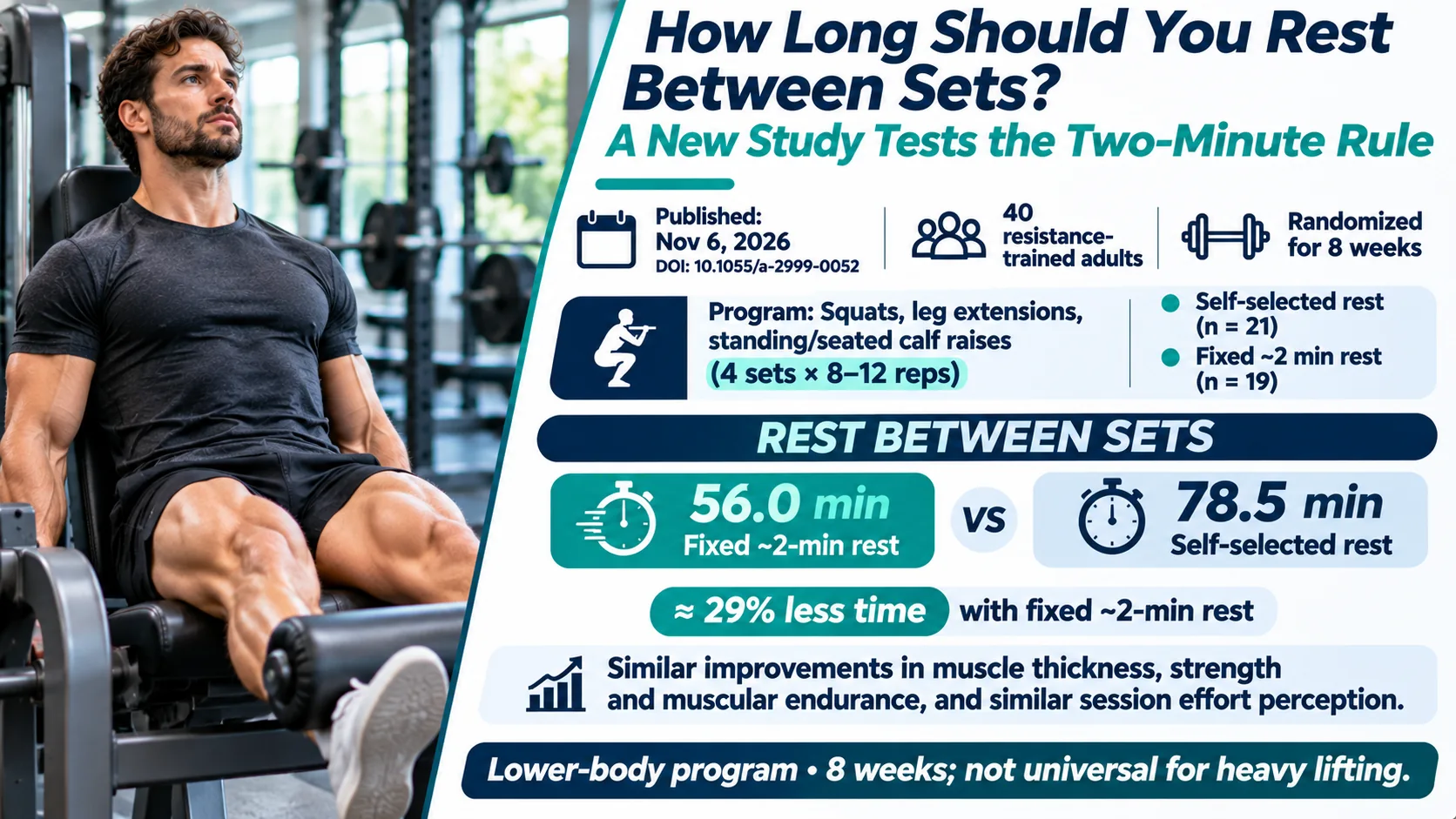
A randomized study published in the International Journal of Sports Medicine on November 6, 2026, examined that question in 40 resistance-trained adults [1]. Over eight weeks, participants followed a supervised lower-body program using either self-selected rest intervals or a fixed rest period of approximately two minutes.
The longer, self-selected approach did not produce meaningfully greater muscle growth, strength, or muscular endurance.
It did, however, make the workouts considerably longer.
Participants using fixed rest completed their sessions in an average of 56 minutes. Those choosing their own recovery periods averaged 78.5 minutes.
For lifters trying to build muscle without spending the entire evening in the gym, that difference deserves attention.
Why Rest Periods Have Always Been Debated
Resting between sets serves a practical purpose. It allows the body to recover enough to perform more work.
During demanding resistance exercise, muscles use stored energy and produce force repeatedly. As fatigue develops, the ability to maintain repetition quality and performance can decline.
Recovery between sets helps restore some of that capacity.
The amount of rest required depends partly on the exercise and the effort involved.
A heavy set of squats may require considerably more recovery than a set of relatively light calf raises. A powerlifter preparing for a near-maximal attempt is also operating under different demands from someone performing moderate-repetition hypertrophy work.
This is why rest recommendations vary.
Short intervals can make a session more time-efficient but may leave an athlete too fatigued to maintain the intended performance.
Longer intervals provide more recovery, potentially allowing the athlete to complete additional repetitions or maintain heavier loads.
There is a practical limit, though. Once enough recovery has occurred to complete the next set effectively, waiting considerably longer may contribute little to the training stimulus.
That was the uncertainty behind the new experiment.
Does allowing lifters to judge their own readiness lead to better muscular adaptations, or does it mostly lengthen the workout?
The Experiment Compared Freedom With a Fixed Timer
The research team, led by Adam Mohan, recruited 40 adults who already had experience with resistance training.
Participants were randomized into two groups.
Twenty-one entered the self-selected rest group, labeled SELF. The remaining nineteen followed fixed rest intervals of approximately two minutes, labeled FIXED.
Both groups trained their lower bodies under supervision for eight weeks.
The program contained four exercises:
- Squat
- Leg extension
- Standing calf raise
- Seated calf raise
Participants performed four sets of 8–12 repetitions per exercise.
The principal difference was how recovery time was managed.
In the SELF group, participants decided when they felt ready to begin the next set.
In the FIXED group, recovery was standardized to approximately two minutes.
The researchers measured muscle thickness using ultrasound, assessed dynamic and isometric strength, tested muscular endurance, and recorded workout duration and perceived session effort.
Because both groups performed the same broad exercise program, the comparison provided a useful way to investigate the consequences of rest-interval selection.
It was not a comparison of training versus inactivity. Both groups received a resistance-training stimulus.
Muscle Growth Was Similar in Both Groups
After eight weeks, both groups demonstrated improvements in muscle thickness.
The researchers did not identify a meaningful between-group advantage for choosing rest periods freely.
Their combined analysis of the hypertrophy outcomes produced a standardized treatment effect of approximately −0.1, with a 95% Bayesian credible interval from −0.2 to 0.0.
The effect was calculated as SELF minus FIXED, so the small negative estimate slightly favored the fixed-rest group.
The estimated difference was trivial in practical magnitude.
This is not evidence that the two rest strategies are biologically identical. Small differences may be difficult to distinguish in a relatively short intervention.
But the findings do not support the assumption that waiting until completely ready produces more muscle growth than taking approximately two minutes between sets.
That is useful because self-selected recovery can feel like a more individualized approach.
A lifter may believe that an additional minute or two must be helping because the next set feels easier.
Yet feeling more recovered before a set doesn’t automatically establish that the training program will produce greater hypertrophy over several weeks.
The outcome that matters is not how comfortable the next set feels. It’s whether the accumulated training provides a sufficient stimulus for adaptation.
In this experiment, both approaches appeared to do that.
Strength and Muscular Endurance Followed the Same Pattern
The researchers also investigated whether self-selected rest provided an advantage beyond muscle size.
Dynamic strength, isometric strength, and local muscular endurance improved in both groups.
The combined performance analysis produced a standardized treatment effect of 0.0, with a 95% credible interval from −0.3 to 0.3.
That interval includes the possibility of small advantages in either direction.
The researchers did not establish a meaningful overall advantage for either rest strategy.
It’s worth separating these outcomes.
Dynamic strength concerns the ability to generate force while moving a load. Isometric strength measures force produced without movement at the tested joint position.
Muscular endurance examines the ability to sustain or repeat muscular effort.
A recovery strategy might conceivably influence these abilities differently, especially when training intensity or exercise selection changes.
The present study did not identify such a benefit from self-selected rest within the program tested.
That doesn’t mean recovery duration becomes irrelevant to strength training.
It means that, for these experienced participants performing moderate-repetition lower-body exercises, allowing substantially longer discretionary recovery did not clearly improve the adaptations measured.
The Biggest Difference Was Time
The workout duration data provided the clearest distinction between the groups.
| Measurement | Fixed rest | Self-selected rest |
|---|---|---|
| Participants | 19 | 21 |
| Rest strategy | Approximately 2 minutes | When the participant felt ready |
| Average session duration | 56.0 minutes | 78.5 minutes |
| Session RPE | 8.2 | 8.1 |
| Muscle growth and performance | Improved | Improved similarly |
The average time difference was 22.5 minutes per session.
Expressed relative to the self-selected group’s training duration, fixed rest reduced the time required by approximately 29%.
That is a substantial difference for people balancing exercise with work, family, and other commitments.
Over two sessions, a 22.5-minute difference would amount to 45 minutes. Across many training weeks, the time cost would accumulate.
The study did not need to establish that short workouts are inherently superior for this to be useful.
Both groups achieved similar measured adaptations, but one required considerably less time.
There was also no obvious difference in overall session effort ratings.
The fixed-rest group reported an average session RPE of 8.2, compared with 8.1 for the self-selected group.
The longer sessions were therefore not accompanied by a clearly more favorable perception of overall exertion.
One possible explanation is that participants choosing their own rest periods allowed more recovery than the next set actually required.
That interpretation is plausible, but the outcome data alone cannot establish precisely why each person waited as long as they did.
The important observation is straightforward: additional time in the gym was not accompanied by additional measurable benefit over this eight-week program.
Does This Mean Two Minutes Is the Ideal Rest Period?
Not for every exercise or training objective.
The study compared approximately two minutes with self-selected rest periods. It did not directly compare two minutes with three, four, or five minutes of fixed recovery.
Nor did it test whether 60 or 90 seconds would have produced equally good results.
Those are different experimental questions.
A two-minute interval worked well enough in this program for the fixed-rest group to achieve similar adaptations with substantially shorter sessions.
It does not follow that two minutes is the optimal rest duration for every lifter.
A person performing low-repetition squats near their maximum strength may need longer recovery to maintain the intended load and movement quality.
Someone performing relatively light accessory exercises may feel ready sooner.
Exercise selection, load, set difficulty, and training experience all influence recovery demands.
FitnessProgramer’s guide to optimizing rest intervals between sets explains how rest duration interacts with different resistance-training goals.
The newer study adds a specific comparison: for experienced adults completing an eight-week, moderate-repetition lower-body program, unrestricted self-selected recovery did not outperform a fixed two-minute approach.
What Previous Research Says About Shorter and Longer Rest
A 2024 systematic review and Bayesian meta-analysis examined the effect of rest-interval duration on muscle hypertrophy across randomized resistance-training studies [2].
It found that hypertrophy could occur across a broad range of rest periods, while suggesting a possible small advantage from longer intervals over shorter ones.
That finding is not necessarily inconsistent with the 2026 experiment.
The two analyses investigated different comparisons.
The 2024 review considered various predefined rest durations across several studies.
The Mohan trial compared a fixed interval of approximately two minutes with an individualized strategy in which participants decided how long to wait.
The new experiment did not show that all longer rest periods are unnecessary.
Instead, it suggests that once recovery is sufficient for the planned training, additional waiting may provide little extra benefit.
There may be diminishing returns from extending rest periods.
For example, increasing recovery from 30 seconds to two minutes could have a very different effect from increasing it from two minutes to four minutes.
That comparison is illustrative. The Mohan trial did not directly test those exact alternatives.
The broader point is that recovery time should be considered in relation to the training demands rather than treated as a variable where more is always better.
Why Self-Selected Rest Sounds Better Than It Performed
Autoregulation is a familiar concept in resistance training.
Rather than following a completely rigid plan, an athlete adjusts part of the session according to current performance, fatigue, or readiness.
Used carefully, that flexibility can be valuable.
A person might reduce their working load after an unusually demanding day, or postpone a difficult set when technique is deteriorating.
Self-selected rest applies a similar idea to recovery.
The athlete waits until they feel ready.
The difficulty is that subjective readiness does not always correspond to the amount of recovery needed for the desired adaptation.
Some people may interpret readiness as feeling almost completely refreshed. Others may start while still breathing heavily.
Individual habits, perceived discomfort, and personal preferences can influence how long someone waits.
A standardized interval removes some of that uncertainty.
It also helps coaches organize training sessions, particularly when several athletes need to use the same equipment or follow a common program.
The new findings do not mean that autoregulation is ineffective.
They show that allowing unrestricted discretion over one particular training variable—rest between sets—did not improve the measured outcomes and came with a substantial time cost.
How This Connects to Cluster-Set Research
Another recent investigation examined a different approach to manipulating recovery during resistance training.
A systematic review and Bayesian network meta-analysis published in September 2026 compared traditional sets with cluster sets and rest-redistribution methods [3].
That review found that alternative set structures generally preserved movement velocity better than traditional uninterrupted sets.
FitnessProgramer covered those findings in Cluster Sets vs. Traditional Sets: Do Shorter Sets Really Keep You Lifting Faster?.
The distinction between the studies is important.
Cluster-set research often examines where rest is placed and how that affects repetition speed during an individual workout.
The Mohan experiment examined how choosing recovery duration influenced muscle growth and performance over eight weeks.
Acute velocity maintenance and long-term hypertrophy are different outcomes.
A set structure that preserves bar speed better does not automatically produce greater muscle growth.
Likewise, an eight-week finding about two-minute rest intervals does not establish the best way to organize repetitions during explosive power training.
Together, the studies show why the purpose of a rest strategy matters.
Rest can be used to preserve repetition speed, sustain training volume, regulate fatigue, or improve time efficiency.
The best approach depends on which of those outcomes a program actually prioritizes.
How to Use a Two-Minute Rest Interval in Practice
For a typical hypertrophy session involving moderate repetition ranges, approximately two minutes is a reasonable starting point.
It gives the athlete a consistent recovery period and makes workout duration more predictable.
But a timer should guide training rather than override obvious performance problems.
If an athlete repeatedly loses substantial repetitions from one set to the next, struggles to maintain technique, or cannot use the planned load, the rest period may need reconsideration.
The same applies when sets become unusually demanding because of accumulated fatigue from earlier exercises.
There is little reason to force an identical recovery interval for every movement simply because a study used it successfully in one lower-body program.
An experienced lifter might use longer recovery for demanding compound exercises and shorter recovery for less taxing accessory movements.
That is a programming choice, not a directly tested conclusion from this trial.
Consistency also matters.
Recording rest intervals alongside loads and repetitions can make training progress easier to interpret.
If one week involves two-minute breaks and the next involves five-minute breaks, an increase in repetitions may partly reflect the additional recovery rather than a genuine improvement in underlying strength.
Standardizing rest periods where practical helps reduce that source of variation.
For readers building a hypertrophy program, FitnessProgramer’s training volume guide offers further context about selecting a manageable number of challenging sets.
Rest duration and training volume interact, but they should not be confused. A longer workout is not automatically a higher-quality or higher-volume workout.
Where the Study’s Conclusions Stop
The trial had several useful design features: random assignment, trained participants, supervised sessions, and direct measurements of muscle thickness and performance.
Nevertheless, its scope was relatively narrow.
The program lasted eight weeks. Differences might develop over longer periods, particularly if training intensity or volume changed.
The exercises focused on the lower body. The study did not establish whether the same comparison would produce similar results for chest, back, or other upper-body muscle groups.
The participants were already familiar with resistance training. Complete beginners or elite strength athletes could respond differently.
The study also did not compare every possible fixed rest duration.
A finding that two minutes performed similarly to self-selected rest does not establish equivalence between two minutes and all shorter or longer alternatives.
Another limitation concerns the intended training goal.
The program used four sets of 8–12 repetitions, a range commonly employed in hypertrophy-oriented training.
It was not designed around repeated near-maximal lifts, Olympic weightlifting attempts, or sports requiring maximal explosive output with full recovery.
Those training situations may place different demands on between-set rest.
Finally, the statistical analyses showed broadly similar adaptations, but a single study cannot establish that the two strategies are precisely equivalent under all conditions.
The reported credible intervals still allow some uncertainty around the true differences.
When Longer Rest May Still Be Worthwhile
A fixed timer is useful until it interferes with the purpose of the session.
If a strength athlete is preparing for a very heavy squat or deadlift, maintaining load and technical consistency may require more than two minutes.
Explosive power training can also benefit from adequate recovery when the goal is to perform repeated high-quality efforts rather than accumulate fatigue.
Some individuals may need longer rest because of their training history, current fatigue, or the demands of a particular exercise.
There is no need to interpret the Mohan findings as an instruction to shorten every rest period.
A better reading is that additional recovery should have a purpose.
If an extra minute allows an athlete to complete meaningful planned work that would otherwise be missed, it may be justified.
If the extra minute simply extends a session without improving training quality or adaptation, it may offer little value.
The new trial cannot tell every lifter exactly where that boundary lies.
It does show that, under one commonly used lower-body training arrangement, letting participants decide when to begin each set substantially increased session duration without improving the measured results.
What the Two-Minute Rule Really Means
For resistance-trained adults following the eight-week program studied by Mohan and colleagues, approximately two minutes between sets proved to be an efficient approach.
Participants achieved similar improvements in muscle thickness, strength, and muscular endurance to those who chose their own recovery periods.
They also finished their workouts about 29% sooner.
The evidence does not establish that two minutes is a universal prescription, or that longer rest is never useful.
It makes a more practical point.
Recovery time should be sufficient to support the work you intend to perform. Beyond that, additional waiting needs a reason.
For many lifters, a consistent two-minute interval may be a useful default. Heavy strength work, demanding compound movements, and power-focused training may justify more flexibility.
A productive workout is not necessarily the one that lasts longest. It’s the one that provides the training stimulus you need, within a schedule you can realistically maintain.
References
[1] Mohan AE, Piñero A, Coleman M, Hopper A, Segtnan R, Montenegro D, Hermann T, Androulakis Korakakis PA, Wolf M, Swinton PA, Schoenfeld BJ. (2026). Freedom of Choice? Effects of Self-Selected Rest Intervals on Muscular Adaptations. International Journal of Sports Medicine. Published online November 6, 2026. https://doi.org/10.1055/a-2999-0052
[2] Singer A, Wolf M, Generoso L, Arias E, Delcastillo K, Echevarria E, Martinez A, Androulakis Korakakis P, Refalo MC, Swinton PA, Schoenfeld BJ. (2024). Give it a rest: a systematic review with Bayesian meta-analysis on the effect of inter-set rest interval duration on muscle hypertrophy. Frontiers in Sports and Active Living, 6, 1429789. https://doi.org/10.3389/fspor.2024.1429789
[3] Nagatani T, et al. (2026). The Effectiveness of Cluster vs. Rest-Redistribution Set Configurations to Maintain Movement Velocity During Resistance Training: A Systematic Review and Bayesian Network Meta-analysis. Sports Medicine – Open. https://doi.org/10.1186/s40798-026-01106-w