
A restless night can make an ordinary workday feel much harder. You lose track of a conversation, struggle to concentrate on something familiar, or wake up feeling as though you never properly rested. When these experiences become more frequent during perimenopause, the search for something that might help is understandable.
Creatine has recently entered that conversation. Long associated with muscle strength and exercise performance, the supplement is now being studied for potential effects on brain function, sleep and symptoms associated with the menopause transition.
But the evidence is much younger than the enthusiasm surrounding it.
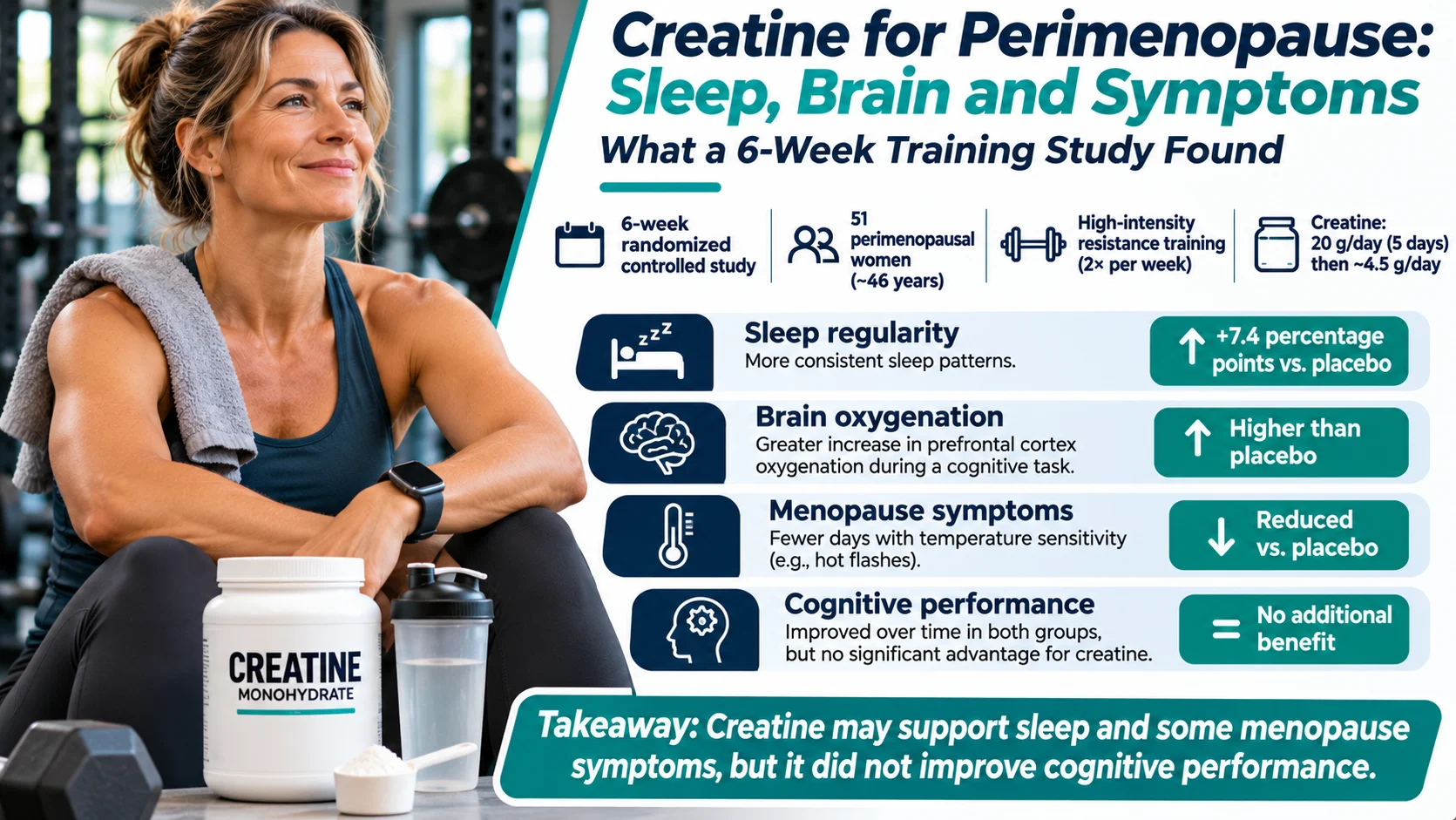
A study published in the European Journal of Applied Physiology on October 24, 2026, investigated creatine supplementation alongside six weeks of high-intensity resistance training in 51 perimenopausal women [1].
The results were intriguing, although not entirely positive.
Women assigned to creatine had more consistent sleep schedules than those receiving placebo by the sixth week. Researchers also detected a difference in prefrontal oxygenation during a cognitive task. Yet creatine did not produce better cognitive test performance, and some reported symptoms moved in opposite directions: fewer days involving temperature sensitivity, but more days involving bloating.
Understanding those differences is far more useful than simply asking whether creatine is good for menopause.
Why Researchers Are Looking Beyond Creatine’s Muscle Benefits
Creatine helps the body regenerate adenosine triphosphate (ATP), an immediate source of energy used by cells.
Its role in brief, demanding exercise is well established. Supplementation can increase muscle creatine availability and improve performance during repeated high-intensity efforts.
The brain also depends on an uninterrupted energy supply, and creatine participates in cellular energy regulation there as well.
That has encouraged researchers to investigate possible cognitive benefits, particularly under conditions of increased energy demand or physiological stress.
Perimenopause presents an interesting setting for that research.
During the transition toward menopause, hormonal fluctuations can coincide with disrupted sleep, changes in temperature regulation and complaints involving attention or memory.
These experiences vary widely. Some women report little cognitive difficulty, while others find that concentration, word retrieval or sleep disruption interferes with everyday life.
Not every symptom necessarily arises from the same biological process. Sleep deprivation, stress, mood disorders, medication and other medical conditions can influence cognition independently of reproductive hormones.
A supplement affecting cellular energy metabolism might plausibly alter certain physiological responses. Whether that produces a meaningful improvement in symptoms is a separate question.
The researchers wanted to examine both.
A Trial That Combined Creatine With Resistance Training
Paul Baker and colleagues recruited 51 women undergoing the menopause transition, with an average age of 46 years.
Participants were allocated to three groups.
| Group | Participants | Intervention |
|---|---|---|
| Creatine | 18 | Creatine monohydrate plus resistance training |
| Placebo | 20 | Placebo plus the same resistance training |
| Control | 13 | No additional training intervention |
The creatine and placebo groups received supplements under double-blind conditions. Neither the participants nor the investigators responsible for testing knew which supplement each woman had received.
The non-training control group was not blinded.
Both exercise groups completed the same six-week program, consisting of two supervised resistance-training sessions per week.
Sessions included leg presses, bench presses, lunges, shoulder presses, biceps curls and triceps extensions.
The exercises were performed using progressive resistance, with loads adjusted as participants became capable of completing the prescribed work.
That design is important because it allowed researchers to compare creatine with placebo while the two groups followed essentially the same training program.
The trial wasn’t comparing creatine users who exercised with people who remained completely inactive.
It was primarily examining what creatine added when resistance training was already present.
How supplementation was arranged
The creatine group completed a five-day loading phase involving 20 grams daily, followed by approximately 4.5 grams per day during the six-week training period.
The placebo group followed a matched supplementation schedule.
These quantities describe the experimental protocol. They should not be interpreted as a dosage recommendation for women experiencing perimenopause.
The researchers assessed cognitive performance and prefrontal oxygenation during laboratory visits. Participants also wore a WHOOP device to collect sleep measurements and record daily symptoms.
One methodological detail matters here: the baseline period used for wearable sleep comparisons included the supplement-loading phase.
There was no untreated wearable baseline recorded before supplementation began.
Consequently, changes described during training are relative to a period when participants had already started their assigned supplements.
What Actually Changed After Six Weeks?
The outcomes did not all move together.
| Outcome | Main finding | Interpretation |
|---|---|---|
| Sleep consistency | +7.4 percentage points with creatine versus placebo at week 6 | Favorable, exploratory finding |
| Prefrontal oxygenation | Higher task-related oxygenation in creatine versus placebo | Physiological difference, not proof of cognitive improvement |
| Stroop cognitive performance | Faster responses over time, without a significant treatment difference | No demonstrated creatine advantage |
| Memory test | No meaningful between-group improvement established | No demonstrated memory benefit |
| Temperature sensitivity | Fewer symptom-positive days in creatine group | Preliminary and statistically less robust |
| Bloating | More symptom-positive days in creatine group | Potentially unfavorable finding |
| Sleep duration | No significant treatment-by-time advantage | Creatine did not establish longer sleep |
The results are more complicated than a single favorable statistic might suggest.
Sleep regularity and sleep duration are different outcomes. A change in brain oxygenation does not establish improved mental performance. And a reduction in one self-reported symptom cannot be separated from an increase in another.
Sleep Became More Consistent, but Not Necessarily Longer
The clearest sleep-related difference concerned consistency.
The wearable device assessed how closely a person’s sleep and waking times followed a regular pattern across successive nights.
By the sixth week, the creatine group had a baseline-adjusted sleep-consistency score 7.4 percentage points higher than placebo.
The 95% confidence interval ranged from 1.5 to 13.3 percentage points, with p = 0.015.
Looking at the groups separately helps explain what happened.
Before the training period, the creatine group’s mean sleep consistency was approximately 75.8%. By the final assessment, it was 77.2%.
The placebo group’s corresponding values declined from approximately 74.8% to 69.4%.
Creatine therefore appeared to preserve sleep consistency while it deteriorated in the placebo group.
That’s different from saying creatine substantially improved sleep regularity beyond where participants began.
It is also different from saying that everyone taking creatine slept better.
The three-group analysis found that the creatine group did not significantly differ from the non-training control group at the final assessment.
The pattern is compatible with creatine attenuating a decline in sleep consistency during the training period, rather than producing an improvement above usual levels.
Did the women sleep more?
No reliable increase in sleep duration was demonstrated.
The researchers found no significant treatment-by-time interaction for total sleep duration. Nor was there a clear corresponding improvement in sleep disturbances or the proportions of slow-wave and REM sleep.
The creatine group actually recorded shorter average sleep duration than the placebo group, but that difference was already present before the training period.
It should not be interpreted as evidence that creatine reduced sleep duration.
The narrower finding is that sleep timing became more consistent relative to placebo, without a demonstrated increase in the amount of sleep obtained.
There is also uncertainty about what the difference means clinically.
The sleep-consistency score was generated using a proprietary wearable algorithm. It was adapted from established sleep-regularity concepts but is not identical to the Sleep Regularity Index.
The specific device and algorithm version had not been independently validated against laboratory polysomnography at the time of the study.
That doesn’t make the result meaningless. It does limit how confidently the change can be translated into a measurable improvement in sleep health.
The Brain Oxygenation Finding Is Interesting—but Easy to Overstate
During cognitive testing, the researchers used functional near-infrared spectroscopy (fNIRS) to estimate changes in oxygenation in the prefrontal cortex.
The prefrontal cortex participates in cognitive processes involving attention, working memory and behavioral control.
The researchers measured a tissue saturation index, which reflects an optical estimate related to oxygenation in the tissue being examined.
During the Stroop task, the post-intervention peak response differed between the two exercising groups.
The creatine group’s mean value was +0.32%, compared with −1.62% in the placebo group.
The post-training comparison between those groups was statistically significant (p = 0.003).
That observation suggests creatine may influence the hemodynamic response accompanying a cognitive task.
It does not demonstrate that the brain became more efficient or that the participants could think more clearly.
There is another important statistical detail.
When all three groups were included in the analysis, the treatment-by-time interaction for the peak oxygenation measure did not reach conventional significance (p = 0.083).
The more favorable comparison came from the analysis restricted to creatine and placebo.
Both results belong in a careful interpretation.
A brain oxygenation measurement provides information about physiological responses, but it is not a direct measure of intelligence, memory or relief from cognitive symptoms.
To establish that the physiological change produces a meaningful cognitive benefit, researchers would need stronger evidence linking the measurement to improvements in performance or daily functioning.
That connection was not demonstrated in this trial.
The Cognitive Tests Did Not Favor Creatine
Participants completed the Stroop task, a commonly used assessment involving attention and the ability to respond while managing potentially conflicting information.
Reaction times became faster over the study period.
For congruent trials, the time effect was statistically significant (p < 0.001). Incongruent trials also improved (p = 0.004).
However, the improvements were not significantly different between the creatine, placebo and control groups.
In other words, the researchers did not demonstrate that creatine improved Stroop performance beyond what occurred in the comparison conditions.
Repeated exposure to a cognitive test may contribute to improved performance simply because participants become more familiar with it.
The investigators acknowledged that possibility.
The memory assessment provided even less evidence of a creatine-specific benefit.
Participants performed the Rey 15-item memory test, but their scores were already close to the maximum possible score at baseline.
When people begin a test near its ceiling, it becomes difficult to detect further improvement.
The study therefore cannot establish that creatine has no cognitive effects under any conditions. Its tests may have been insufficiently demanding or sensitive to detect certain changes.
Nevertheless, the findings do not support the claim that creatine relieved brain fog or improved memory during this six-week intervention.
Fewer Temperature-Sensitivity Days, but the Evidence Is Fragile
The daily symptom reports revealed another potentially favorable pattern.
Women in the creatine group reported fewer days involving temperature sensitivity than those receiving placebo during the middle and final stages of training.
Temperature sensitivity was assessed through a daily yes-or-no question about unusual sensitivity to changes in temperature.
It was not a validated clinical measure of hot-flash frequency or severity.
The difference was statistically significant in the primary day-level analysis, but it relied on a particularly small subgroup.
Only nine women receiving creatine and ten receiving placebo contributed to the relevant analysis.
When the researchers repeated the analysis using participant-level summaries, the late difference no longer met the conventional significance threshold (p = 0.064).
That makes the result considerably less secure than it might appear from the main analysis alone.
The study did not directly measure core temperature, thermoregulation or physiological hot-flash episodes.
Consequently, it cannot establish that creatine treats vasomotor symptoms associated with menopause.
The finding is better viewed as a reason to conduct a larger study using validated symptom assessments.
An Unfavorable Finding: More Bloating With Creatine
The same symptom diary revealed a result that deserves equal attention.
Women receiving creatine reported more days involving bloating than those receiving placebo during the middle and final periods of the intervention.
The treatment-by-time interaction was statistically significant (p < 0.001).
Bloating was one of several symptoms recorded through the wearable application’s journal feature.
The results do not identify the precise mechanism. Gastrointestinal sensations, dietary factors and individual tolerance could all influence reports of abdominal discomfort.
The study also used a particular supplement formulation and protocol, so the results should not be generalized automatically to every creatine product or administration method.
Still, the finding complicates any claim that supplementation broadly improved menopause-related symptoms.
Some symptom reports favored creatine. Another favored placebo.
There were no convincing creatine-related advantages for the self-reported measures of fatigue, soreness or brain fog.
A balanced reading must include all of those outcomes.
How This Differs From the SMART Brain Menopause Study
Another 2026 investigation examined resistance training and brain health during the menopause transition.
The SMART Brain pilot randomized controlled trial followed 35 women through nine months of progressive resistance training [2].
Its investigators reported improvements in episodic memory among perimenopausal participants and cognitive flexibility among women in early postmenopause.
FitnessProgramer covered those findings in Strength Training During Menopause: Can It Improve Memory?.
The two studies raise related questions but should not be treated as contradictory.
SMART Brain examined a much longer resistance-training intervention and compared exercise with a wait-list control condition.
The Baker study examined whether creatine provided additional effects during six weeks of training.
The duration, outcome measures and participant characteristics differed.
A cognitive benefit from an extended resistance-training program does not imply that creatine must improve cognition over a much shorter period.
Equally, the lack of a creatine advantage in the six-week trial does not disprove the cognitive findings reported by SMART Brain.
Both studies are exploratory, and neither establishes that resistance training or creatine prevents dementia.
The useful connection is that exercise and brain function are being investigated through different interventions and measurements. Their results need to be interpreted according to what each trial actually tested.
What Established Creatine Research Can Tell Us—and What It Cannot
Creatine has a considerably stronger evidence base for exercise performance than for treating symptoms during perimenopause.
A separate 2026 three-level meta-analysis combined 63 studies involving 1,489 participants [3].
It found that adding creatine to resistance training produced moderate improvements in upper- and lower-body strength and a smaller increase in lean mass.
Fat mass did not show a statistically significant increase.
Those findings were discussed in FitnessProgramer’s Creatine Weight Gain: Does It Mean Fat Gain?.
But the established relationship between creatine and muscle performance cannot be used as proof of a benefit for memory, sleep or menopause symptoms.
The physiological processes are related through energy metabolism, yet the relevant outcomes are different.
Improving repeated high-intensity exercise performance is not equivalent to relieving cognitive complaints.
Likewise, a supplement that increases muscle creatine stores cannot be assumed to improve prefrontal oxygenation or sleep in every population.
The Baker study offers early evidence on these additional outcomes. It does not elevate them to the same level of certainty as creatine’s better-established exercise benefits.
Why the Trial Needs More Than a Quick Reading of Its Abstract
The study used randomization, placebo control and blinding between the supplement groups—important design strengths.
But several limitations affect how much confidence readers should place in the results.
Although 51 women were randomized, not all participants contributed usable data to every analysis.
The primary sleep analysis included 37 women across the three groups, while individual symptom analyses involved substantially smaller samples.
Missing wearable recordings and daily journal entries could have affected the results.
The sleep and symptom measurements were also secondary outcomes of a larger pilot study, which was primarily designed around measures of muscle quality and strength.
The sample-size calculation was not based specifically on detecting changes in cognition, sleep or menopause-related symptoms.
Another difficulty is the number of outcomes examined.
Researchers assessed several cognitive and oxygenation measures, multiple sleep characteristics and five categories of self-reported symptoms.
No adjustment for multiple comparisons across all exploratory outcome families was applied.
When a study conducts many statistical tests, some apparently favorable results can occur by chance.
The authors explicitly cautioned against treating isolated significant findings as confirmatory evidence.
The wearable baseline is another limitation. Because supplementation started before the reference sleep period, the investigators could not establish what participants’ untreated sleep patterns looked like.
The study also excluded people with certain sleep and mental health conditions or related medications, limiting how broadly the results apply.
Industry relationships were disclosed
The study received creatine products from AlzChem and Create Wellness, while WHOOP supplied the wearable devices.
One senior researcher disclosed advisory relationships, equity interests and supplement-industry research funding. Another author was an employee of WHOOP and held company stock options.
The authors stated that the supplement suppliers did not influence the study’s design, conduct or interpretation.
Industry involvement does not automatically invalidate research.
However, transparent reporting is especially important when an investigation relies partly on proprietary sleep metrics and examines products sold by companies connected to members of the research team.
Independent replication, ideally using validated sleep and clinical symptom measures, would increase confidence in the findings.
Should Women Consider Creatine Specifically for Menopause Symptoms?
The six-week trial does not provide enough evidence to recommend creatine as a treatment for brain fog, disturbed sleep or hot flashes.
It found a potentially useful difference in sleep consistency and an intriguing prefrontal oxygenation response.
But cognitive test performance did not improve more than placebo, and the symptom results included both favorable and unfavorable findings.
For women already considering resistance training, the better-established reasons to exercise remain highly relevant.
Progressive training can support strength, muscle function and the ability to perform everyday activities. Those benefits do not depend on creatine supplementation.
Nutrition, sleep habits and medical care also remain important during the menopause transition. FitnessProgramer’s guide to menopause nutrition discusses dietary considerations alongside exercise and recovery.
Persistent sleep disruption, substantial hot flashes or cognitive complaints that interfere with daily functioning deserve individualized medical assessment. These symptoms may have several treatable causes.
Someone considering supplementation, particularly while taking medication or managing a medical condition, should discuss suitability with an appropriate healthcare professional.
The dosing protocol used in this experiment should not be mistaken for a clinically validated treatment regimen.
What the Study Adds to the Conversation
Creatine supplementation during perimenopause is an interesting research topic because it sits between two areas with very different levels of evidence.
We know considerably more about creatine’s role in resistance-training performance than about its influence on sleep or cognitive symptoms during reproductive aging.
The Baker trial adds a small, controlled piece of evidence.
During six weeks of progressive resistance training, women receiving creatine maintained more consistent sleep patterns than those receiving placebo. Their prefrontal oxygenation response during a cognitive task was also more favorable in the direct supplement-group comparison.
Those differences did not translate into superior cognitive performance.
Fewer temperature-sensitivity days were reported in the creatine group, but that result was fragile and based on a very small sample. Bloating was reported more often.
It’s a study worth paying attention to, not one that settles the question.
For now, creatine remains a supplement with established applications in exercise performance and much less certain potential benefits for perimenopausal sleep and cognitive health.
The next studies will need to determine whether those early signals are reproducible, clinically meaningful and worth the additional burden of supplementation.
References
[1] Baker PA, DelBiondo GM, Kelly CG, Johnson WM, Grosicki GJ, Smith-Ryan AE. (2026). Creatine supplementation effects on cognition, sleep, and menopause symptoms in response to six weeks of high-intensity resistance training in perimenopausal females. European Journal of Applied Physiology. Published online October 24, 2026. https://doi.org/10.1007/s00421-026-06481-6
[2] Faridi W, et al. (2026). Study of Menopause and Resistance Training for Brain Health (SMART brain): a randomized controlled trial. BMC Medicine. https://doi.org/10.1186/s12916-026-05258-0
[3] Wang H, et al. (2026). Resistance training combined with creatine supplementation: a three-level meta-analysis of multidimensional outcomes from strength enhancement to body composition remodeling. Journal of the International Society of Sports Nutrition. https://doi.org/10.1080/15502783.2026.2718316