Getting out of a chair is something most people do without thinking. But later in life, that simple movement can become a useful measure of physical independence. It requires leg strength, balance, coordination and enough confidence to shift body weight forward and stand.
Exercise programs for older adults often use slow, controlled movements to develop those abilities. A common instruction is to take several seconds to lower the body during a squat or sit-to-stand exercise. The slower the descent, the longer the muscles remain under tension.
That sounds like a reasonable way to make a simple exercise more demanding. Whether extending the lowering phase actually produces better results is another question.
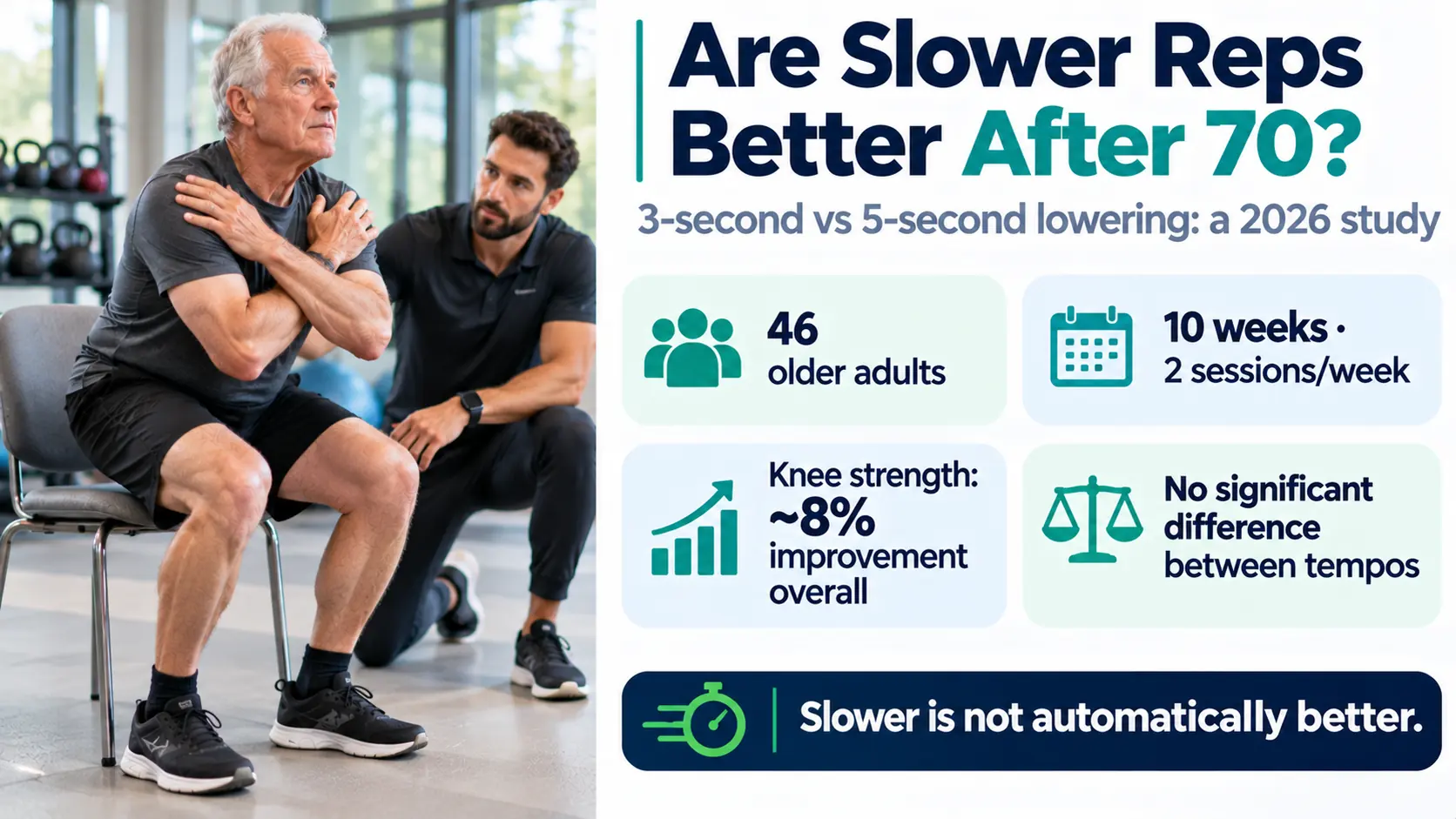
In September 2026, researchers published a study in the European Journal of Applied Physiology comparing two versions of bodyweight resistance training in healthy older adults. One group performed the lowering phase of each exercise over three seconds. The other used five seconds [1].
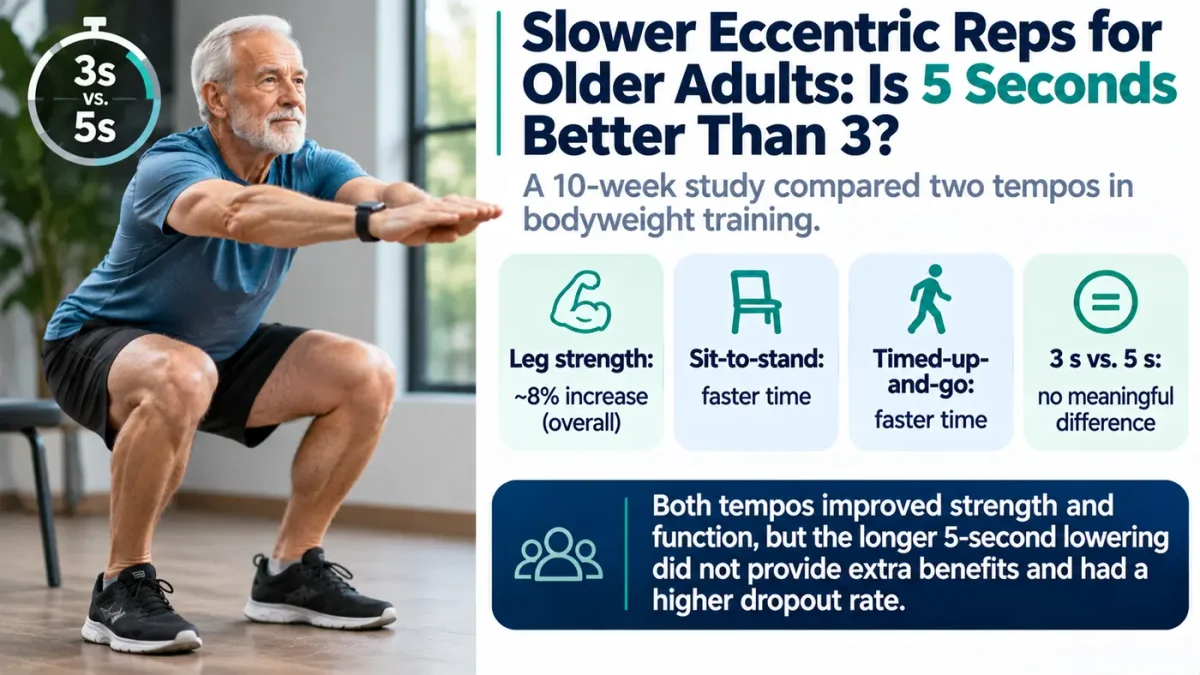
After ten weeks, both groups showed improvements in knee extensor strength and several measures of physical function. The longer lowering phase did not produce a statistically significant advantage.
There was also a striking difference in participation: half of the five-second group dropped out, compared with approximately one in six participants assigned to three seconds.
The results offer a useful perspective on exercise tempo, especially when the goal is not simply to make an exercise harder but to help people keep exercising.
What Happens During the Eccentric Phase of an Exercise?
Every repetition involves different types of muscular action.
During the lowering portion of a squat, the knee and hip extensors help control the descent while lengthening under load. This is an eccentric contraction.
When standing back up, those muscles shorten as they produce force. That is the concentric phase.
A controlled eccentric movement is different from simply letting gravity pull the body downward. The muscles remain active, regulating the speed and position of the movement.
Eccentric exercise has attracted considerable interest because muscles can generally tolerate relatively high forces while lengthening. Researchers have investigated its effects on strength, muscle structure and physical function.
But the benefits of eccentric exercise do not mean that every repetition should be performed as slowly as possible.
A five-second descent increases the time spent lowering compared with a three-second descent, assuming the movement and range of motion remain the same. It may also change how difficult the exercise feels.
Whether that extra time produces additional adaptation depends on factors such as loading, effort, training volume and the characteristics of the people performing the exercise.
For an older adult learning a chair squat, the most appropriate tempo may be the one that allows consistent, controlled movement without unnecessary discomfort or fatigue.
How the Ten-Week Study Was Conducted
Katsura and colleagues recruited 46 healthy older adults with an average age of 77.1 years.
Participants were assigned to two training groups:
- Three-second eccentric group: 24 participants.
- Five-second eccentric group: 22 participants.
Both groups performed six bodyweight resistance exercises twice per week for ten weeks.
The intended difference between the programs was the duration of the eccentric contraction. Participants were instructed to use minimal effort during the concentric portion, allowing the researchers to focus on the effect of the controlled lowering phase.
The investigators assessed several outcomes before and after training, including knee extensor strength, sit-to-stand performance, walking-related function, balance, blood pressure and blood lipid markers.
Unlike studies comparing exercise with no exercise, this investigation compared two active training programs.
That design can help answer whether one tempo is more effective than the other. It cannot establish how much of the improvement would have occurred without either program, because there was no non-exercising control group.
What Improved After Ten Weeks?
The researchers found no statistically significant differences between the three-second and five-second groups for changes in the measured outcomes.
The reported between-group p-values ranged from 0.159 to 0.914.
When results were considered across both training groups, several measures improved significantly.
| Outcome | Approximate overall change |
|---|---|
| Knee extensor isometric strength | +8% |
| Five-times sit-to-stand time | −7% |
| Timed Up and Go time | −5% |
| Systolic blood pressure | −5% |
| Total cholesterol | −6% |
| LDL cholesterol | −9% |
These are approximate changes reported across the intervention, not separate improvements attributable to the three-second or five-second tempo.
The reductions in sit-to-stand and Timed Up and Go times represent faster task completion.
The results are encouraging because they concern activities that have practical relevance to older adults. However, the absence of a non-exercising control group means that improvements cannot be attributed exclusively to the training intervention with the same confidence as in a controlled trial.
Nor does the lack of a significant between-group difference prove that the two tempos are exactly equivalent.
Why an 8% Increase in Knee Strength Is Relevant
Knee extensor strength contributes to movements such as standing from a chair, climbing stairs and controlling the descent when sitting down.
In the study, maximal voluntary isometric contraction strength of the knee extensors increased by approximately 8% across the training groups.
An isometric strength test measures the force a person can produce while the joint position remains fixed. It is a useful indicator of muscular capacity, although it does not capture every aspect of everyday movement.
An increase in measured strength may make certain tasks less demanding relative to a person’s maximum capacity.
That doesn’t mean an 8% improvement automatically produces an equivalent improvement in walking speed, balance or independence.
Those outcomes involve additional factors, including coordination, joint mobility, sensory function and confidence.
The study measured some of these broader functional abilities separately, allowing the researchers to look beyond isolated muscle strength.
Standing Up Faster May Matter More Than Repetition Tempo
The five-times sit-to-stand test asks participants to stand up and sit down five times as quickly as possible under standardized conditions.
It is a familiar assessment in older-adult fitness and rehabilitation because it reflects the ability to perform repeated transitions between sitting and standing.
Across the study groups, completion time improved by approximately 7%.
The Timed Up and Go test improved by around 5%. This assessment combines standing from a chair, walking a short distance, turning, returning and sitting down.
These changes suggest improvements in the measured tasks over the intervention period.
They do not establish that every participant experienced a clinically meaningful change. Whether a difference is meaningful for an individual depends on baseline ability, measurement reliability and the threshold used for clinical interpretation.
For readers interested in assessing physical function, FitnessProgramer’s 5 Strength Tests for Your 50s discusses several practical movement assessments, including sit-to-stand ability.
Although that article is aimed at a younger age group than the participants in this study, the underlying idea remains relevant: everyday movements can reveal useful information about strength and physical capacity.
The important point is not to turn every movement into a timed competition. For older adults, safe and consistent execution should come before speed.
Did Five-Second Repetitions Produce Better Results?
The researchers began with the hypothesis that a longer eccentric contraction would produce greater improvements.
The results did not support it.
Across the measured strength, functional and health outcomes, the five-second group did not demonstrate a statistically significant advantage over the three-second group.
A longer lowering phase may increase time under tension for an individual repetition. But more time under tension does not guarantee greater adaptation, particularly when the additional duration changes fatigue, comfort or the ability to complete the prescribed training.
There is also a methodological distinction worth preserving.
A non-significant result means the study did not detect a reliable difference between the two programs. It does not prove that three and five seconds are interchangeable under every training condition.
The sample was relatively small, and the high dropout rate in one group reduced the amount of information available at follow-up.
The findings apply most directly to the specific bodyweight program and older-adult population examined.
They should not be used to conclude that longer eccentric contractions are ineffective in younger adults, experienced lifters or rehabilitation programs using different loads.
The Dropout Rates May Be the Most Practical Finding
At the beginning of the intervention, 24 participants were assigned to the three-second group and 22 to the five-second group.
The reported attrition rates were:
- Three-second group: 17%.
- Five-second group: 50%.
That is a substantial difference.
An exercise program cannot deliver its intended long-term benefits if participants find it too difficult, inconvenient or unpleasant to continue.
Longer repetitions may increase the time required to complete a session or change the perceived difficulty of each exercise. But the study does not establish that those factors caused the higher dropout rate.
The authors explicitly cautioned that the difference in retention could not necessarily be attributed to eccentric duration alone.
Participant characteristics, personal circumstances and other unmeasured factors may have contributed.
The dropout pattern is therefore an important observation rather than proof that five-second repetitions are inherently less tolerable.
Still, it raises a question that matters outside the laboratory: when two exercise prescriptions produce similar measured outcomes, is the more demanding one worth choosing?
For many older adults, the ability to maintain a manageable routine may be more valuable than adding complexity without a demonstrated benefit.
What About Blood Pressure and Cholesterol?
The study also reported changes in cardiovascular and metabolic health markers.
Across the two groups, systolic blood pressure decreased by approximately 5%, total cholesterol by around 6% and LDL cholesterol by roughly 9%.
These changes were statistically significant within the study’s analysis.
They are worth reporting, but their interpretation requires restraint.
Without a non-exercising control group, the researchers could not rule out other influences on blood pressure or lipid measurements over the ten-week period.
Diet, medication, normal biological variation and other lifestyle factors can affect these outcomes.
The findings therefore do not establish that three-second or five-second eccentric exercise is a treatment for hypertension or high cholesterol.
They also do not justify replacing prescribed medication with bodyweight training.
For older adults managing cardiovascular conditions, exercise decisions should account for medical history, current treatment and professional guidance.
Does Slower Eccentric Training Build More Muscle?
Muscle hypertrophy was not directly measured in this study.
The researchers assessed knee extensor strength and functional outcomes, but they did not report direct measurements of muscle thickness or cross-sectional area to determine whether one tempo produced greater muscle growth.
This limits how the findings should be connected to bodybuilding-style discussions of time under tension.
A slower repetition may feel more demanding because the muscles remain active for longer. That sensation is not itself evidence of greater hypertrophy.
FitnessProgramer’s article Can You Build Muscle With Bodyweight Training? discusses how exercise difficulty, volume and progression can influence muscle development without external weights.
The present study adds a narrower observation: among these older adults, extending the eccentric phase from three to five seconds did not demonstrate better strength or functional outcomes over ten weeks.
It cannot tell us which tempo maximizes muscle growth.
How This Fits With Recent Resistance-Training Research
Several recent studies have examined whether making a training method more specialized produces better results.
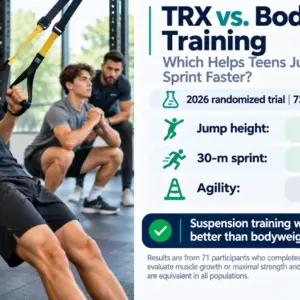
A 2026 randomized trial comparing suspension training with conventional bodyweight resistance training in adolescent boys found that both approaches improved jumping and sprinting relative to a control group, without a significant advantage for suspension training [2].
Another investigation compared velocity-based and percentage-based bench press training in trained young men. Both groups improved strength and pectoralis major size, with no significant between-group advantage [3].
Those studies involved different participants, exercises and outcomes. They should not be treated as direct evidence about eccentric tempo in older adults.
There is nevertheless a useful programming question connecting them.
When a modification makes training more elaborate, what additional outcome does it actually improve?
A suspension trainer may offer exercise variety. Velocity tracking may provide useful feedback. Slower eccentric repetitions may help someone control a movement.
Each feature can have practical value without necessarily producing superior long-term adaptations.
The best choice depends on the purpose of the intervention and whether the extra complexity is justified.
How Older Adults Can Use Controlled Bodyweight Exercises
For someone beginning resistance training later in life, the priority is usually to establish movements that can be performed safely and repeated consistently.
A chair-assisted squat is one example. It allows the participant to practice lowering the body toward a stable seat and standing again.
The chair provides a clear movement target and can help standardize the exercise.
Other movements might include supported calf raises, wall push-ups and appropriately assisted step-ups, depending on individual ability.
FitnessProgramer’s bodyweight exercise guide provides examples of movements that can be modified for different fitness levels.
That guide is not a substitute for individualized exercise assessment in older adults with balance problems, significant joint pain or medical limitations.
A controlled three-second lowering phase may be a reasonable option for some participants, but it should not be treated as a universal prescription derived from this study.
A person who needs hand support, a smaller range of motion or a different movement speed may require those adjustments.
The objective is controlled, comfortable movement with a suitable level of challenge—not forcing every repetition to match a stopwatch.
What the Study Cannot Establish
The trial provides a useful comparison, but several limitations affect the strength of its conclusions.
First, there was no non-exercising control group. Improvements observed across both groups cannot be attributed exclusively to training with the same certainty as in a randomized trial including an inactive comparison.
Second, the sample included 46 healthy older adults. The findings may not apply to frail individuals, people recovering from injury or those with significant neurological or cardiovascular conditions.
Third, the high attrition in the five-second group makes the comparison more difficult to interpret. When many participants leave a study, the remaining participants may not represent everyone who began the intervention.
Fourth, the program lasted ten weeks. It cannot establish which tempo is more sustainable over six months or a year.
Finally, the study did not directly measure hypertrophy, and its results do not identify an optimal eccentric duration for every bodyweight exercise.
The authors’ conclusion was appropriately limited: the longer eccentric phase did not produce a significant advantage, while the higher retention in the three-second group may indicate better practicality.
Is Three Seconds the Better Choice?
For healthy older adults performing a similar bodyweight resistance-training program, the evidence does not provide a compelling reason to extend every lowering phase from three to five seconds.
Both groups showed improvements in knee strength and functional tests. The longer tempo did not demonstrate additional benefits, and substantially fewer participants completed that program.
That does not make three seconds a magic number.
Someone may benefit from a slower descent when learning control, while another person may need a more natural rhythm to complete the movement comfortably.
The appropriate tempo should support the exercise rather than become an obstacle to it.
In later life, the ability to stand, walk, climb stairs and remain physically active has value far beyond the number of seconds spent lowering into a squat.
A program that people can perform confidently and continue over time may ultimately be more useful than one that looks more demanding on paper.
References
- Katsura Y, Takeda N, Inami T, Yamaguchi S, Takahashi S, Nakamura M, Nosaka K. (2026). Eccentric contraction duration in bodyweight resistance exercise training for changes in physical function and health parameters of older adults. European Journal of Applied Physiology. https://doi.org/10.1007/s00421-026-06443-y
- Wang Y, Sun M, Yang Y, Xu W, Batrakoulis A. (2026). Effects of suspension training and bodyweight resistance training on neuromuscular power, sprint, and agility performance in untrained male adolescents: a three-arm randomized controlled trial. BMC Sports Science, Medicine and Rehabilitation. https://doi.org/10.1186/s13102-026-02106-9
- Fitas A, et al. (2026). Effects of velocity-based hypertrophy training on pectoralis major morphology, neuromuscular activation and bench press maximal strength. European Journal of Applied Physiology. https://doi.org/10.1007/s00421-026-06428-x