
Progressive overload is one of the most familiar principles in strength training. The idea is straightforward: as your muscles adapt to resistance exercise, training demands should gradually increase to support continued progress. But an important question remains: Can muscles still grow if you keep lifting the same weight for the same number of repetitions?
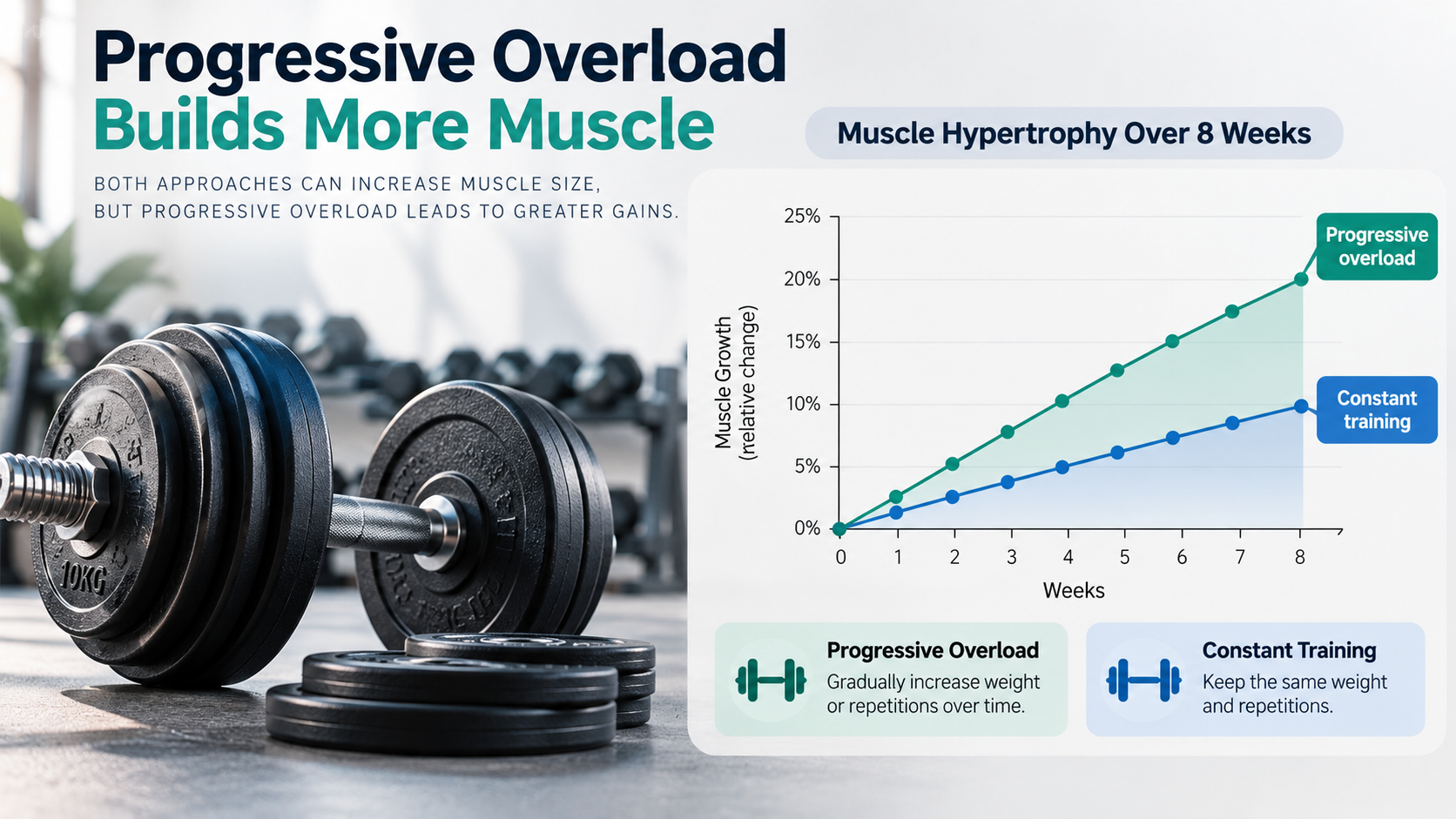
A randomized controlled study published in Medicine & Science in Sports & Exercise in 2026 provides valuable evidence. Researchers compared progressive overload with a training approach that maintained the same weight and repetitions over eight weeks. Both approaches increased muscle size in previously untrained young women, but progressive overload produced substantially greater improvements [1].
The findings challenge two common assumptions. First, muscle growth does not necessarily stop immediately when training demands remain unchanged. Second, simply repeating the same workout may not produce as much hypertrophy as systematically increasing the challenge.
Understanding this distinction can help lifters develop more effective resistance training programs without feeling pressured to increase the weight at every workout.
What Is Progressive Overload?
Progressive overload is the process of gradually increasing the demands placed on the body during training as physical capacity improves.
In resistance training, this usually involves increasing the weight lifted, performing more repetitions, or otherwise making an exercise more challenging.
For example, someone might begin performing three sets of eight repetitions with a 20 kg dumbbell. After several training sessions, they may be able to perform three sets of twelve repetitions with the same weight. Increasing the dumbbell weight slightly and returning to eight repetitions would represent a progression in training load.
The principle is based on the body’s ability to adapt to repeated physical demands. When training provides a sufficiently challenging stimulus, muscles can undergo structural and functional adaptations.
Over time, an unchanged training stimulus may become relatively less demanding as strength and exercise proficiency improve.
However, progressive overload should not be confused with continuously increasing weight regardless of technique, fatigue, or recovery.
Effective progression is gradual, measurable, and appropriate for the individual’s current abilities.
What Did the 2026 Progressive Overload Study Investigate?
Kassiano and colleagues conducted a randomized controlled trial to investigate whether progressive overload produces greater muscle hypertrophy than resistance training performed without increasing the workload [1].
The study involved 55 previously untrained young women.
Instead of comparing entirely separate groups of individuals, the researchers randomly assigned participants’ arms to different experimental conditions.
The Three Experimental Conditions
The study included three conditions:
- Progressive overload (PO): Training loads increased whenever participants reached the upper limit of the prescribed repetition range.
- Nonprogressive overload (N-PO): Participants maintained the same training load and number of repetitions throughout the intervention.
- Control: A time-matched condition without resistance exercise.
The training involved unilateral elbow extension exercises targeting the triceps brachii.
Participants in the exercise conditions completed three sets of 8–12 repetitions, three times per week, for eight weeks.
Muscle thickness was measured using ultrasonography at two locations along the upper arm, corresponding to 60% and 70% of arm length.
The researchers also calculated the combined thickness measurements to evaluate overall changes across the assessed regions.
This design provided a controlled comparison of progressive and nonprogressive training during the initial stages of resistance exercise participation.
Key Results: Progressive Overload Produced Greater Muscle Growth
The most important finding was that both training approaches increased triceps muscle thickness, but progressive overload produced larger improvements [1].
At the measurement location corresponding to 60% of upper-arm length, muscle thickness increased by approximately 21.4% in the progressive overload condition compared with 11.3% in the nonprogressive condition.
At the 70% location, progressive overload increased muscle thickness by approximately 25.0%, compared with 12.0% under nonprogressive training.
When the two measurement locations were combined, the results showed a similar pattern.
| Measurement | Progressive Overload | Constant Training |
|---|---|---|
| Triceps thickness at 60% arm length | +21.4% | +11.3% |
| Triceps thickness at 70% arm length | +25.0% | +12.0% |
| Combined thickness measurement | +22.9% | +11.6% |
The control condition showed only small changes.
These results suggest that progressively increasing resistance training demands can produce substantially greater regional muscle thickness gains than maintaining the same workload over eight weeks.
Importantly, the reported percentages describe changes in ultrasound-measured muscle thickness. They should not be interpreted as equivalent percentage increases in total muscle mass.
The study also does not establish that progressive overload always doubles muscle growth. The observed differences were specific to the participants, exercise, training protocol, and measurement period.
Can You Build Muscle Without Increasing Weight?
Yes. One of the study’s most useful findings was that participants in the nonprogressive training condition still experienced meaningful muscle hypertrophy.
Despite maintaining the same load and repetition count throughout the intervention, their triceps muscle thickness increased by approximately 11–12% across the measured locations [1].
This finding is particularly relevant for beginners.
Someone who has never performed structured resistance training may experience muscle growth when introduced to a new exercise stimulus, even if the training workload does not increase immediately.
An initially unfamiliar exercise can remain sufficiently challenging for a period of time.
However, this does not mean that constant training demands will continue producing the same results indefinitely.
The study lasted only eight weeks, and the researchers specifically identified longer-term responses to nonprogressive training as an unanswered question.
The distinction is important: muscle growth without progression is possible, but progression may increase the magnitude of that growth.
Why Does Progressive Overload Matter for Hypertrophy?
Muscle hypertrophy refers to an increase in muscle size, primarily associated with adaptations within skeletal muscle fibers.
Resistance training stimulates these adaptations through mechanical loading and the biological processes involved in muscle protein remodeling.
As a lifter becomes stronger, a previously challenging weight may represent a smaller percentage of their current strength capacity.
For example, a person who initially struggles to complete ten repetitions with a particular weight may eventually perform the same ten repetitions with considerably less effort.
Although the absolute workload remains unchanged, its relative difficulty has decreased.
Increasing the load when appropriate can help maintain a meaningful training challenge.
This provides a plausible explanation for why progressive overload produced greater hypertrophy in the 2026 study.
However, the investigators did not establish every biological mechanism responsible for the observed difference. The findings demonstrate an effect of the training conditions, not a complete explanation of the underlying cellular processes.
Does Progressive Overload Mean Increasing Weight Every Workout?
No. Progressive overload does not require adding weight during every training session.
The ability to increase resistance depends on several factors, including training experience, exercise selection, recovery, and the size of available weight increments.
Beginners may initially progress relatively quickly, while experienced lifters often require longer periods to achieve measurable improvements.
A practical strategy is to increase the load only after the current weight can be lifted for the prescribed repetitions with consistent technique.
For example, consider an exercise performed for three sets within an 8–12 repetition range.
A lifter might initially complete eight repetitions per set. Over subsequent sessions, they gradually increase their repetition performance until they can complete all three sets for twelve controlled repetitions.
At that point, increasing the load slightly and returning toward the lower end of the repetition range can provide a new challenge.
This method is commonly known as double progression.
For a detailed explanation of when and how to increase resistance, see our guide: How Do You Know When to Increase the Weight and by How Much?.
Different Ways to Apply Progressive Overload
Although the 2026 study specifically increased training load when participants reached the upper repetition limit, progressive overload can be implemented through several programming methods.
1. Increase the Training Weight
Increasing external resistance is one of the most direct ways to progress.
For example, a lifter may move from 40 kg to 42.5 kg on an exercise once the original load becomes manageable.
The increase should be small enough to preserve technique and the intended repetition range.
2. Increase Repetitions
Completing more repetitions with the same weight can represent improved performance.
For example, progressing from eight to eleven controlled repetitions with an unchanged load demonstrates an increase in repetition capacity.
This can be especially useful when the next available weight increment is too large.
3. Increase Training Volume
Adding an appropriate number of challenging sets can increase the total training stimulus.
However, increasing volume indefinitely is not advisable. Additional sets create more fatigue and may eventually provide diminishing returns.
Volume progression should be guided by recovery and performance rather than the assumption that more sets always produce more muscle growth.
4. Improve Exercise Execution
Using a more consistent range of motion, reducing excessive momentum, or improving exercise control can make training more standardized and potentially more demanding.
These improvements are valuable, but they should not automatically be treated as equivalent to increasing mechanical loading.
5. Increase Exercise Difficulty
Bodyweight training offers another example.
A lifter may progress from assisted pull-ups to unassisted pull-ups or eventually weighted pull-ups.
The goal is to increase the training challenge while preserving an appropriate movement pattern.
Not all progression methods have been demonstrated to produce identical hypertrophy outcomes, and the 2026 study should not be interpreted as having tested all of them.
How to Apply Progressive Overload in a Hypertrophy Program
An effective hypertrophy program should provide enough training stimulus to encourage adaptation while allowing adequate recovery.
Progressive overload works best when combined with consistent exercise selection, appropriate effort, and reliable performance tracking.
A practical approach involves selecting a manageable repetition range and maintaining it long enough to evaluate improvement.
For example, a lifter performing a dumbbell press could use three working sets of 8–12 repetitions.
Rather than increasing the weight immediately, they would first attempt to improve repetition performance while maintaining similar technique and effort.
Once the upper end of the repetition range is consistently achieved, the weight can be increased.
This approach makes progression easier to monitor and reduces unnecessary changes between workouts.
Readers interested in applying these principles to structured repetition schemes can also explore our 4×8 Hypertrophy Training Guide.
Example: Four Weeks of Progressive Overload
The following example illustrates a simple double-progression strategy. It is an educational example, not the exact protocol used in the 2026 study.
| Week | Load | Sets | Repetitions |
|---|---|---|---|
| 1 | 20 kg | 3 | 8, 8, 8 |
| 2 | 20 kg | 3 | 10, 9, 9 |
| 3 | 20 kg | 3 | 12, 12, 12 |
| 4 | 22 kg | 3 | 8, 8, 8 |
The lifter increases repetitions before increasing the weight.
After achieving the upper repetition target, the load increases and the process begins again.
In real training, progress may be slower and less predictable. Some weeks may involve no improvement, particularly during periods of poor sleep, elevated stress, or accumulated fatigue.
The objective is not to force progression according to a fixed calendar but to increase training demands when performance supports doing so.
Common Progressive Overload Mistakes
One of the most common mistakes is increasing weight before the lifter can control the current load.
Using excessive resistance may reduce range of motion, change the intended movement pattern, or make performance difficult to compare between sessions.
Another mistake is changing too many training variables simultaneously.
If weight, repetitions, exercise selection, and rest periods all change at once, it becomes difficult to determine which factors contributed to improved performance.
Some lifters also confuse progressive overload with continuously increasing fatigue.
Adding more sets, training closer to failure, and reducing rest periods may make a workout feel harder, but greater fatigue does not necessarily indicate a better hypertrophy stimulus.
Finally, progression should not be evaluated from a single workout.
Training performance fluctuates naturally. Looking at trends across several sessions provides a more useful picture than reacting to every small change.
What Are the Limitations of the 2026 Study?
The Kassiano study provides valuable controlled evidence, but several limitations should be considered [1].
Participants Were Previously Untrained Young Women
The findings cannot automatically be generalized to experienced bodybuilders, older adults, or other populations.
Beginners often respond differently to resistance training than individuals with several years of structured experience.
Only Triceps Training Was Investigated
The intervention involved unilateral elbow extension exercises.
It remains uncertain whether identical differences would occur with squats, deadlifts, bench presses, or multi-joint training programs.
The Study Lasted Eight Weeks
Eight weeks is sufficient to observe short-term training adaptations, but it does not establish what happens over six months or several years.
Longer-term studies are needed to determine how nonprogressive training compares with progressive overload as training experience accumulates.
Muscle Thickness Was the Primary Outcome
Ultrasound measurements provide useful information about regional muscle size, but they do not measure every aspect of muscular adaptation.
The findings should not be interpreted as direct evidence about total-body muscle mass or long-term strength development.
The Study Tested a Specific Progression Method
The progressive condition increased external load when participants reached the upper repetition limit.
The study did not directly compare all possible progression strategies, such as adding sets, increasing frequency, or changing exercise difficulty.
These distinctions are essential when translating research findings into practical training recommendations.
Frequently Asked Questions
Is progressive overload necessary for muscle growth?
Not necessarily for short-term growth. The 2026 study found that previously untrained women gained triceps muscle thickness even when training load and repetitions remained unchanged. However, progressive overload produced greater improvements [1].
How often should I increase the weight?
There is no universal schedule. Increase resistance when you can consistently complete your prescribed repetitions with appropriate technique and manageable effort. Progression frequency depends on the exercise and your training experience.
Can I build muscle by increasing repetitions instead of weight?
Increasing repetitions can be a practical progression strategy. However, the featured study specifically tested load progression against constant training, so it does not establish that repetition progression and load progression produce identical outcomes.
Does progressive overload work for beginners?
Yes. The featured research involved previously untrained participants and found greater triceps hypertrophy with progressive overload. Beginners should prioritize technique, consistency, and manageable increases in training demands.
What happens if I lift the same weight every week?
Muscle growth may still occur, particularly during the early stages of training. However, as your strength and exercise capacity improve, the same workload may become less challenging. The 2026 findings suggest that progressing the load can produce greater short-term hypertrophy than maintaining an unchanged workload.
Conclusion: Progression Matters, but It Does Not Have to Be Constant
The 2026 randomized study by Kassiano and colleagues provides direct evidence that progressive overload can increase the magnitude of muscle hypertrophy during resistance training [1].
Both progressive and nonprogressive training produced triceps muscle growth in previously untrained young women. However, the progressive condition resulted in substantially larger increases in muscle thickness over eight weeks.
The most important practical lesson is that muscle growth does not require increasing weight at every workout, but systematically increasing training demands can improve results.
Lifters should focus on controlled repetitions, appropriate effort, consistent performance tracking, and gradual progression when their current training workload becomes manageable.
Rather than chasing heavier weights at every opportunity, effective progressive overload involves making training more challenging at a rate that supports continued adaptation and recovery.
References
- Kassiano, W., Santos-Melo, V., Manske, I., Lisboa, F., Miguel, A., Gomes, F., Prado, A., Stavinski, N., Costa, B., & Cyrino, E. S. (2026). Progressive Overload Affects the Magnitude of Muscle Hypertrophy. Medicine & Science in Sports & Exercise, 58(7), 1556–1565. DOI: https://doi.org/10.1249/MSS.0000000000003968