
If your forearms burn before your back during pull-ups, you’re not alone. Many beginners—and even experienced lifters—notice that their grip gives out or their forearms become painfully fatigued long before their lats feel challenged.
At first, this can make it seem as though pull-ups are simply a grip exercise. In reality, your back muscles may never reach their full potential because your forearms become the limiting factor.
The good news is that this problem is usually fixable. In most cases, it comes down to grip endurance, pulling mechanics, muscle coordination, and training experience rather than weak back muscles alone.
Why Do Your Forearms Tire First?
During every pull-up, your hands are the only connection between your body and the bar.
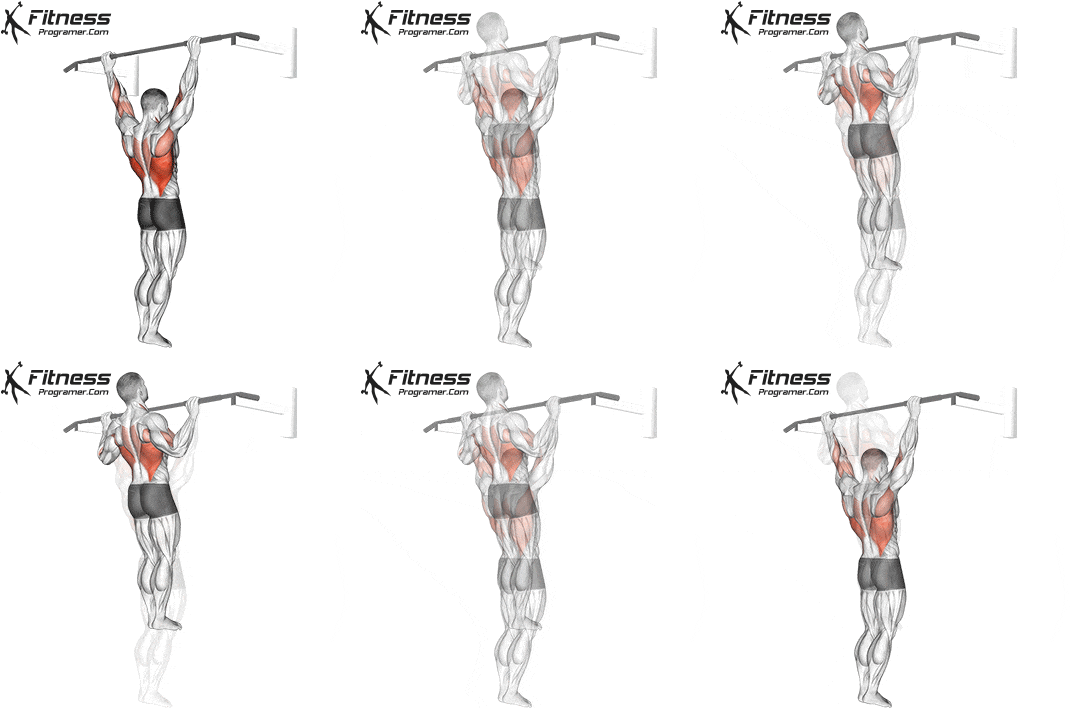
Before your lats, rhomboids, and other back muscles can generate force, your forearm flexors must maintain a firm grip throughout the entire repetition. These muscles work almost continuously in an isometric contraction, meaning they stay contracted without changing length.
Meanwhile, your back muscles repeatedly shorten and lengthen as you move through the exercise.
Because of this difference, the smaller muscles of the forearm often fatigue sooner than the much larger muscles of the back.
This doesn’t necessarily mean your forearms are weak—it simply means they’re reaching their endurance limit before your larger pulling muscles.
1. Your Grip Is the Weak Link
The most common reason for forearm fatigue is simple: your grip strength hasn’t yet caught up with your pulling strength.
Even if your lats are capable of producing more force, they can’t do their job if your hands can’t maintain a secure hold on the bar.
Signs your grip is limiting your performance include:
- Your fingers begin opening during the last repetitions.
- You struggle to hang from the bar for 30 seconds.
- Pull-ups feel easier when using lifting straps.
- Your forearms fatigue during rows, deadlifts, and lat pulldowns as well.
Improving grip endurance often improves pull-up performance without adding any back-specific exercises.
2. You’re Pulling With Your Arms Instead of Your Back
Another common mistake is initiating the movement by bending the elbows immediately.
When this happens, the elbow flexors—including the brachioradialis and other forearm muscles—become heavily involved before the shoulder muscles have a chance to contribute effectively.
Instead, think about beginning every repetition by pulling your shoulders down and back.
Many coaches describe this as “bringing your elbows toward your ribs” rather than “pulling yourself with your hands.”
Although both actions occur together, this cue often helps lifters recruit the lats more effectively.
3. You Squeeze the Bar Too Hard
A death grip may feel secure, but it can also accelerate forearm fatigue.
Many lifters unknowingly grip the bar much harder than necessary throughout every repetition.
A firm grip is important, but excessive gripping increases the workload on the forearm flexors without improving pull-up performance.
Try holding the bar securely instead of crushing it.
You’ll often notice your forearms stay fresher for longer.
4. Your Pull-Up Technique Needs Adjustment
Small technical mistakes can shift more work toward the forearms.
Common examples include:
- Pulling with rounded shoulders.
- Allowing the shoulders to shrug upward.
- Using only elbow flexion.
- Losing body tension.
- Swinging excessively.
Instead, begin each repetition by setting the shoulders before bending the elbows.
Imagine driving your elbows downward rather than pulling your chin upward.
This simple cue often changes how the exercise feels almost immediately.
5. Your Grip Width May Not Suit You
Many people assume that a very wide grip automatically targets the lats better.
In reality, an excessively wide grip may reduce your pulling efficiency while making the movement feel harder on your wrists and forearms.
For most people, a grip slightly wider than shoulder width provides an excellent balance between comfort and muscle activation.
Experimenting with small grip-width adjustments may help reduce unnecessary forearm fatigue.
6. Your Forearms Simply Need More Training
Just like any other muscle group, the forearms adapt to repeated exposure.
If you recently started doing pull-ups, it’s perfectly normal for your grip to fatigue quickly.
With consistent training, the forearm muscles become more resistant to fatigue.
Simple exercises that help include:
- Dead hangs
- Farmer’s carries
- Towel hangs
- Wrist roller exercises
- Heavy carries
You don’t necessarily need hours of grip training. A few minutes at the end of your workouts is often enough.
What Does the Research Say?
Electromyography (EMG) studies consistently show that pull-ups produce high activation of the latissimus dorsi, biceps brachii, lower trapezius, and several stabilizing muscles.
However, these studies also demonstrate that maintaining grip throughout the movement requires continuous activation of the forearm flexor muscles. Because these muscles work isometrically for the duration of every repetition, fatigue can occur before the larger pulling muscles are fully challenged.
Research comparing pull-up variations also shows that grip position changes muscle recruitment patterns slightly, but no grip completely eliminates the demand placed on the forearms.
In other words, some forearm fatigue is normal—but excessive burning that consistently ends your sets usually indicates that grip endurance or technique needs improvement.
How to Feel Your Back More During Pull-Ups
If your forearms always give out first, try the following:
- Warm up with light scapular pull-ups.
- Use a shoulder-width or slightly wider grip.
- Pull your shoulders down before bending your elbows.
- Think about driving your elbows toward your hips.
- Avoid squeezing the bar harder than necessary.
- Lower yourself under control.
- Stop one repetition before grip failure.
- Train grip strength separately two or three times per week.
Many lifters notice significant improvements after just a few weeks of practicing these adjustments consistently.
Should You Use Lifting Straps?
Lifting straps can reduce grip demands during some pulling exercises, but they are rarely recommended for regular pull-up training.
Because pull-ups naturally develop grip strength, relying on straps too early may slow that adaptation.
However, advanced athletes occasionally use straps during very high-volume back sessions when the goal is maximizing back training rather than improving grip.
For most people, building grip strength is the better long-term solution.
Frequently Asked Questions
Is it normal for forearms to burn during pull-ups?
Yes. Some forearm fatigue is expected because your grip muscles work continuously throughout every repetition. However, if your forearms always fail before your back feels challenged, your grip endurance or technique may need improvement.
Will grip strength improve pull-ups?
Absolutely. Stronger grip endurance often allows you to perform more repetitions before fatigue limits your performance.
Should I use chalk?
If sweaty hands cause your grip to slip, chalk may improve friction and reduce unnecessary grip fatigue.
Why don’t I feel my lats?
This usually results from pulling primarily with your arms, insufficient shoulder engagement, or limited mind-muscle connection. Improving technique and reducing excessive grip tension often helps.
Conclusion
If your forearms burn before your back during pull-ups, the issue is rarely caused by weak lats alone. More often, grip endurance, pulling mechanics, excessive grip tension, or limited training experience prevents your back muscles from becoming the primary movers.
Focus on improving your grip gradually, initiating each repetition with your shoulders, and pulling with your elbows rather than your hands. Over time, your forearms will become more resistant to fatigue, allowing your back muscles to receive the training stimulus they were meant to get.
References
- Dickie JA, Faulkner JA, Barnes MJ, Lark SD. Electromyographic Activity in Pull-Up Variations: A Systematic Review. Sports Biomechanics.
- Youdas JW, Amundson CL, Cicero KS, et al. Surface Electromyographic Activation Patterns and Elbow Joint Motion During Pull-Up Variations. Journal of Strength and Conditioning Research. https://pubmed.ncbi.nlm.nih.gov/21068680/