
Building a stronger bench press and developing larger chest muscles are two common goals in resistance training. Although both adaptations can occur within the same program, the most effective way to organize training may depend on how much fatigue accumulates during each set.
A 2026 randomized training study published in Medicine & Science in Sports & Exercise investigated how training intensity and velocity loss interact to influence bench press strength, pectoralis major hypertrophy, and muscular endurance. The researchers found that relatively heavy loads produced the greatest overall improvements, but the amount of velocity loss permitted within a set influenced which adaptations were emphasized [1].
The findings highlight an important distinction: training with heavier weights and training until substantial fatigue develops are not the same thing.
For lifters and coaches, understanding this difference may help improve exercise programming without automatically taking every set to muscular failure.
What Is Velocity Loss in Strength Training?
Velocity loss refers to the reduction in repetition speed that occurs as fatigue accumulates during a resistance training set.
When a lifter performs the bench press with the intention of pushing the bar as quickly as possible during the lifting phase, repetition speed generally decreases as the set progresses.
This reduction can be measured using velocity-tracking equipment.
For example, imagine a lifter whose initial repetition is performed at a bar velocity of 0.60 meters per second.
If a later repetition slows to 0.45 meters per second, the reduction represents 25% velocity loss.
The calculation is:
Velocity Loss (%) = [(Initial Velocity − Current Velocity) / Initial Velocity] × 100
Using the example:
[(0.60 − 0.45) / 0.60] × 100 = 25%
This means the lifter has reached a 25% velocity loss threshold.
In velocity-based training, a coach can use this information to determine when a set should end instead of prescribing only a fixed number of repetitions.
Velocity loss is particularly useful because two lifters using the same relative load may experience different levels of fatigue after completing the same number of repetitions.
However, velocity loss should not be confused with a direct measurement of muscular failure. The relationship between repetition speed, fatigue, and repetitions remaining can vary with the exercise, load, and individual.
What Did the 2026 Bench Press Study Investigate?
Pareja-Blanco and colleagues examined the combined effects of relative training intensity and velocity loss on bench press adaptations [1].
The randomized study involved 158 resistance-trained men completing an eight-week bench press training intervention.
Participants were assigned to 12 experimental groups combining three relative intensity ranges with four velocity loss thresholds.
Training Intensity Conditions
- Low intensity: 40–55% of one-repetition maximum (1RM)
- Moderate intensity: 55–70% of 1RM
- High intensity: 70–85% of 1RM
Velocity Loss Conditions
- 0% velocity loss
- 15% velocity loss
- 25% velocity loss
- 50% velocity loss
The researchers evaluated several outcomes before and after the intervention, including pectoralis major cross-sectional area, maximal strength, bar velocity against submaximal loads, and maximum repetition performance.
This experimental design allowed the researchers to examine not only the effects of training intensity but also how different levels of fatigue within sets influenced the results.
Key Finding: Heavier Loads Produced the Greatest Overall Improvements
Across the intensity conditions, training with 70–85% of 1RM produced the greatest improvements in several measured outcomes, including maximal bench press strength and pectoralis major muscle size [1].
This suggests that relatively heavy resistance can be an effective approach when the objective is to improve both strength and hypertrophy in trained individuals.
However, these findings do not establish that lighter weights are ineffective for muscle growth.
The study examined specific combinations of training intensity and velocity loss over eight weeks. Its results should not be interpreted as proof that every muscle group or exercise requires loads above 70% of 1RM for optimal hypertrophy.
The more interesting finding was that the velocity loss threshold changed the relative emphasis of the training adaptations.
Why 25% Velocity Loss May Be Better for Maximal Strength
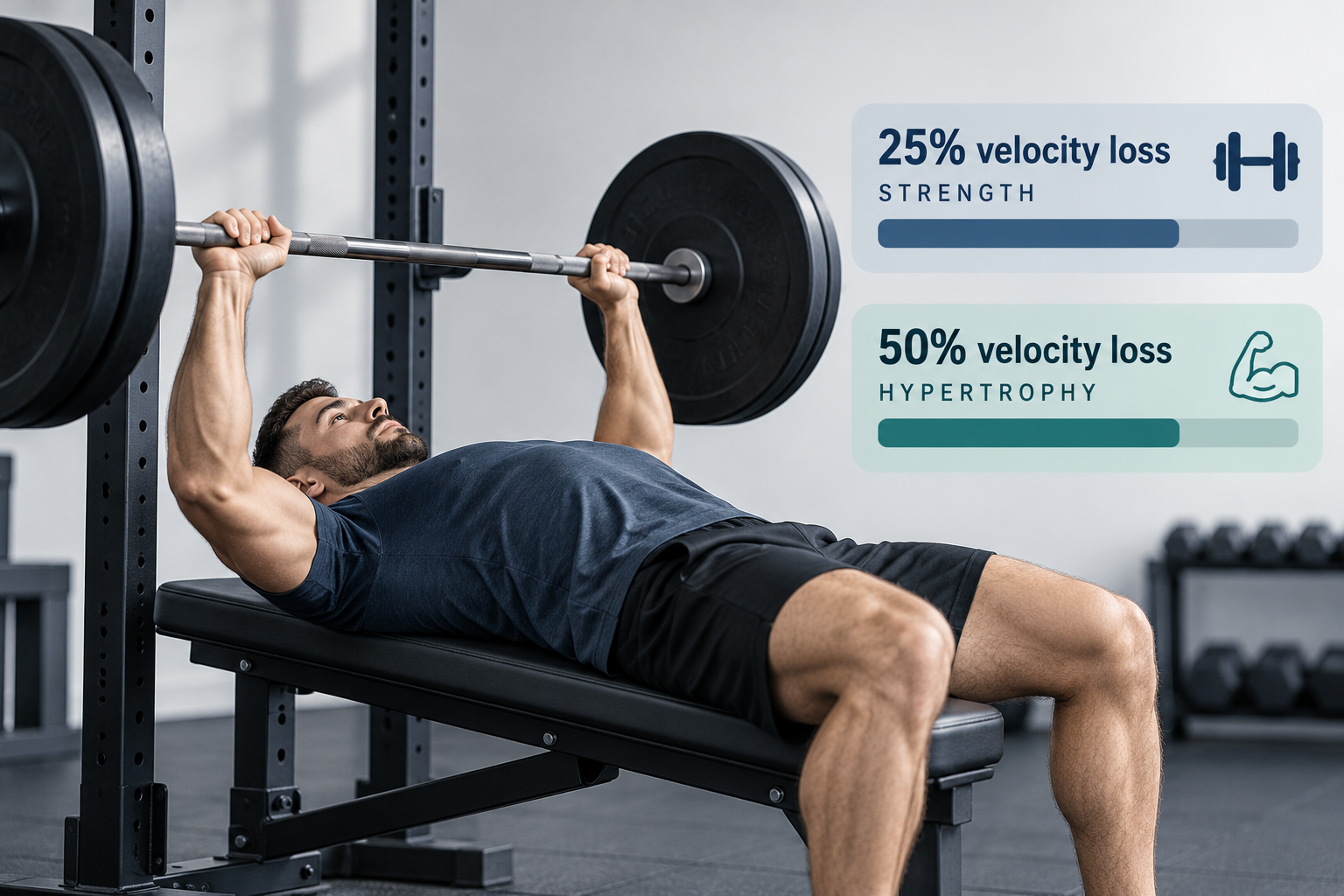
The researchers reported that a 25% velocity loss threshold produced the greatest improvements in one-repetition maximum performance among the velocity loss conditions [1].
This finding is relevant because maximal strength training requires more than simply accumulating repetitions.
Heavy lifting involves the ability to produce high levels of force, coordinate the movement efficiently, and maintain performance under demanding loads.
Allowing moderate fatigue within a set may provide sufficient training exposure without requiring every set to continue until repetition speed deteriorates substantially.
Consider a lifter performing bench press sets with 80% of 1RM.
Instead of continuing until another repetition becomes impossible, the lifter could terminate the set once repetition velocity has declined by approximately 25% from the reference repetition.
This strategy may help balance training stimulus and fatigue.
It is important to distinguish the research finding from a universal prescription. The study supports the effectiveness of moderate velocity loss for maximal strength development under its experimental conditions. It does not establish that exactly 25% is the ideal threshold for every lifter, training phase, or exercise.
Why 50% Velocity Loss May Support Greater Muscle Hypertrophy
The same study found that a 50% velocity loss threshold produced the greatest increases in pectoralis major cross-sectional area and maximum repetition performance [1].
A larger velocity loss threshold generally allows more repetitions to be completed before the set ends.
As the set continues, fatigue accumulates and repetition velocity declines.
This creates a different training stimulus from terminating the set earlier.
For hypertrophy-focused training, completing additional repetitions under sufficiently challenging conditions may increase the stimulus associated with muscle growth.
However, the results do not mean that every hypertrophy set must reach 50% velocity loss or that muscular failure is always necessary.
Greater velocity loss also represents greater fatigue within the set, which can influence subsequent performance and recovery demands.
The practical challenge is determining whether the potential benefit of additional repetitions justifies their fatigue cost.
For lifters performing multiple exercises and training sessions throughout the week, this distinction becomes especially important.
Strength vs. Hypertrophy: How Should You End a Bench Press Set?
The research suggests that different velocity loss thresholds can emphasize different adaptations.
| Training Goal | Research-Supported Direction |
| Maximal bench press strength | Moderate velocity loss, approximately 25% |
| Pectoralis major hypertrophy | Greater velocity loss, approximately 50% |
| Repetition endurance | Greater velocity loss, approximately 50% |
| Combined strength and muscle growth | Relatively heavy loads with fatigue managed according to the primary goal |
These findings describe the overall patterns reported in the eight-week study, not mandatory targets for every training program [1].
A strength-focused athlete may benefit from preserving repetition quality and limiting unnecessary fatigue.
A hypertrophy-focused lifter may sometimes allow sets to continue further, provided that technique remains controlled and recovery is adequate.
For individuals pursuing both outcomes, using different fatigue targets across exercises or training sessions may be a reasonable programming approach, although that specific strategy was not directly tested in the study.
Does More Fatigue Always Mean More Muscle Growth?
One of the most important lessons from resistance training research is that additional training stress does not automatically guarantee additional adaptation.
A separate 2026 study by Räntilä and Ahtiainen investigated the effects of exceptionally high resistance training volumes in 27 strength-trained male athletes [2].
Following an initial 10-week training period, participants completed a further seven-week phase involving either normal training volume or approximately 1.5 times that volume.
The higher-volume condition reached approximately 60 or more weekly sets in the studied programming structure.
Despite the substantial increase in training volume, the researchers did not observe statistically significant additional improvements in the measured muscle thickness or overall strength outcomes. Deadlift improvements favored the lower-volume condition.
Importantly, the weekly set totals should not be interpreted as a universal prescription or as equivalent to 60 isolated sets for every muscle.
Although training volume and within-set velocity loss are different variables, both studies highlight the importance of considering the relationship between training stimulus and fatigue.
Completing more work can sometimes be beneficial, but the additional work must be evaluated against its recovery demands and actual contribution to progress.
How Progressive Overload Fits Into Bench Press Training
Managing fatigue is only one part of an effective resistance training program.
Long-term improvements also require attention to progressive overload.
In another 2026 randomized study, Kassiano and colleagues examined the effects of progressive and nonprogressive resistance training in 55 previously untrained young women [3].
Participants performed unilateral elbow extension training over eight weeks.
Both progressive and nonprogressive training conditions increased triceps muscle thickness, but the progressive condition produced greater hypertrophy.
These results suggest that muscle growth can occur without continually increasing the training demand, particularly among beginners. However, progressive overload may increase the magnitude of the adaptation.
For bench press programming, progression can involve gradually increasing the load, completing more repetitions with a given load, or improving performance while maintaining appropriate technique.
This does not mean that weight must increase every workout.
Instead, training demands should develop over time in a way that reflects the lifter’s performance, recovery, and goals.
Velocity loss monitoring can complement this process by providing information about how repetition performance changes within a set.
Practical Bench Press Programming for Strength
A strength-oriented bench press program should prioritize technically consistent repetitions, sufficiently challenging loads, and manageable fatigue.
Based on the 2026 study, training with relatively heavy loads while limiting velocity loss to a moderate threshold may be an effective strategy [1].
A practical approach could involve the following principles:
- Select a load appropriate for strength development and current technical ability.
- Perform each lifting phase with the intention of moving the bar forcefully while maintaining control.
- Monitor repetition velocity when reliable tracking equipment is available.
- Consider ending working sets around a moderate velocity loss threshold rather than automatically continuing to failure.
- Adjust training demands according to performance, recovery, and progress.
A velocity loss threshold should not override safe lifting technique.
If bar control deteriorates, discomfort develops, or the lifter cannot maintain a stable pressing position, the set should end regardless of the recorded velocity.
These principles are practical interpretations of the research, not a complete training protocol tested by the investigators.
Practical Bench Press Programming for Hypertrophy
For lifters primarily interested in chest muscle growth, the study suggests that allowing greater velocity loss within sets may provide additional benefits [1].
However, hypertrophy programming should still consider total weekly training volume, exercise selection, recovery, and progressive overload.
A practical strategy may involve performing some challenging bench press sets with greater fatigue accumulation while avoiding the assumption that every set must reach the same threshold.
For example, a lifter could emphasize more demanding sets during selected hypertrophy sessions while managing fatigue during other pressing exercises.
This approach may be especially relevant when the bench press is combined with incline pressing, chest fly variations, and triceps exercises.
The optimal balance will depend on the individual’s training history and ability to recover.
More repetitions are not automatically better if they compromise technique or reduce the quality of the remaining workout.
Can You Use Velocity Loss Without a Velocity Tracker?
Velocity-based training is most precise when repetition speed is measured using appropriate equipment.
Without a velocity tracker, a lifter cannot reliably determine whether a set has reached exactly 15%, 25%, or 50% velocity loss.
However, the general principle of managing fatigue can still be applied.
Repetitions in reserve (RIR) provide an alternative method of estimating how close a set is to muscular failure.
For example, ending a set when approximately two repetitions remain may help limit fatigue compared with continuing until no additional repetition is possible.
Nevertheless, RIR and velocity loss are not interchangeable measurements.
A particular RIR value does not correspond to one fixed velocity loss percentage across all lifters, loads, and exercises.
Coaches without velocity-tracking equipment can use RIR, repetition consistency, and training performance to guide set termination, but they should avoid presenting these estimates as precise velocity loss measurements.
Does Range of Motion Change the Picture?
Set fatigue and training intensity are not the only variables influencing hypertrophy.
A 2026 randomized study by McMahon and colleagues examined different ranges of motion during knee extension training [4].
The researchers compared shortened partial repetitions, lengthened partial repetitions, full-range repetitions, and a control condition over eight weeks.
They reported that moderate-intensity partial repetitions performed at longer muscle lengths produced vastus lateralis hypertrophy outcomes similar to those achieved with heavier full-range training.
The findings suggest that the position in which a muscle is trained can influence its adaptation.
However, this research involved knee extension rather than bench press.
It therefore cannot establish that partial bench press repetitions produce the same effects.
For chest training, the evidence reinforces the broader importance of evaluating exercise technique, range of motion, loading, and fatigue together rather than treating any single variable as the complete explanation for muscle growth.
Important Limitations of the Bench Press Research
Although the Pareja-Blanco study provides valuable evidence, several limitations should guide its interpretation [1].
First, the participants were resistance-trained men. The results may not apply equally to women, beginners, older adults, or clinical populations.
Second, the intervention lasted eight weeks. Longer training periods may produce different patterns as fatigue, adaptation, and training demands accumulate.
Third, the investigation focused on the bench press. Findings cannot automatically be transferred to squats, deadlifts, isolation exercises, or other movement patterns.
Fourth, participants were distributed across 12 experimental groups. Although the total sample was relatively large for a training intervention, each individual condition contained fewer participants.
Finally, implementing precise velocity loss thresholds requires appropriate measurement equipment and consistent procedures.
The findings are therefore best viewed as evidence supporting goal-specific fatigue management rather than a definitive formula for all resistance training.
Frequently Asked Questions
What is the best velocity loss percentage for bench press strength?
In the 2026 Pareja-Blanco study, a 25% velocity loss threshold produced the greatest improvements in bench press one-repetition maximum performance. However, the ideal threshold may vary with training experience, exercise selection, and program structure [1].
Is 50% velocity loss better for muscle growth?
The study reported the greatest pectoralis major hypertrophy with a 50% velocity loss threshold. This does not establish that 50% is necessary for hypertrophy or that every set should be performed with such substantial fatigue [1].
Should you bench press to failure to build muscle?
Training to failure is not automatically required for muscle growth. The 2026 study examined velocity loss thresholds rather than establishing a universal requirement to reach momentary muscular failure. Appropriate effort, progressive training, and recovery remain important.
Is heavier bench press training always better for hypertrophy?
Not necessarily. The study found the greatest overall improvements with loads of 70–85% of 1RM, but its findings do not prove that lighter loads cannot effectively stimulate hypertrophy under other training conditions [1].
Can velocity-based training replace repetitions in reserve?
Velocity-based training and RIR provide different information. Velocity loss measures changes in repetition speed, while RIR estimates the number of repetitions remaining before failure. They can complement one another, but they should not be treated as equivalent.
Conclusion: Match Bench Press Fatigue to Your Training Goal
The 2026 research by Pareja-Blanco and colleagues provides useful evidence that bench press adaptations depend on both training intensity and the amount of fatigue permitted within each set.
Relatively heavy loads produced the greatest overall improvements, while moderate velocity loss favored maximal strength and greater velocity loss favored pectoralis major hypertrophy and repetition endurance [1].
The practical message is not that every lifter must train with a velocity tracker or follow one exact percentage.
Instead, strength and hypertrophy training may benefit from different approaches to managing fatigue.
Lifters focused on maximal strength can prioritize high-quality repetitions and avoid unnecessary fatigue. Those primarily seeking muscle growth may allow selected sets to continue further while accounting for total training demands and recovery.
Ultimately, effective bench press programming requires more than choosing the right weight. It involves balancing intensity, effort, progressive overload, and recovery to support consistent improvements over time.
References
- Pareja-Blanco, F., Sánchez-Valdepeñas, J., Cornejo-Daza, P. J., & Rodiles-Guerrero, L. (2026). Optimizing Strength and Hypertrophy: The Combined Effect of Intensity and Velocity Loss Thresholds in Bench Press Training. Medicine & Science in Sports & Exercise, 58(8), 1773–1781.
- Räntilä, A., & Ahtiainen, J. P. (2026). Exploring the Upper Limits of Resistance Training Volume for Muscle Hypertrophy and Strength in Trained Athletes. Journal of Science in Sport and Exercise.
- Kassiano, W., et al. (2026). Progressive Overload Affects the Magnitude of Muscle Hypertrophy. Medicine & Science in Sports & Exercise, 58(7), 1556–1565.
- McMahon, G., Morse, C., Burden, A., Winwood, K., & Onambele-Pearson, G. (2026). Moderate Intensity Resistance Training With Partial Range-of-Motion at Long Muscle Lengths Elicits Similar Hypertrophy and Architectural Adaptations as High Intensity Resistance Training Using Full Range-of-Motion. Journal of Strength and Conditioning Research.