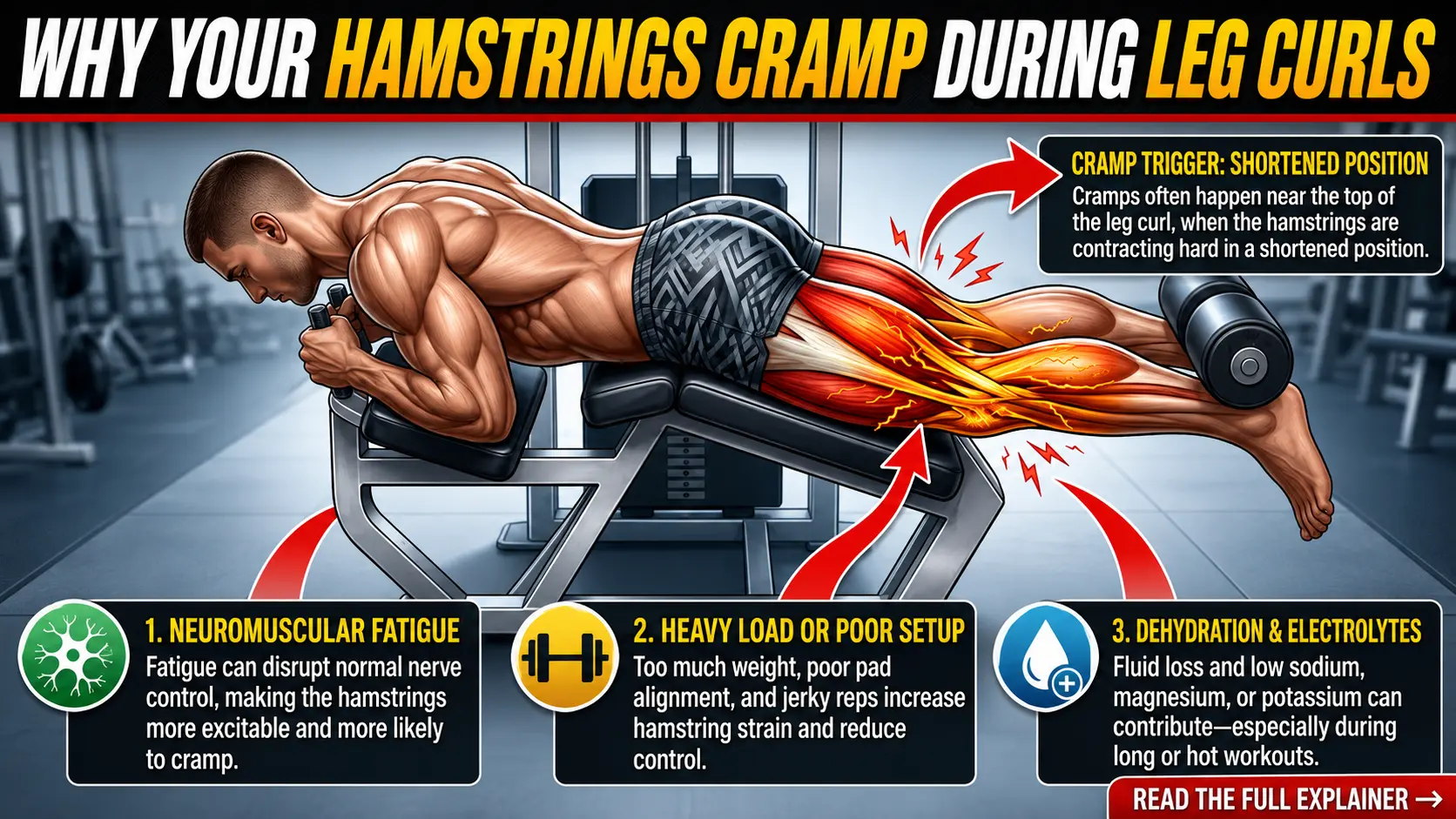
If your hamstrings cramp during leg curls, the most likely explanation is that the muscles are becoming highly fatigued while contracting in a shortened position. Heavy resistance, high repetitions, poor machine setup, insufficient preparation, previous hamstring fatigue, and fluid or electrolyte losses may also contribute.
A muscle cramp is not the same as the normal burning sensation you feel near the end of a set. It is a sudden, involuntary, and often painful contraction that makes the muscle feel as though it has temporarily locked.
Although hydration matters, exercise-related cramps are not always caused by dehydration or a magnesium deficiency. Current research suggests that muscle cramps are usually multifactorial, with neuromuscular fatigue playing an important r
Why Are Leg Curls Likely to Cause Hamstring Cramps?
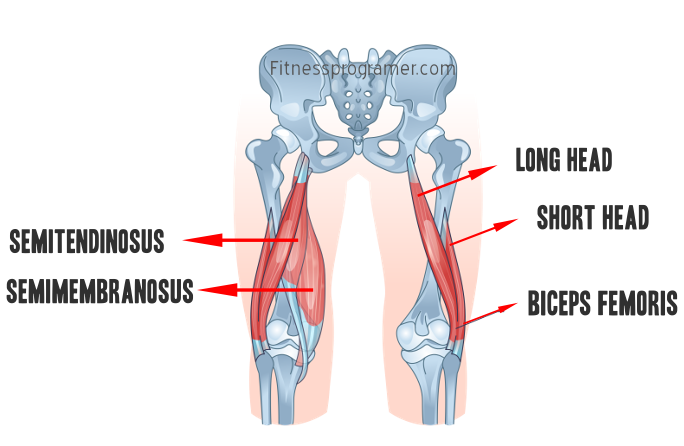
The hamstrings are responsible for bending the knee and assisting with hip extension. Most of the hamstring muscles cross both the hip and knee joints.
During the final portion of a leg curl, the knee is deeply flexed and the hamstrings become shorter. This is especially noticeable during lying leg curls because the hip is relatively extended while the knee is flexed.
Muscles that cross two joints may be more susceptible to cramping when they are repeatedly contracted in a shortened position. When this position is combined with fatigue, the nervous system may temporarily lose its normal balance between signals that stimulate and inhibit muscle contraction.
As a result, the hamstrings may continue contracting even after you try to relax them.
1. Local Hamstring Fatigue
Local fatigue is one of the most common reasons your hamstrings cramp during leg curls.
Leg curls isolate the knee-flexion function of the hamstrings. Unlike compound exercises, there is limited assistance from the glutes, lower back, or other large muscle groups. The hamstrings must therefore produce most of the force themselves.
Cramping becomes more likely when you:
- Train close to muscular failure.
- Perform more repetitions than usual.
- Increase the weight too quickly.
- Use slow repetitions with long pauses.
- Perform leg curls after deadlifts or Romanian deadlifts.
- Add unfamiliar intensity techniques such as drop sets.
Research reviews describe exercise-associated muscle cramps as a combination of individual risk factors rather than the result of one universal cause. Fatigue, training intensity, previous injury, conditioning level, heat, hydration, and exercise duration can all influence susceptibil
2. Contracting the Hamstrings in a Shortened Position
A cramp commonly occurs near the top of a lying or standing leg curl, where the heel is closest to the glutes.
In this position, the hamstrings are producing force while significantly shortened. Laboratory research has shown that intense contractions performed with a muscle in a shortened position can make cramping easier to induce in susceptible individu
This does not mean you should avoid the top of the movement. Full knee flexion can still be part of a properly performed leg curl. However, aggressively pulling the heel toward the glutes, holding a long maximal contraction, or forcing extra range may increase cramp risk.
Control the final portion of the repetition instead of jerking the weight or squeezing as hard as possible.
3. The Weight Is Too Heavy
Using excessive weight often changes a controlled leg curl into a fast, shortened-range movement.
You may lift your hips, arch your lower back, swing the weight, or pull explosively to complete the repetition. Even when the machine pad moves, the hamstrings may not be producing force efficiently through the entire range.
A more appropriate weight allows you to:
- Lower the resistance under control.
- Keep your hips stable.
- Complete the planned range of motion.
- Avoid sudden acceleration.
- Stop before technique breaks down.
If cramping regularly occurs during the final repetitions, reduce the resistance by approximately 10–20% and observe whether the problem improves.
For a technique review, see the leg curl exercise guide.
4. Incorrect Leg Curl Machine Setup
Poor machine setup may place unnecessary stress on the hamstrings or make the movement less efficient.
The machine’s knee-joint axis should be aligned as closely as possible with your knee. The lower pad should rest above the heel and around the lower calf rather than directly on the Achilles tendon.
During a lying leg curl, your knees should be positioned close to the edge of the bench. Your hips should remain in contact with the pad instead of lifting as the knees bend.
During a seated leg curl, adjust the thigh pad so that your legs remain secure without excessive pressure. The seat and backrest should allow you to maintain a stable pelvis.
Hamstring recruitment can change according to hip and knee position. One study comparing different hip-extension and knee-flexion conditions found that hip angle influenced knee-flexion performance and hamstring recruitment. This was not a cramp study, but it demonstrates why body position and machine setup can change how the hamstrings are loa
5. Your Hamstrings Were Already Fatigued
Exercise order matters.
If you perform leg curls after Romanian deadlifts, stiff-leg deadlifts, good mornings, Nordic curls, sprinting, or a high-volume leg workout, the hamstrings may already be fatigued before the first leg-curl set begins.
In that situation, the weight may normally feel manageable but exceed your remaining capacity.
Possible adjustments include:
- Performing leg curls earlier in the workout.
- Reducing the number of warm-up or working sets.
- Separating heavy hip-hinge and leg-curl sessions.
- Allowing more rest between sets.
- Avoiding failure on every set.
You can also distribute hamstring training across different movement patterns. The best hamstring exercises guide includes both knee-flexion and hip-extension options.
6. Dehydration and Electrolyte Loss
Dehydration and electrolyte loss can contribute to cramping, particularly during long workouts, hot conditions, heavy sweating, or repeated training sessions.
However, drinking more water or taking magnesium is not a guaranteed solution. Research indicates that some cramps may involve fluid and sodium losses, while others appear more closely related to muscle fatigue and altered neuromuscular control. No single explanation accounts for every exercise-related cr
Pay closer attention to hydration when:
- You train in a hot or humid environment.
- Your clothes become heavily soaked with sweat.
- Your workout lasts much longer than usual.
- Several muscle groups begin cramping.
- You have not eaten or consumed fluids for many hours.
For a normal gym session, increasing water or electrolytes may not solve the problem if excessive load, fatigue, or poor setup is the primary cause.
What Should You Do When a Hamstring Cramp Starts?
Stop the set immediately and avoid trying to complete another repetition.
Slowly straighten your knee to lengthen the hamstrings. Once the muscle begins to relax, use a gentle static stretch until the contraction subsides. Do not bounce or force the stretch.
Gentle stretching remains one of the most consistently recommended immediate responses to exercise-associated muscle cra
After the cramp:
- Walk slowly and allow the muscle to relax.
- Rest before attempting another exercise.
- Drink fluids if you may be dehydrated.
- Reduce the load if you continue training.
- End direct hamstring training if the cramp returns.
Do not aggressively massage or stretch a muscle that remains sharply painful, swollen, or weak, as these symptoms may indicate something other than an ordinary cramp.
How Can You Prevent Hamstring Cramps During Leg Curls?
Use the following progression during your next workout:
- Perform five minutes of general lower-body movement.
- Complete one or two light leg-curl warm-up sets.
- Check the machine’s knee alignment and pad position.
- Begin with a manageable resistance.
- Use controlled repetitions without jerking.
- Avoid forcing the heel into the glutes.
- Stop the set when technique begins to deteriorate.
- Rest long enough for the hamstrings to recover.
- Progress weight or repetitions gradually.
- Monitor hydration during long or hot training sessions.
Strengthening the hamstrings in different positions may also improve their overall capacity. For example, the Romanian deadlift trains the hamstrings primarily through hip extension and at longer muscle lengths, while leg curls train their knee-flexion function.
Are Hamstring Cramps During Leg Curls Dangerous?
An occasional cramp near the end of a demanding set is usually temporary and may simply indicate that the hamstrings were fatigued beyond their current capacity.
However, frequent or unexplained cramps should not automatically be treated as a normal part of training.
Consider seeking medical evaluation when cramps:
- Regularly occur at rest or during sleep.
- Continue despite reducing training intensity.
- Are accompanied by numbness or significant weakness.
- Cause persistent pain, swelling, or bruising.
- Affect several unrelated muscle groups.
- Began after starting a new medication.
- Are associated with illness, vomiting, or severe fluid loss.
Frequently Asked Questions
Should I lower the weight if my hamstrings cramp?
Yes. If the cramp repeatedly occurs during heavy leg curls, reduce the resistance and focus on controlled repetitions. A lighter weight can help determine whether excessive intensity is the main trigger.
Does a hamstring cramp mean the exercise is working?
No. A cramp is not evidence of better muscle activation or greater muscle growth. It is an involuntary contraction and should not be used as a measure of workout quality.
Is magnesium deficiency the main cause?
Not necessarily. Electrolyte deficiencies can contribute in some situations, but exercise-related cramps often involve several factors. Fatigue, training load, muscle position, conditioning, hydration, and individual susceptibility may all play a role.
Why does only one hamstring cramp?
One side may be weaker, more fatigued, previously injured, or positioned differently on the machine. Check that your hips are level and both knees are aligned equally. Unilateral leg curls can also help reveal side-to-side differences.
Conclusion
When your hamstrings cramp during leg curls, the cause is usually more complex than simply needing more water or magnesium. Local fatigue, heavy resistance, shortened muscle position, machine setup, exercise order, hydration, and individual cramp susceptibility may all contribute.
Start by reducing the weight, correcting the machine setup, warming up gradually, and avoiding forced contractions at the top of the movement. If the cramps remain frequent, severe, or occur outside training, consult a qualified healthcare professional.
References
- Miller KC, McDermott BP, Yeargin SW, Fiol A, Schwellnus MP. An Evidence-Based Review of the Pathophysiology, Treatment, and Prevention of Exercise-Associated Muscle Cramps. Journal of Athletic Training. 2022;57(1):5–15.
https://pmc.ncbi.nlm.nih.gov/articles/PMC8775277/ - Maughan RJ, Shirreffs SM. Muscle Cramping During Exercise: Causes, Solutions, and Questions Remaining. Sports Medicine. 2019;49(Suppl 2):115–124.
https://pmc.ncbi.nlm.nih.gov/articles/PMC6901412/ - Yanagisawa O, Fukutani A. Muscle Recruitment Pattern of the Hamstring Muscles in Hip Extension and Knee Flexion Exercises. Journal of Human Kinetics. 2020;72:51–59.
https://pmc.ncbi.nlm.nih.gov/articles/PMC7126262/