
Contents
- What “Recovery Peptides” Actually Are
- BPC-157: A Large Preclinical Record
- TB-500 and Thymosin β4
- Where the Evidence Stops
- The Problem Nobody Talks About: Knowing What You’re Even Looking At
- Reading the Evidence Like a Scientist
- A Few Honest Answers to Common Questions
- The Takeaway for People Who Train
- What a Smart Approach to Recovery Science Looks Like
Ask ten people in a gym about recovery peptides and you’ll get ten confident answers — most of them wrong in one direction or the other. Some treat compounds like BPC-157 and TB-500 as miracle repair tools that rebuild tendons on demand. Others dismiss the whole category as snake oil. The research itself sits in a more honest, more interesting middle, and if you train seriously enough to care about how your body repairs, it’s worth understanding properly.
This is not a recommendation to use anything. It’s a guide to what the science actually says, where it stops, and how to read claims in a field that’s drowning in marketing.
What “Recovery Peptides” Actually Are
Peptides are short chains of amino acids — the same building blocks that make up proteins. Your body produces thousands of them as signalling molecules. The compounds discussed in a recovery context are synthetic versions studied for how they interact with the body’s repair machinery: angiogenesis, cell migration, collagen synthesis, and growth-factor signalling. Those are the genuine biological processes behind healing, which is why the research exists at all.
The two names you’ll hear most are BPC-157 and TB-500, and they’re worth taking individually.
BPC-157: A Large Preclinical Record
BPC-157 is a synthetic peptide derived from a sequence found in human gastric juice. It has an unusually deep preclinical literature, much of it produced over three decades by researchers at the University of Zagreb. In animal models it has been reported to accelerate healing across a striking range of tissues — tendon, ligament, muscle, bone, and the gut lining — largely through pro-angiogenic activity and modulation of growth-factor pathways and the nitric-oxide system.
The tendon and ligament findings are what make it interesting to anyone who trains. In cell and rodent studies, BPC-157 has been shown to encourage the outgrowth and migration of tendon fibroblasts and to improve the biomechanical strength of healing tissue. There’s also a body of work on its effects on the gut, which is part of why it gets discussed in such broad terms. The mechanisms proposed are biologically plausible and have been reproduced across independent labs, which is more than can be said for most supplement-aisle claims.
TB-500 and Thymosin β4
TB-500 is a synthetic fragment of Thymosin β4, a naturally occurring peptide central to cell migration and tissue repair. Thymosin β4 itself has a respectable research pedigree: it binds actin, supports the migration of cells involved in wound closure, promotes angiogenesis, and has been studied in contexts ranging from corneal healing to cardiac repair after injury. The appeal for recovery is obvious — faster, more complete tissue repair — and the underlying biology is real.
One nuance worth carrying forward: much of the strongest evidence concerns full-length Thymosin β4, not the TB-500 fragment specifically. That kind of distinction matters when you’re judging how solid a claim really is.
Where the Evidence Stops
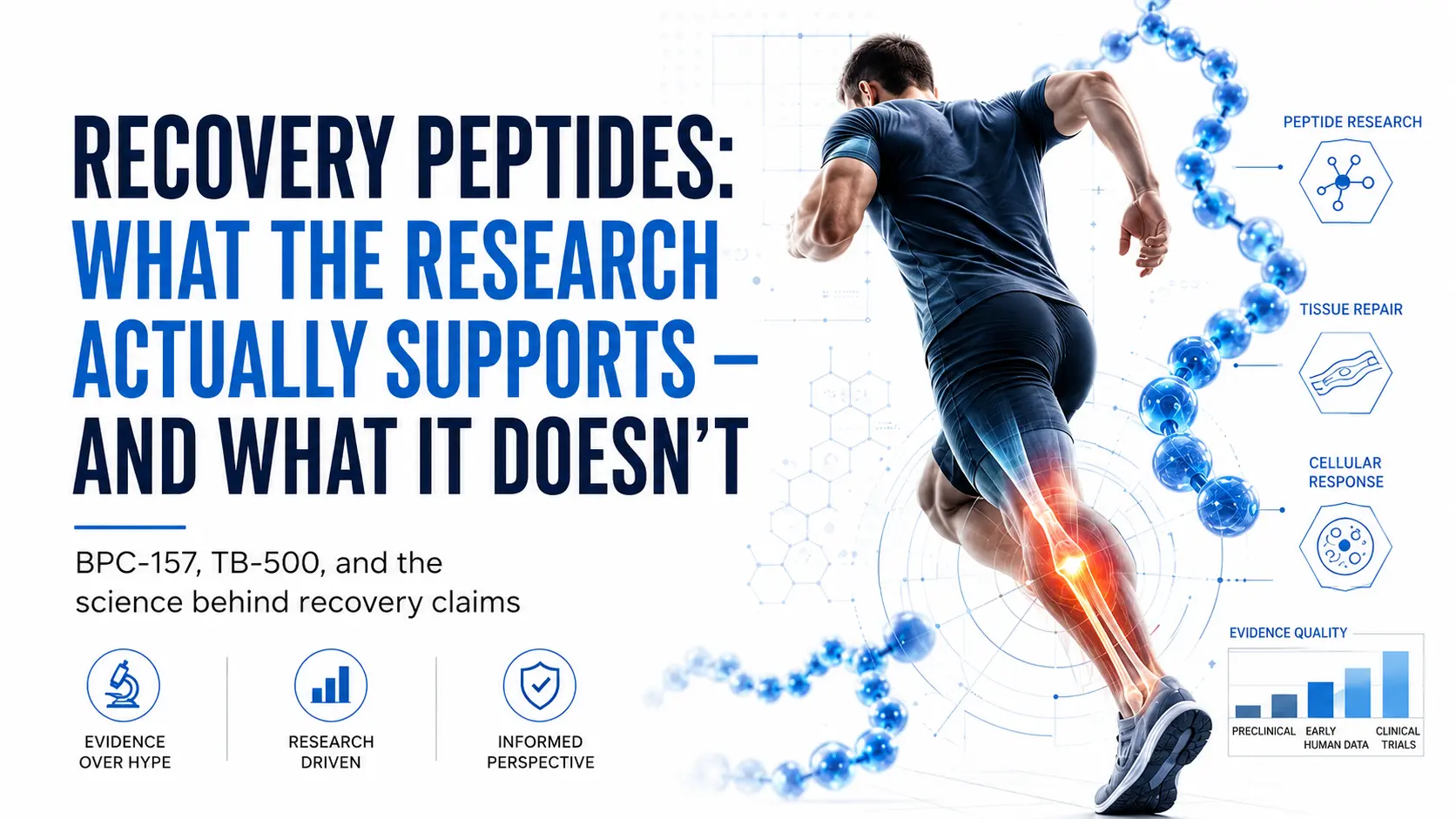
Here’s the most important paragraph in this article: almost all of that evidence is preclinical. Cell cultures and rodents, not humans. Robust, peer-reviewed human clinical trials on these compounds for musculoskeletal injury are thin to essentially absent. Promising animal results have a long and well-documented history of failing to translate cleanly to people — the path from “works in mice” to “works in humans” is littered with compounds that looked great and then didn’t deliver. Until that human work exists, the honest description is “encouraging in preclinical research,” not “proven.”
There’s also a hard practical point for any competitive athlete: both BPC-157 and TB-500 fall under the World Anti-Doping Agency’s prohibited list. A positive test carries consequences regardless of intent, and “I was using it to recover from an injury” is not a defence. That alone moves these compounds out of “supplement” territory and into research-compound territory — which is exactly how they should be understood.
The Problem Nobody Talks About: Knowing What You’re Even Looking At
Step back from the pharmacology, because there’s a problem upstream of all of it. These are unregulated research compounds. That means what’s printed on a label and what’s actually in a vial are two different questions — and in a research setting, an unverified sample makes any result meaningless. You can’t attribute an effect to a compound you can’t confirm you actually have.
This is why the serious end of the field — operations like the research-compound supplier Bastion Peptides — has standardised around independent, batch-specific testing rather than taking anyone’s word for what’s in a vial. The benchmark is a certificate of analysis from a genuine third-party laboratory, tied to the specific batch in question, that can be verified at the lab itself rather than on the seller’s own website. The gap between independent, batch-specific lab verification and a single certificate reused across a dozen batches for a year is the gap between data and decoration. If you ever read about these compounds, that distinction is the first thing to check — long before any claim about results.
Reading the Evidence Like a Scientist
Two samples can show the same headline purity figure and mean completely different things, because purity and identity are separate questions. Purity — usually measured by HPLC — tells you a sample is clean. Identity — confirmed by mass spectrometry — tells you it’s actually the molecule it claims to be. A certificate that reports one without the other is half a document. Once you know to look for both, a lot of impressive-sounding paperwork falls apart.
A Few Honest Answers to Common Questions
“If the Animal Data Is So Strong, Why Isn’t This Mainstream Medicine?”
Because animal data is a starting line, not a finish line. The expensive, slow human-trial process is exactly what separates a promising hypothesis from an approved treatment, and most candidates don’t survive it.
“Aren’t Lots of Athletes Using These?”
Anecdotes aren’t evidence, and they’re also not risk-free — these are sport-prohibited and unapproved. Popularity tells you about marketing, not about whether something works or is safe.
“How Would I Even Evaluate a Source?”
Separate preclinical from clinical, demand both purity and identity verification, and treat confident dosing advice for an unapproved compound as a red flag rather than expertise.
The Takeaway for People Who Train
Recovery peptides are a genuinely interesting research area — not a shortcut, and not a scam. The evidence is early, overwhelmingly preclinical, and the compounds are prohibited in sport. The useful posture is the one that serves you everywhere in training: curiosity paired with standards. Separate preclinical from clinical. Separate purity from identity. Treat any source that glosses over those distinctions as marketing, not information.
The boring truth is that the fundamentals still win recovery — sleep, nutrition, sensible load management, and time. The cutting-edge research is worth following because the science is real. Just follow it as an informed reader, not an early adopter.
What a Smart Approach to Recovery Science Looks Like
If you take one practical habit from all of this, make it this: match your confidence to the strength of the evidence. For the fundamentals that have decades of human data behind them — progressive overload, adequate protein, sleep, deload weeks — act with full confidence, because the science is settled. For early-stage research like recovery peptides, keep the same curiosity but a fraction of the certainty, because the human evidence simply isn’t there yet.
That calibration is what separates people who get quietly better year after year from people who chase every new compound and gadget. The chasers spend money and attention on things with thin evidence while neglecting the boring inputs that actually drive results. The steady improvers do the opposite: they nail the fundamentals, stay informed about the frontier, and refuse to confuse “interesting” with “proven.”
It also helps to understand why the field moves slowly. Human trials are expensive, ethically careful, and time-consuming. That’s frustrating when you want answers now, but it’s also the reason you can trust the conclusions that eventually emerge. A compound that clears that bar will still be there in two years; one that can’t was never going to help you anyway. Patience here isn’t just a virtue — it’s a filter that does your due diligence for you.
There’s a useful mental model for any new recovery claim, whether it’s a compound, a device, or a supplement. First, ask what kind of evidence supports it: mechanism, animal studies, or human trials? Second, ask whether the thing itself is verified — for a compound, that means independent batch testing; for a device, real measurement rather than testimonials. Third, ask what it costs you in money, attention, and risk to be wrong. Run any new claim through those three filters and most of them sort themselves out quickly.
So follow the research. Read about BPC-157 and TB-500 if the science interests you, and enjoy it — it’s a genuinely fascinating area. But anchor your actual routine in what’s proven, verify any claim before you trust it, and let the frontier stay the frontier until it earns its place in the mainstream. Your tendons don’t care how cutting-edge your approach sounds. They respond to consistent, well-fuelled, well-rested training — and they always have.
Educational only; not medical advice. The compounds discussed are research-use-only and not approved for human use.
References
- Chang, C. H., Tsai, W. C., Lin, M. S., Hsu, Y. H., & Pang, J. H. (2011). The promoting effect of pentadecapeptide BPC 157 on tendon healing involves tendon outgrowth, cell survival, and cell migration. Journal of Applied Physiology, 110(3), 774–780. https://doi.org/10.1152/japplphysiol.00945.2010
- Chang, C. H., Tsai, W. C., Hsu, Y. H., & Pang, J. H. (2014). Pentadecapeptide BPC 157 enhances the growth hormone receptor expression in tendon fibroblasts. Molecules, 19(11), 19066–19077.
- Seiwerth, S., Sikiric, P., Brcic, L., et al. (2021). Stable gastric pentadecapeptide BPC 157 and wound healing. Frontiers in Pharmacology, 12, 627533. https://doi.org/10.3389/fphar.2021.627533
- McGuire, F. P., et al. (2025). Regeneration or risk? A narrative review of BPC-157 for musculoskeletal soft tissue healing. Cureus.
- Malinda, K. M., Goldstein, A. L., & Kleinman, H. K. (1999). Thymosin beta4 accelerates wound healing. Journal of Investigative Dermatology, 113(3), 364–368.
- Philp, D., Scheremeta, B., Sibliss, K., et al. (2004). Thymosin beta4 promotes angiogenesis, wound healing, and hair follicle development. Mechanisms of Ageing and Development, 125(2), 113–115.
- Sosne, G., Qiu, P., Kurpakus-Wheater, M., & Matthew, H. (2007). Thymosin beta 4: A novel corneal wound healing and anti-inflammatory agent. Clinical Ophthalmology, 1(3), 201–207.
- Kleinman, H. K., Sosne, G., & Thymosin beta4 research group. (2016). Thymosin β4 promotes dermal healing. Vitamins and Hormones, 102, 251–275.
- Xing, Y., Ye, Y., Zuo, H., et al. (2021). Progress on the function and application of Thymosin β4. Frontiers in Pharmacology, 12, 767785.
- World Anti-Doping Agency. (2025). The World Anti-Doping Code International Standard: Prohibited List. World Anti-Doping Agency.
- U.S. Food and Drug Administration. (2026). Certain bulk drug substances for use in compounding that may present significant safety risks. FDA.
- Mant, C. T., & Hodges, R. S. (2007). HPLC analysis and purification of peptides. Methods in Molecular Biology, 386, 3–55.
- Li, M., et al. (2018). Identification and accurate quantification of structurally related peptide impurities by LC-HRMS. Journal of Pharmaceutical and Biomedical Analysis.